This same weekend, at the Fira de Barcelona, more than 15,000 athletes, motivated, muscular, and shirtless, dedicated themselves to exploring their physical limits by running a total of eight kilometers, stopping at each station, each one tougher and more unpronounceable. First SkiErg, then Sled Push, Sled Pull, Burpee Broad Jumps, Rowing, Farmers Carry, Sanbag Lunges, and, to finish, Wall Balls... All together, completed in just over an hour by mortals, is called Hyrox and is the trendy sport. And in Spain, the queen is Manuela García: "Yes, this is a beast."
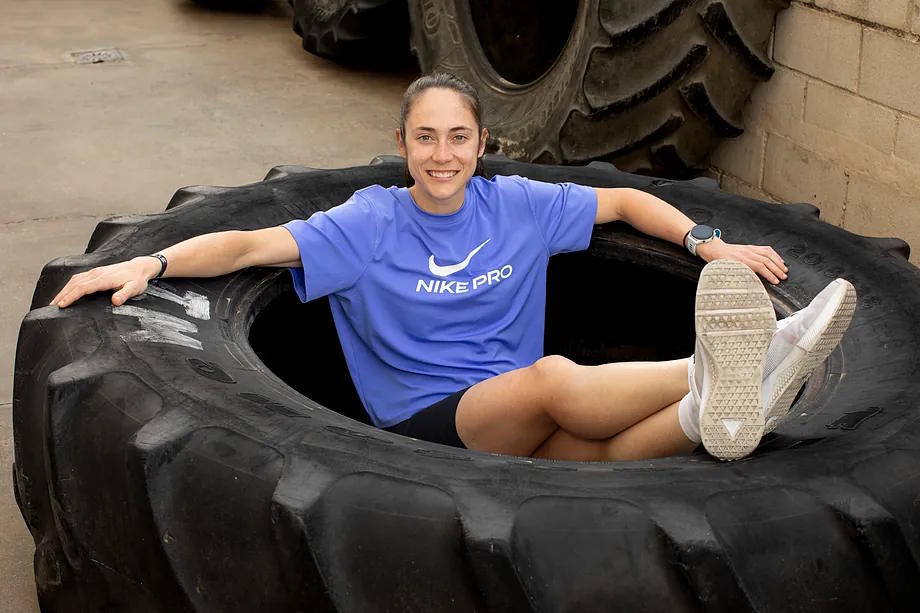
At the VAM Box in Móstoles, Manuela welcomes EL MUNDO amidst tractor wheels, ropes hanging from the ceiling, weights called Kettlebell, and booming music. In a few weeks (starting from June 7), she will face the World final in Stockholm and pushes through her training days, always double. "I wake up before eight, have the typical breakfast: egg whites, rice... Depending on the plan, from 11 to one we do the first session, more gym-based. I rest at noon and in the afternoon, I go out for a run, no more than an hour. The running in Hyrox is super important. In total, about 10 hours a week," explains the 28-year-old woman from Almería.
Like for most practitioners, pure boom, Hyrox for her is still a novelty. Basically, it involves introducing gym addicts to competition. A successful invention that emerged in 2017 in Germany, led by the Olympic field hockey champion Moritz Fürste and two former executives, from Audi (Michael Trautmann) and Ironman (Christian Toetzke). They created a hybrid training, between crossfit and running. "There are many triathletes coming and people from marathons, who you might think may not excel due to the strength component it requires," explains Manuela, who also leads her own training group - she holds a degree in Sports Science from the European University, where she also completed a Master's in training and nutrition - the economic basis to be able to be a professional.
Her encounter with Hyrox was love at first sight. "I was captivated," she recalls with a smile. As a child, in Vera, she practiced every sport that came her way, encouraged by her parents. "I always had ease and some ability, even to stand out among children," she recalls from her time in athletics, swimming, horse riding, and even basketball. And then came weightlifting (she won some Madrid championships) and, more intensely, CrossFit. "I tried with all my might, but I really didn't have the capabilities to reach the elite level. It was also a psychological process, accepting that I would never reach the level I would like while still maintaining a healthy relationship with sports. And then Hyrox appeared, embraced me," she enthusiastically recounts, who would soon become a global reference.
This past Friday, she lowered her time in Barcelona, which is a Spanish record (1:01:02). She was among the top 15 in the world, the Elite 15, where she aims to return (not far off) to be able to compete in the grand final of the World in Stockholm. She did achieve it in the pairs category, alongside the German Seka Arning.
García boasts of being able to make a living from Hyrox, thanks also to the support of sponsors like Weider or Nike. And she dreams of one day becoming an Olympian: "I would love that. What a dream." It doesn't seem unattainable, as there are indications pointing to the progressive approach of the discipline to the Olympics. A few months ago, a modality called Hyathlon was included in the Spanish Triathlon Federation. Additionally, the competition itself has changed its rules: by 2027 Manuela will not be able to compete with her German partner, as it will be based on nationalities. "Luckily, the girl who has the second-best time in Spain, Mónica Ferrer, has one hour and three minutes. We have talked about training together, it motivates me."
Beyond the elite, the appeal of Hyrox lies in the social response it has received. Registrations for age groups, at 125 euros for individuals, are flying. And the number of events is multiplying (Lisbon and Tenerife have been among the latest to join the calendar): it is estimated that, throughout the season, from July to July, the number of participants in Spain will approach 100,000. In countries with even more rooted interest, like Great Britain, London gathered 40,000 competing athletes in December. "Primarily, it makes you feel capable," explains Manuela about a "combination of exercises that is addictive." "The technical complexity is not high. It does have a component of endurance, of maintaining a sustainable pace for a long period. You can train it almost anywhere and have plenty of options when it comes to competing. And then there's the travel aspect, the appeal of the venues. The locations are amazing, they make you feel like an athlete," she describes.
Manuela does not deny the toughness of her discipline, how her legs burn after burpees or in the transition from the sled to the run, and how fatigue takes its toll on those eight kilometers, broken down one by one, which she can run at a pace of 3:50. And the mental demand that she compares to tennis for the "ability to regroup when things get tough."
Like any good sport, Hyrox - which offers substantial cash prizes of up to $15,000 to the winners in its Majors circuit - is starting to have its own controversies, regarding judges' penalties. For example, when it comes to having parallel feet in the burpee jump: after a warning, a 15-second penalty can be imposed.