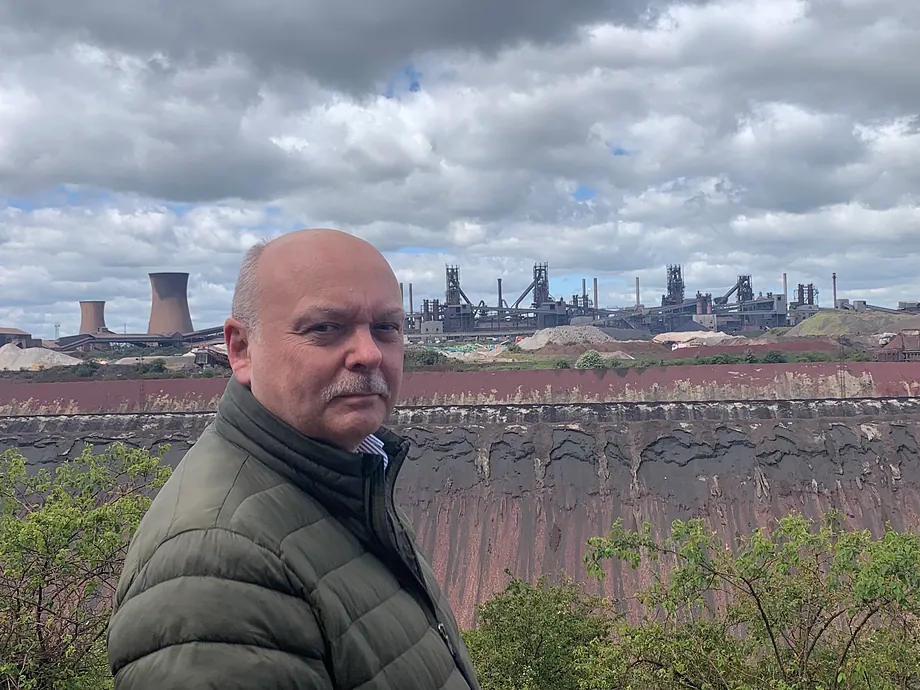
When on June 26, 2017, the aircraft carrier Queen Elizabeth set sail for the first time, it carried about 2,000 tons of steel sheets manufactured at the steel plant in Scunthorpe. Just over two years later, its twin, the Prince of Wales, did the same. But without steel from Scunthorpe. The 2,000 tons had been imported from Sweden.
"They had to bring the steel from Sweden because in Scunthorpe they had closed the steel sheet manufacturing plant," explains Martin Foster to EL MUNDO, who started working at the Scunthorpe steelworks in 1978 when he was 16. "Today, in the whole of the UK, there is not a single plant left that manufactures steel sheets. The last one, Liberty Steel, has not been operating for a year because it is in administration, and the State has had to take over it," reflects Foster, who is the union delegate of the Unite union, the second largest at the factory.
Behind him, in the distance, stand in a line, from North to South, the silhouettes of the last four blast furnaces in the UK. Each one is named after a queen. "Victoria, Anne, Bess [affectionate diminutive of Elizabeth], and Mary", recites Foster. In reality, only Anne is operational. Bess is undergoing maintenance. Victoria and Mary have been shut down for years. And once a blast furnace is deactivated, it is practically impossible to get it working again. It is more cost-effective to scrap it and build a new one.
Just 180 kilometers in a straight line from the town of Coalbrookdale, where Abraham Darby erected the first modern blast furnace in 1709, Anne and Bess are now the last two in the UK. Their salvation has mobilised the British Prime Minister himself, Keir Starmer, who declared last Monday from his official residence in Downing Street: "In Scunthorpe, we have been negotiating with the current owner [of the company]. It has not been possible to find a private buyer. So, I can announce that this week legislation will be presented to give the Government the power to take full control of British Steel." The Scunthorpe factory is practically all of British Steel's assets.
In reality, the plant is already being operated by the State. In April last year, it was costing its owner, the Chinese group Jingye, 700,000 pounds (800,000 euros) per day, who suddenly decided to stop buying material to keep Bess and Anne running.
Panic spread in London. The Parliament met on a Saturday and agreed to intervene in the company. The management is controlled by London, which also bears the operating costs through what is legally a loan, but in practice is simply passing the costs onto the taxpayer. For now, the bill for the State exceeds 300 million pounds (350 million euros).
There are three reasons that explain Starmer's interventionism. Firstly, national pride; if Scunthorpe closes, the UK will become the only G-7 country without blast furnaces. Secondly, for national security: buying the plates for the Prince of Wales from Sweden is a logical strategy from an economic point of view, but there is consensus that it is necessary to maintain a certain steel production capacity within the country, especially in a world where the vulnerability of supply chains has been exposed when countries have fought over the supply of masks during Covid-19, or due to the closure of the Red Sea by the Houthis (or now the Strait of Hormuz by Iran).
And finally, for politics. The 4,200 workers at the factory are less than 20% of what it had in its heyday in the sixties and seventies. But still, British Steel is the second largest employer in Scunthorpe, behind the local Administration, which has been growing precisely as the steel industry has been shrinking. And the Labour Party knows they cannot afford to lose this territory, which is a kind of showcase of the political transformation of the UK. And also of the West.
It is an industrial region that experienced a boom until the seventies thanks to the gigantic steel industry, which occupies an area of about 850 hectares, equivalent to half of Madrid's Casa de Campo. But since then, Scunthorpe has become, in the eyes of many Britons, synonymous with economic crisis, abandonment, drug addiction, marginalisation, and social collapse.
This view may be biased, as the city's 81,000 inhabitants are the highest number it has ever had. But it is equally true that it is impossible to find any resident who says that the local economy is doing well. Opinions range from a cautious "okay" from Andy, 54, who works as an administrative officer at the City Council, to a string of curses uttered in a northern English accent.
However, although commerce and services continue to grow, the city's streets are full of potholes, and the facades of many of its houses are in need of quite substantial repairs. It is impossible to take a stroll through Scunthorpe without thinking of Appalachia, the mining and industrial area in total collapse in the United States where Donald Trump has some of his strongest bastions.
In the UK, the equivalent of Donald Trump is called Nigel Farage, from the Reform UK party, who, after his victory in the local elections 10 days ago, seems on track to become Prime Minister in 2029. In a traditionally left-wing area, everyone seems to detest the current Prime Minister, Keir Starmer. "Last year, I stopped being a member of the Labour Party. I can't stand Starmer's arrogance," explains Tom, 45, who works at British Steel, at the Blue Bell pub.
However, for many, "arrogance" is an understatement. In their opinion, Starmer is the culmination of the process of alienation of the working class in general and the unions in particular that began in the Labour Party with Tony Blair. The Mayor of Greater Manchester, Andy Burnham, a representative of the left-wing of Labour, is their favourite to succeed the Prime Minister, whose leadership is in trouble after the failure in these elections and those of last year. As for former Health Minister Wes Streeting, who is preparing to make a bid for the position of Prime Minister, his main problem is that he has been part of Starmer's cabinet.
But the change began over 40 years ago, in the eighties, when Margaret Thatcher began to undermine Labour's dominance in the region. Today, the Mayor of North Lincolnshire, which includes Scunthorpe, is the Conservative Janet Lee, although in Parliament, the city is still represented by the Labour Nic Dakin.
But it is not unlikely that the municipal elections of 2027 will give the mayoralty to the ultranationalist Reform UK party. This is paradoxical because Brexit - driven by Reform leader Nigel Farage - was one of the causes of the collapse of British Steel, as the UK's exit from the European Union cut off Scunthorpe's steel access to the Single Market. As for the Conservatives, they are being wiped off the map.
So, the word heard most when Starmer's decision to nationalise the factory is raised is "relief". But it is a temporary relief. The factory was nationalised in 1951, privatised in 1953, nationalised again in 1967 when the State created British Steel, which was privatised by Thatcher in 1988. In 1999, British Steel merged with the Dutch Koninklijke Hoogovens to create the giant Corus, which in 2007 was bought by the Indian Tata for over 10 billion euros at the time.