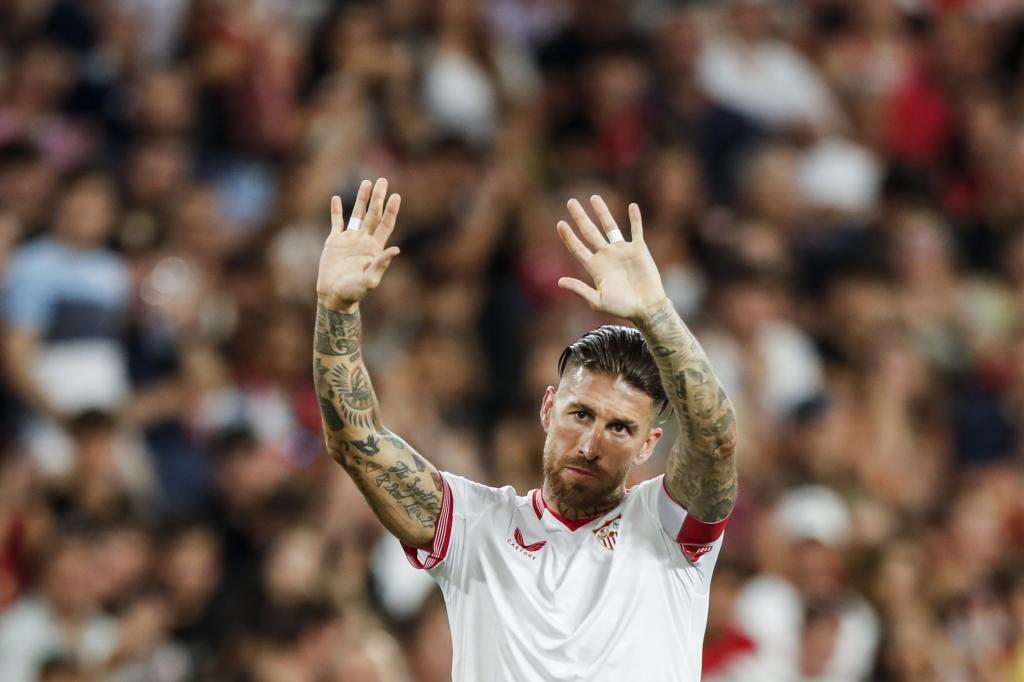
"Sevillismo is not negotiable, it's in your blood from birth. You can count on me for whatever you need, it's a see you later." These were the words with which Sergio Ramos bid farewell to Sevilla in his second stint as a player. Less than two years later, the Camas-born player returned to rescue a club that is currently struggling both financially, with a debt of 90 million euros, and in terms of performance, despite narrowly avoiding relegation.
Ramos arrived at Sevilla with the Five Eleven fund as an investing partner in a 450 million euro deal. One of the largest investments made by a footballer in a sports entity. Many of Ramos' former teammates have made similar investments, but perhaps the one with Sevilla, in terms of volume, has been one of the most significant. The latest being Thibaut Courtois with CD Extremadura.
Thus, Real Madrid's player has joined a trend that is attracting not only retired footballers but also active ones. A very lucrative investment for many of them. "It's a business they know better than restaurants and other sectors, and they like it more," says Carlos Cantó, CEO of SPSG Consulting, to EL MUNDO.
If we can talk about one of the pioneers, we must mention David Beckham and his involvement with Inter Miami. The Englishman, a businessman since his football days, had a trump card up his sleeve when he signed with Los Angeles Galaxy, allowing him to participate in an MLS franchise upon retirement, leading him to later join Inter Miami for a reported amount of around 25 million euros.
With the financial backing of Mexican tycoon Jorge Mas, Beckham acquired control of a club now valued at over 1 billion dollars, mainly boosted by the arrival of Leo Messi to the team in July 2023.
Perhaps influenced by the English footballer, the Argentine decided to follow suit, albeit on a much smaller scale. Messi recently acquired all the shares of Unió Esportiva Cornellà, a club playing in the fifth tier of Spanish football and known for producing players like Gerard Martín, Jordi Alba, and David Raya.
"A player's interest in a small club is to leave their mark, generate more income, and contribute to its development," Cantó comments on the Argentine's investment, which focuses on talent identification. "Additionally, young players will want to join Leo Messi's club," he adds, highlighting the sponsorship opportunities his name generates. In Ramos' case, Cantó sees it more as a "door opener" and a sentimental interest.
The main rival of the Argentine this century had also previously invested in another Spanish club. Cristiano Ronaldo had purchased a 25% stake in Unión Deportiva Almería in February of the same year, a club currently fighting for promotion to La Liga.
"I have long had the ambition to contribute to football beyond the field," stated the Portuguese star about an investment made through his company, CR7 Sports Investments, which is estimated to have exceeded 25 million euros, although official figures have not been disclosed.
Another Real Madrid player, Luka Modric, now at AC Milan, has also decided to invest in a football club. In Modric's case, it involves a stake in Swansea, a Welsh club competing in the Championship (English Second Division) and where the Asturian Michu was once a standout player.
The latest Real Madrid player to join the trend, although already having a stake in Le Mans, is Thibaut Courtois with his involvement in CD Extremadura, a club that has achieved four consecutive promotions and is now in the Primera Federación.
It is common for players to invest in football clubs after retiring, like Beckham or Thierry Henry, who became shareholders in Como while coaching, a club where Cesc Fábregas also has a stake, or towards the end of their careers. When they have accumulated earnings and experience, along with their advisors to determine whether entering or founding a club is appropriate, as Paolo Maldini did with Miami FC, the other franchise in the American city.
It is less common to see active players making such investments, but it is becoming more frequent. Gerard Piqué, for example, bought Andorra while still playing for FC Barcelona and with two league titles and a Copa del Rey yet to win. In 2018, through his company, Kosmos Holding, the former footballer acquired a club that has moved between the second and third tiers of Spanish football in recent years.
Even more unusual is a world-renowned star, with a promising future and one of Real Madrid's franchise players, acquiring Caen through his fund Coalition Capital Partners. In 2024, in a deal valued at around 20 million euros, Kylian Mbappé took ownership of the club competing in the French second division at just 25 years old.
Football clubs are now the new 'restaurants' for footballers. A trend in which they enter with greater knowledge and where "if done right, a lot of money can be made." "Furthermore, players today are much better prepared and advised," Cantó concludes.