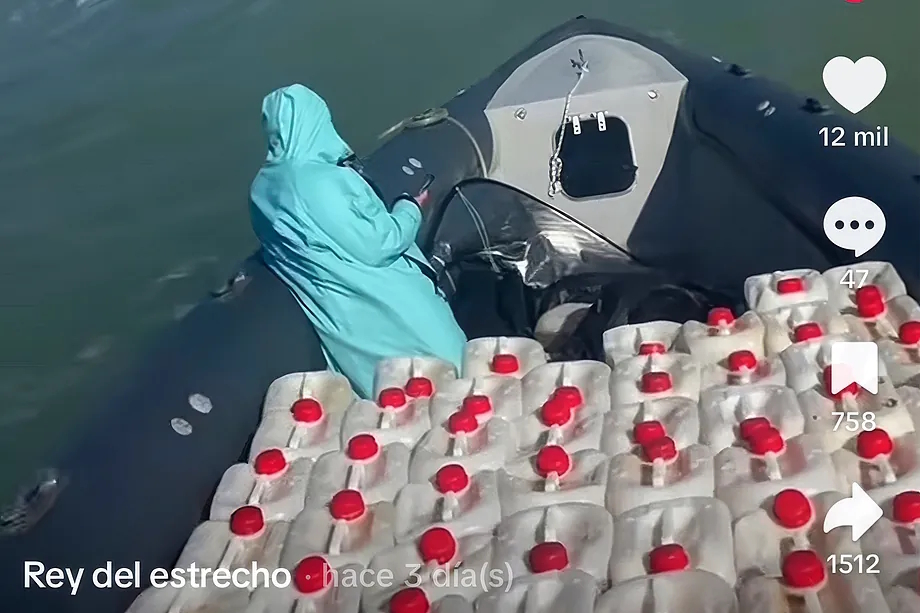
Scene 1. Two petaqueros aboard a boat in the middle of the sea dance on top of dozens of stacked fuel canisters at the bow of their vessel.
Scene 2. A trafficker shows his feet resting on the pole holding a satellite antenna of a goma with four engines.
Scene 3. A narco in nautical clothing poses for the camera, hiding his face under the lenses of his glasses and a neck gaiter covering up to his nose.
Scene 4. The crew of several rigid-hulled inflatable boats moored in the middle of the sea watch as another powerful narco boat spins rapidly around them, creating waves several meters high. Euphoria breaks out among the spectators.
Scene 5. A photo from the 90s shows a group of 25 men with a small caption: "This is one of the best memories. Alan Parker's wedding (a deceased Gibraltarian narco), where we were all warriors. Some have left this life, others are older, but we all still remain family. May God have those who are no longer here in his glory."
All these scenes are taken from posts that have appeared in the last five years —some in the last few weeks— on various TikTok profiles, the social network filled with narcopropaganda from traffickers in the south of the peninsula and the one they have become most fond of.
They show police chases of their boats, cooking food in the middle of the sea on portable stoves, protecting themselves from the sun and winds in tents, or how the crews calmly wait together for the boss's approval to approach the coast and unload the drugs.
The profiles of these users are countless: la Línea, Hamid Rif, King of the Strait, la caja negra 113... The hashtags they use to upload their videos or photos are recurrent: #patrondepatrones, #guardiacivil, #estrecho, #gomas...
These posts are often associated with flamenco music or singers like the Spanish rapper of Moroccan descent Morad, with lyrics reminiscent of the excesses of the narco lifestyle. "We managed to go up and from there they can bring us down, but what we have experienced no one can take away from us," plays in one of the latest entries on one of those mentioned profiles. "Blessings to the soldiers who silently fight with the weight of the world but never kneel," says another.
Ostentation, a hallmark
"It all stems from the fact that we have lost the principle of authority," argues the general secretary of the Unified Association of Civil Guards (AUGC) in Andalusia, José Manuel Manso.
"To that we add that young traffickers, who are more violent and provocative than the old ones, are nobody if they don't publish what they do," Manso continues. "Furthermore, this exhibitionism causes a breeding ground to be created among those who follow them, allowing them to continue with their activities. Now they know they can record themselves and nothing happens. The new generation of traffickers is the one bringing these public displays."
Francisco Mena, president of the anti-drug platform Alternativas, in the Campo de Gibraltar region of Cadiz, shares a very similar opinion, although he believes that traffickers from the south of the peninsula have always liked to show off. In his view, the new generations of traffickers have to show that they are and demonstrate to their peers what they achieve by moving drugs through the waters of the Strait.
"Ostentation has always been a hallmark within the hashish trafficking world," explains Mena. "That ostentation comes because the origin of these narco individuals is in very humble, very disadvantaged neighborhoods, and because they come in many cases from families with economic problems. Now a much younger generation has joined, and that ostentation has moved to social media, where they boast about luxury cars, houses worth hundreds of thousands of euros, or their exploits on TikTok. Decades ago, this happened on the streets of the neighborhood, and now it happens on social media. They do it even though they can be investigated, and it may end up being counterproductive for them because law enforcement agencies are watching them."
'EL TITI': PHOTOS FROM PRISON
Over the last five years, a period in which the trend among traffickers to post videos on social media has increased, perhaps the one who has gone the furthest is Borja Amador S. S., nicknamed el Titi, like his father. In December 2021, just released from prison, he dared to post several photos on his TikTok profile that he had taken with a mobile phone inside his cell —something prohibited, moreover—.
"I hate the blues and also the picolos." In the background, over a 14-second video with six still images, the song "Normal" by Morad, a controversial rapper of Moroccan descent based in L'Hospitalet (Barcelona), plays. The narcos in southern Spain adore him. His lyrics are trendy among them.
In the video, a presumed drug trafficker, son of a drug lord, is seen inside his own cell, taking a selfie and showing the dinner that was sneaked in from the street with the help of someone inside the prison.
That night, as if it were Christmas, they had crayfish and what appears to be meat accompanied by a sauce. Click. His smartphone stores all the photos in memory: the table in the cell, the TV, the bed, his hanging clothes, the bars of the small window...
But he —as Borja Amador himself thinks— is not just any prisoner: his family has been involved in hashish trafficking through the waters of the Strait of Gibraltar for years, and its members accumulate great wealth. Apartments, luxury villas, yachts, boats, jet skis, cars whose prices exceed six figures... At that time, el Titi felt so untouchable that, as soon as he regained parole, he uploaded that video to his TikTok profile.
He took those images with a mobile phone during his penultimate stint in prison, which lasted for the five months he was incarcerated between September 21, 2020, and February 21, 2021.
On the same day he was released from prison, he posted another image on his social media. It showed a yellow Mercedes Class A and a Lamborghini Urus. Only the second vehicle can reach half a million euros in the market. The two cars were waiting for Borja Amador in the prison parking lot. "This is how you leave Botafuegos [the Algeciras prison he was in]," he said.