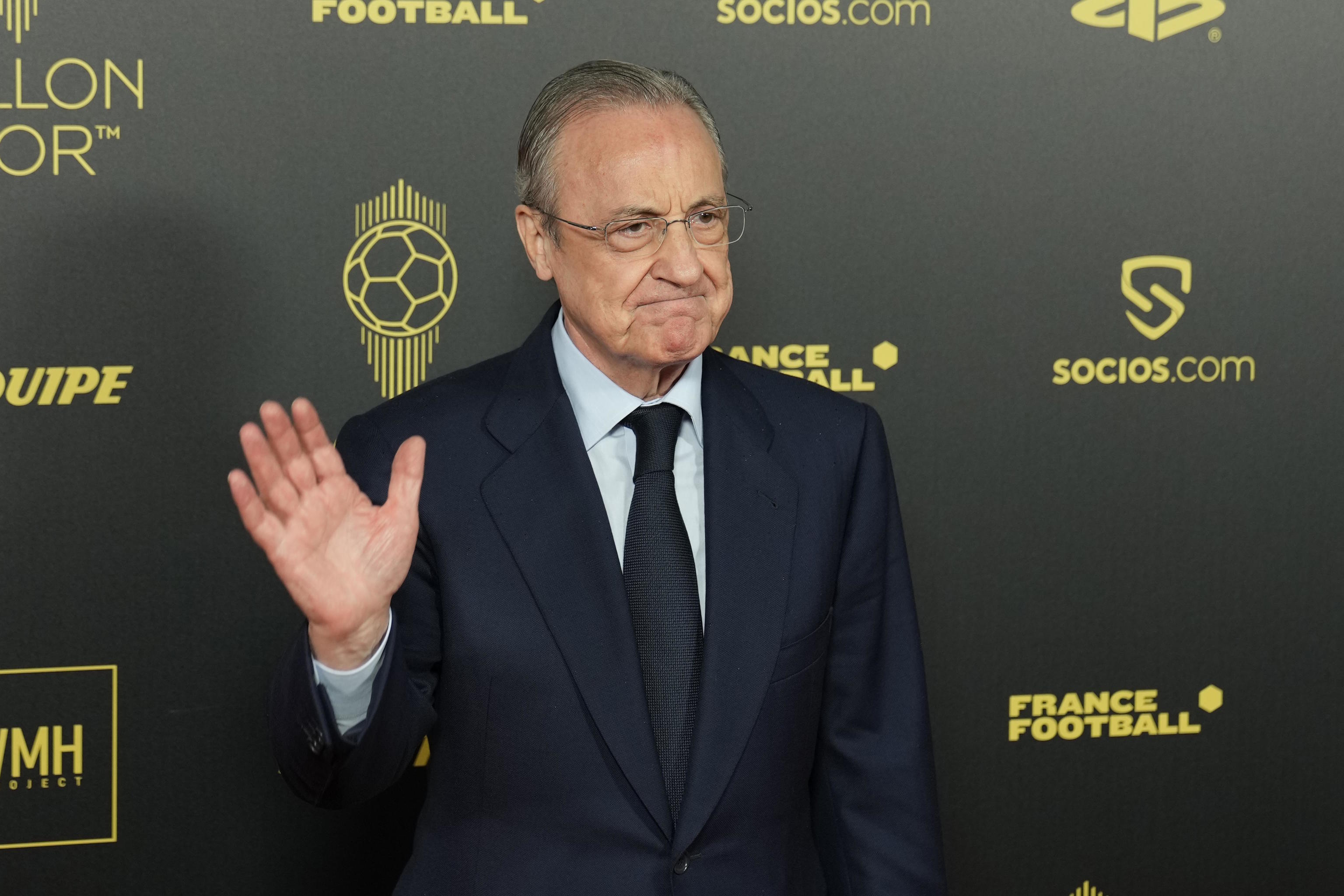
Florentino Pérez seeks to square the circle. In other words, to change the ownership model of Real Madrid to open it up to new liquidity avenues without upsetting the members or being remembered as the president who privatised the most successful club in history. Especially with the upcoming election against Enrique Riquelme. His lawyers have been working on this for over a year and have already found the solution.
As per information obtained by EL MUNDO from sources close to the project, the current scheme being considered involves transferring the "football business" to a new subsidiary and selling a minority stake of it to a financial investor or investors. Real Madrid would remain as the holding company under which this subsidiary would operate, a shell that would maintain its current nature as a sports club and would continue to be owned by its nearly 100,000 members.
Although there is no specific definition of what encompasses the "football business," presumably, the new subsidiary will concentrate the major sources of income for the white club such as TV rights, sponsorships, merchandising, and even the proceeds from player transfers. However, the exploitation of the Santiago Bernabéu stadium, which has already been transferred to the American fund Sixth Street, would not be included.
The idea is to sell a minority stake in this new subsidiary to one or more passive financial investors. In other words, they would provide the necessary financial muscle to continue competing with state-owned clubs, but without voting rights or the ability to intervene in the sports management or day-to-day operations of the institution.
The goal is to privatise between 5 and 10% of this subsidiary. The figures being handled in the environment of the ACS president point to this participation reaching an enterprise value (valuation within the operation) of between 500 and 1,000 million euros, which would value the subsidiary at around 10,000 million euros. A crucial injection of liquidity given the economic situation of the club. "We are not like Barça, but we are not thriving either," indicate the sources.
This is the latest transformation scheme that the lawyers have advised the civil engineer on, who initially proposed another route: changing the legal nature of Real Madrid from a sports club to a commercial company. Under this plan, 51% of the capital would be held by the Real Madrid Foundation, becoming the majority shareholder, and the rest would be traded among private investors, as reported by El Confidencial.
The lawyers rejected this scheme due to its legal and tax drawbacks. Finally, they have opted to "create a subsidiary" for the sports business. At first glance, even for this approach, which strictly does not imply changing the corporate nature of the club, Florentino plans to submit the matter to a referendum.
It may seem like a puzzle, but the idea on paper is simple. The current Real Madrid would be like a large family home owned by all its members (the members). With the new model, they will continue to be the absolute owners of the deeds of that house (the club or holding company), but almost all the contents of the property (the football business) will be moved to an adjacent building (the subsidiary), and a minority of this will end up in the hands of third parties. In other words, the members would be formal owners of the original property, but it would be stripped of much of its value.
While the members will own between 90 and 95% of the new subsidiary, unlike potential private investors who can profit through dividends from their stake in the subsidiary; it is practically impossible for this model to apply to the members, who also would not be able to freely dispose of their portion of that company.
Aware that this could create tensions within the club's membership, Florentino has instructed his team to find a second formula that allows for profit-sharing among the nearly 100,000 members. "This is what he means when he talks about giving economic ownership to the members. But it is very complex because a sports club, legally, cannot distribute dividends as it is a non-profit association," explain the sources.
"One of the main legal risks of these operations is the potential hollowing out of the entity," points out Álvaro Gómez de la Vega, partner at Jofre Sports Law. "The issue is not whether Real Madrid remains formally a sports club, but whether it continues to be the true entity that carries out the activity that justifies its existence," he adds. Thus, it is not the same for the future subsidiary to manage ancillary areas (merchandising, events, hospitality...), as it is to assign the exploitation of essential elements of professional football.
EL MUNDO contacted Florentino's candidacy regarding this corporate formula, but they have chosen not to comment and refer to the president's statements at an event yesterday in Toledo where he outlined some ideas of the proposed model. "The member will become the real and commercial owner of a very valuable asset. It is about turning the membership card into something with value," he stated.