Six years ago, on May 25, 2020, the phrase "I can't breathe" became the slogan of the largest wave of political and racial violence in the United States in over five decades. Those "I can't breathe" were the last words of George Floyd, a 46-year-old African American who was suffocated to death in the city of Minneapolis by the white police officer Derek Chauvin, who was sentenced to 22 years and six months in prison. Floyd's death triggered a wave of protests that resulted in over 50 deaths, an attempt by Donald Trump to deploy the military in Washington, and a political crisis that contributed to Joe Biden's victory in that year's presidential elections.
Now, the United Kingdom is experiencing its own George Floyd case. The port city of Southampton, southwest of London, has been shaken by a night of riots caused by the perception that, just like in the United States, the British police have double standards, even when a person is dying with a stab wound to the heart.
The major difference is that in the case that sparked the protests and tremendous controversy in the United Kingdom, the victim is white. In this case, he was not killed by a police officer, but by a person wearing a turban, who stabbed him to death after a street altercation that, although could have been interpreted as racist, did not pose any serious risk. However, the police's actions were chilling. Not only did they believe the attacker, but they did not provide any assistance despite him dying from five stab wounds. They even denied that he was injured.
The questions raised by the case are clear. The former Conservative MP and now from the ultranationalist and anti-immigration party Reform UK, Robert Jenrick, has stated that the British police have "double standards". Its founder and leader, Nigel Farage, has claimed that, for law enforcement, "the rights of whites count less than those of minorities". Meanwhile, the Prime Minister, the Labour leader Keir Starmer, has reacted with his usual coldness by describing the case as "terrible" and expressing confidence in the police's internal investigation.
It was on December 3rd. The victim's name was Henry Nowak and he was 18 years old. The officers did not kill him. But, despite receiving five stab wounds, one of them in the heart, with a knife blade measuring 8.3 centimetres, they handcuffed him while he repeated, just like Floyd, "I can't breathe". On nine occasions, Nowak repeated "I've been stabbed". The police paid no attention to him, and in a video published by The Times, his voice showed no sense of urgency as Nowak was dying at the doorstep of a house. An officer even told him: "I don't believe you, mate", before commenting: "He must be sick". A female officer asked him: "Where have you been stabbed?". But Nowak was probably too weak to respond. When he fell into a coma, the police called an ambulance. "We have a man who has been beaten", says an officer, before commenting: "His pupils are not reacting". Seven minutes after midnight on December 3rd, Henry Nowak was officially declared dead.
His killer, also British, Vickrum Digwa, 23 years old, was with the police. He was not the one who called the officers. Passersby and neighbours did. When law enforcement arrived, he told them that he had acted in self-defence, as Nowak had insulted him with racist epithets, punched him, and removed his turban, which in the Sikh community, to which he belongs, is a serious offence. Therefore, it was all a case of self-defence against a racist attack. Digwa's parents arrived at the crime scene before the police, and he gave the knife he used to commit the murder to his mother, who hid it in their home.
Despite Digwa even recording with his phone how Nowak, fatally wounded, tried to escape, the police fully believed his version. Not only did they ignore the victim's pleas for help, but they treated him as if he were the aggressor and in perfect health.
On Monday, Digwa was sentenced by a jury in Southampton to life imprisonment, which in this specific case means a minimum of 25 years in prison and being on probation once that sentence is completed. But what has sparked the wave of outrage and protests are the details of the case, exposed in the trial. In particular, several minutes of terrifying video filmed by the cameras worn by the police officers, which show how they ignored Nowak as he begged for help and slowly died. There have been additional reasons for outrage, such as the fact that the judge in the case, William Mousley, advised the jury at the start of the trial to consider the possibility of convicting Digwa of involuntary manslaughter, as, according to his incredible judgement, he had stabbed Nowak but without the intention to kill him. The killer's mother has also been found guilty of aiding in the crime.
Digwa always maintained his innocence and claimed to be a victim of a violent racist attack to which he had no choice but to respond by using his kirpan, a ceremonial dagger that Sikhs must carry everywhere since this precept was instituted in their religion in 1699, to fulfil their role as warriors and saints. Carrying the kirpan in public places is, with some limitations, accepted in most Western countries, with the exception of Denmark. In 2008, leaders of the American Sikh community refused to participate in an interreligious dialogue ceremony with Pope BenedictXVI because US security forces prohibited carrying weapons, including daggers, whether ceremonial or not.
Nowak initiated the incident. After drinking in a pub —although his blood alcohol concentration was well below the limit— he started filming Digwa with his phone and posting the video on the social network Snapchat, where posts disappear shortly after being uploaded. "Tough guy, right? You're a bad boy. Say you're a bad boy. Come on, say it", he says. Digwa ignores the provocation and walks away. But Nowak persists. "Say you're a bad boy, say you're a boy...". That's when the killer turns around and says: "I'm a bad boy". The recording then cuts off.
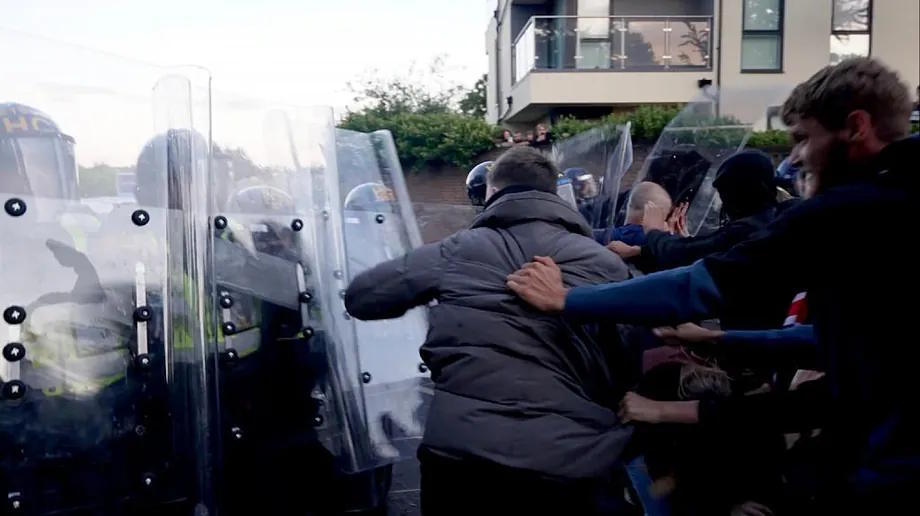
Now the tension has erupted. In the streets of Southampton but also in the Westminster Parliament. The neo-fascist leader Tommy Robinson (whose real name is Stephen Yaxley-Lennon) called for a demonstration on Wednesday night near the place where Nowak died, resulting in 11 injuries. The world's richest man, Elon Musk, who has intensified his media offensive against Reform UK for considering it too soft on immigration and supports the ultra faction of that party, Restore Britain, has described the actions of the 11 police officers involved in the case as "disgusting" and has pledged to fund a lawsuit to have them investigated for criminal negligence.
Starmer has accused Farage of "exploiting" the murder, and Labour members have booed Farage in Parliament.
Other centrist parties have also expressed their repulsion. Conservative MP Chris Philp stated: "The police seemed more concerned about racism allegations than helping Henry".