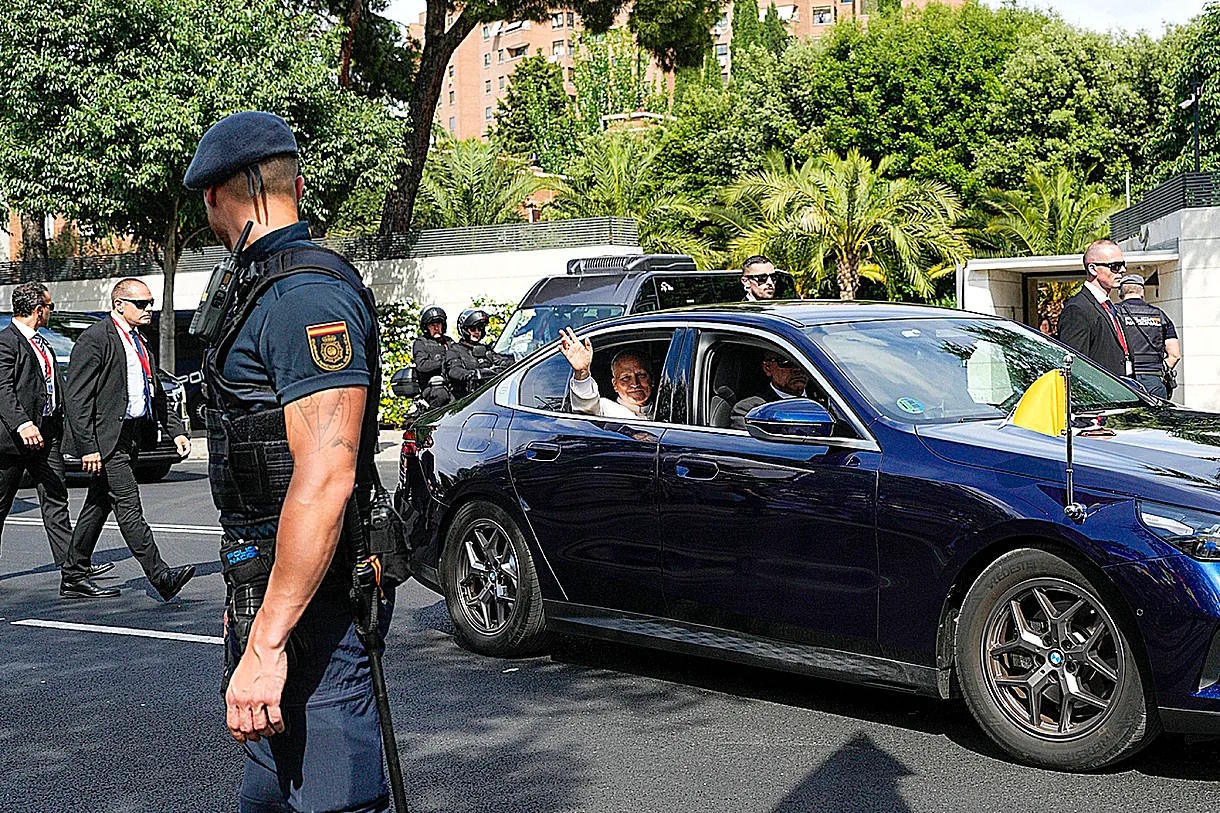
Residents of Pío XII street in Madrid approached the Nunciature yesterday to greet Pope León XIV and bid him good morning as he departed in the popemobile towards Plaza de Cibeles to officiate the Corpus Christi Mass. Officers from the National Police Corps and other security personnel guarded the access points to the apostolic delegation in a high-level deployment, matching the stature of the Holy Father, who, by the end of his Madrid visit, will have travelled nearly 200 kilometers completely secured.
"The Pope's visit is always a very significant challenge for a country," explains the General Commissioner of Citizen Security, Francisco López Gordo. Firstly, due to the weight that any head of state's visit carries, but also because León XIV is a religious leader "whose role demands great public exposure in all the events organized for this visit," dissects the General Commissioner. These factors make the Vicar of God one of the main figures susceptible to a terrorist attack, a risk amplified considering the large number of people attending his events. Just yesterday, during the Corpus Christi Mass, over 1.5 million faithful gathered along the Recoletos-Castellana axis, around Plaza de Cibeles, and also extending along Calle de Alcalá.
"This flow of people leads us to deploy all police resources: not only the uniformed part, which is the most visible, but all the more technical areas, the economic division, the trainee officers... It is an activity that coordinates and involves the entire Police force," he details. Even the 2,600 trainees from the National Police Academy, located in the city of Ávila, joined the operation set up for the events in Madrid.
"We are extremely grateful to have a first contact with the streets at an event with the Head of State of the Vatican. It is something we will experience once or twice in our lifetime, at most," two cadets expressed emotionally. They had woken up around two in the morning to leave the Academy and arrive in the capital on time.
Although significant operations had been planned for other relevant events, such as the Fourth International Conference on Financing for Development of the UN in Seville last year, the Madrid NATO Summit in June 2022, or the European summits during the Presidency of the Council of the European Union in 2023 - all with high international and political representation - none had required an effort like this.
Specifically, López Gordo explains that during the weekend in Madrid, between 11,000 and 12,000 police officers were deployed, divided between central services and headquarters. In Barcelona, where the Pope will arrive tomorrow, this number decreases to 750 as it is the Mossos d'Esquadra who are responsible for controlling public order and external security. Additionally, around 1,200 officers from the Central Protection Unit and the Police Intervention Unit will join the 2,500 officers patrolling the Canary Islands, where the Pope will land on June 11.
The fact that Robert Prevost's agenda includes a journey through four cities and the Pontiff's trip to the southernmost islands of Spanish territory implies "the mobilization of logistical resources and personnel in a very short period of time." For example, a ship will depart from Huelva transporting 203 vehicles to the Canary Islands to reinforce the available equipment in that territory. These logistical maneuvers further highlight the importance of the challenge faced by the State Security Forces when planning the papal security operation.
López Gordo adds that between three and four advance teams from the Vatican service have joined the National Police Force. "Furthermore, with six or seven of their security delegates, we conducted the routes and event locations when organizing the visit," he concludes.