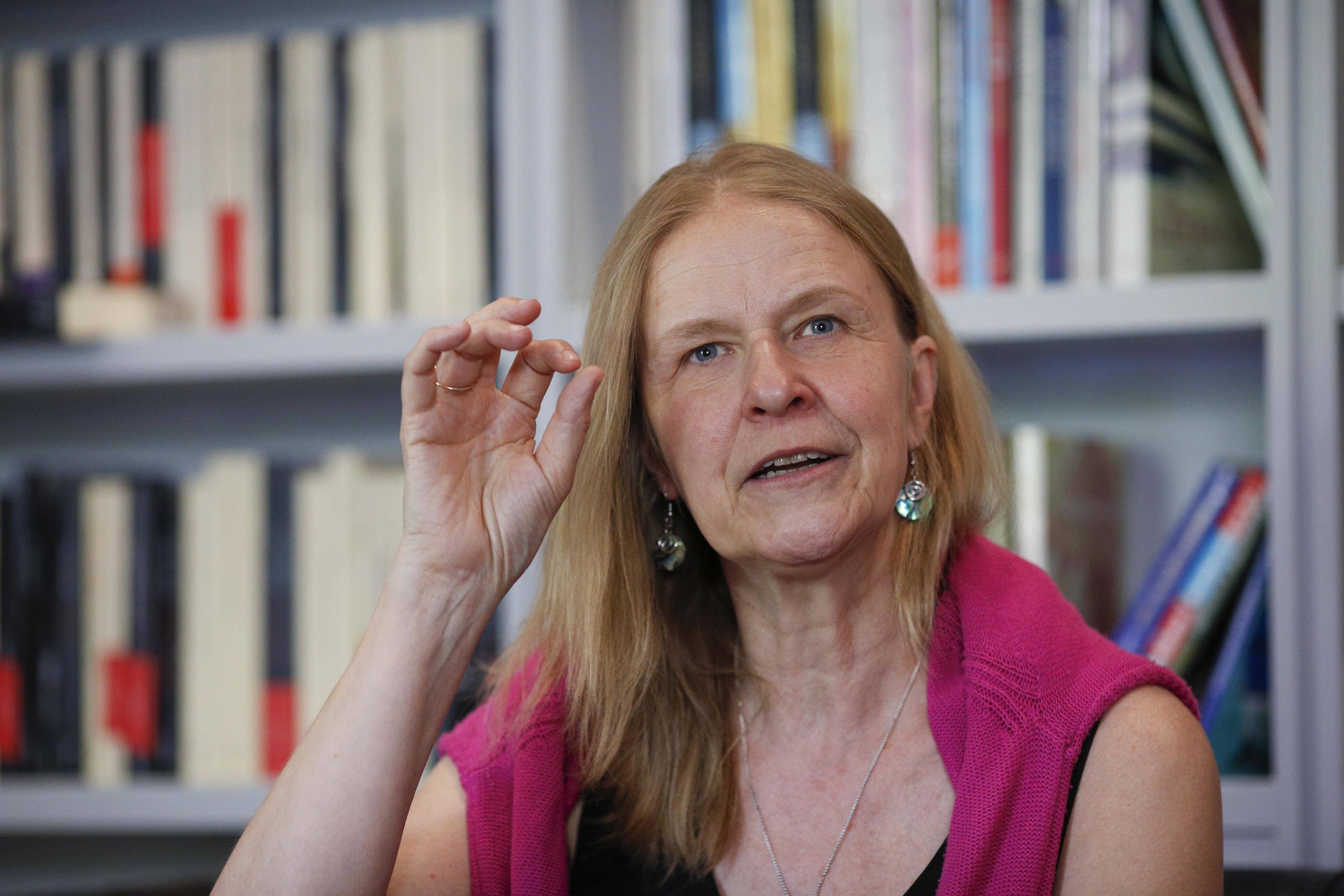
Do you believe in destiny? Cornelia Funke (Germany, 1958) does. For the illustrator and writer of children's and young adult books, there is no evidence proving its existence, although "somehow we have to justify what happens every day." Henry David Thoreau once said: "It is not enough to be busy; so are the ants. The question is: what are we busy about?" A life motto that Funke has taken to heart, and at 67 years old, she has become one of the most important literary references worldwide.
What keeps the German busy? Currently, she is reading How Flowers Made Our World (Penguin Books) by David Haskell. "You should listen to me every morning while I have my coffee. I am amazed by things about flowers that I didn't know." Her day seems to have more hours than usual: she also dedicates herself to writing several books at once and, on special occasions, finds time to chat with journalists about her new book, Inkdeath (Siruela), the fourth and final part of a saga that began over two decades ago. Her schedule has never been less busy.
Once again, what occupies the mind of a veteran of literature? The answer lies in the over 40 books she has written, some of which have been translated into more than 30 languages, and the occasional television script -which she now only turns on to disconnect from reading, occasionally-. Her CV also reflects the sale of over 12 million copies on five continents. And the number keeps growing.
She wanted to be a social worker and, in fact, practiced for a while. From that time, she took lessons that she still applies today while her literature is acclaimed worldwide. Not only do her works receive recognition. In 2005, Funke was chosen as one of the 100 most influential people in the world by Time magazine. Now she fills her time in Tuscany, from where she directs the Artist in Residence project, an initiative where young artists from all fields find their place to create. A busy life, undoubtedly, but exceptional, nonetheless.
It's been almost 20 years since the release of the first three parts of the 'Inkworld' saga. What made you revisit the story now?
I remember sitting on my sofa in Italy. I had been painting and drawing a lot, much more than I had in many years. And I wondered: Is an image more powerful than a word? So, the question lingered in my mind, and I thought, "Oh! That would be an interesting issue to raise in the Inkworld. A place where words are important, yes, but where illustration is also significant. What if Orpheus [one of the characters in the saga] were planning his revenge? What if, this time, he used images instead of words?" That was the beginning. The story simply came to me and said, "Here I am. Write me."
Is an image more powerful than a word?
I was very surprised by the answer the book gave me. Because, as I was writing it - as always happens to me - I didn't know how it would end. The story told me that music was much more powerful than both [laughs]. My son is a musician, and when I told him, he said, "Of course, mum. Music has always been there. It wasn't created by humans." I loved that idea.
How did the inspiration for this fourth book come about? Among its pages, it says that the antagonist of 'Inkspell' himself narrated the events to you...
That's right. I never believe that I created the characters. They, in some way, already exist, and I simply find them. Just as I search for the stories, they search for me. I don't feel like I invent them. That's why many times the characters end up being completely different from what I imagined. Sometimes I need hundreds of pages to discover who they really are. They deceive me, distract me.
What do you mean?
Have you ever written a fiction novel? Perhaps at that moment you didn't listen to your characters. Because I think the most exciting thing about writing a story is to stop thinking that you are the one writing it. A good story is like a maze where you get lost: you have to find the way, run through the hedges, and it will deceive you. And then, at some point, maybe you will come to understand the story. But it's always something with a life of its own. I don't believe for a second that I invented my characters. For me, it's always magical when a story arrives, and I see that it's huge, a true beast. That remains the greatest adventure.
Have you had to question anything from your past to write 'Inkdeath'?
Not at all. I was very surprised by how familiar it felt to me. It was a great comfort to reconnect with my own old books and keep thinking, "I know that girl. I know the woman who wrote this." I haven't changed that much. I know more about the world, of course. I have learned a lot, but that Cornelia is not a stranger. When I started writing 'Inkdeath,' I thought, "Well, finally I'm going to write a book about Dustfinger and the Black Prince. I had always wanted to do that." Then many young characters started to appear, and suddenly I realized that the book was also about my feeling that the young will be the saviours of the world. That is a conviction that I feel very intensely. So, I think, in that sense, the story is a reflection of my own life.
Do you believe that the young will save the world?
What do you think? [Laughs]. Every artist I know, every naturalist, every environmental activist, every writer... they are all between 15 and 35 years old. Each brings a piece of hope. There are also many older people who are still very valuable, but the elders will pass. That's the nature of things. Now, the only possibility is for the young to preserve the light in which they believe, what they dream of. As long as that dream is alive, we have to fight for it. And if we lose, we will lose a good fight, you know? Because what else can we do?
Have you always believed in the future of youth?
When I was young, I fought for many things. I was a social worker for a while. I was actively involved in Amnesty International. That's why I can't stand the world we are leaving to future generations. When I was young, I saved some people and helped a few others, and that's enough for me. Someone once said, "You may not be able to save the world, but maybe you can save the world of one person, one creature, or one plant." And isn't that a treasure in itself?
In this fourth installment, you talk about power, fear, and manipulation. Are young people more susceptible to these situations?
Youth do not need to learn from these situations. I think many times adults have such rigid ideas about the world that they are much more at risk of being swayed by propaganda. My experience with my young readers is that they do question how the world works. The adult world, to which I somehow belong now, has very strange values and goals. I don't understand most of them. I question what they consider important. I question the obsession with fame, money, and power. I believe life should not revolve around that. And perhaps children can understand it better than some adults who have been quite indoctrinated about what they think is important in life. What we teach children cannot be right. What we believe cannot be right because if it were, we wouldn't be where we are.
Where are we right now?
We have a planet on the brink of becoming a desert. The heat will increase to such an extent that many countries and people will be threatened by it. We will know hunger and we will know water scarcity because, driven by our greed, we have taken more from the world than we have given. And this has been happening for hundreds, perhaps thousands of years: we have developed a civilization that does not harmonize with this planet. That's why we have to deeply question our way of living. We live as if there were no tomorrow. We live as if we have no respect for others or for those who will come after us.
How can we reverse this?
Starting by not being so narcissistic and not being completely obsessed with our own desires; trying, step by step, to respect the rights of others and not trample on them. The way we live is not right, and it has a lot to do with the adults in charge. Because right now, we are regressing. There is much more racism, more sexism. It's as if the old monsters know that the world, as they understand it, is coming to an end because we are becoming a community with cultural diversity. And they don't like that. That's why they become even more ferocious. And that's why we are also governed by many older men who try to impose the old rules. It's never easy to take power away from the monsters, but I believe we have to keep dreaming of another world because do we really want this one? No. Certainly not. We don't want to keep living this way.
Currently, many countries are debating censorship and the limits of certain literary content. Do you weigh the protection of young readers against inhibiting creative freedom?
I don't believe in that kind of protection. I don't think censorship, or saying, "You can't read this," or "you shouldn't think this," will lead us anywhere. Of course, on the other hand, we do have problems related to social media and artificial intelligence, and we do need some protection, but these problems have been caused by the companies that develop that software. And, once again, we find greed and power behind it all. It's not the young people who are making the mistake; it's those who created these systems in this way, to make them addictive, harmful, and to operate without clear rules.
Why do you write fantasy books?
Fantasy portrays the reality of the world much better. Our world is fantastic. I think when we say we write a realistic story, we usually mean that we only write about humans. There's no one with fur or feathers. Almost never do we see any of the other beings that live in this world with us. Whereas in fantasy, we can shapeshift, suddenly have feathers. We can try to understand who else inhabits this world. So, for me, fantasy is more realistic.
Is our world truly fantastic?
You probably refer to human reality.
Yes.
Well, for any bird that flies past our windows, our reality tends to harm it, but that is not the reality of the world. We like to believe it is because we think we are the most important creatures on this planet. We think that our walls, our problems, our dirt, our garbage... that all of that is reality. But the reality is that this planet is millions of years old. Earth orbits around a ball of fire that would laugh at our pretension of thinking that our reality is everyone's reality.
Human beings are just one of the species inhabiting the planet.
In fact, we are the most problematic. We are a parasitic species. Perhaps one day we will become something more. I just hope that one day humans will be good for this world instead of just being parasites. Because we are always good to ourselves, but never towards others. Don't get me wrong, right now there are many people trying, wanting to make this a different world, and wanting to understand all the other beings living with us. And that is something I also try to do. Do you know how many times I think I have no idea what that tree is called? I know nothing about bird songs. I am teaching myself every day to open my ears and eyes because I am trapped in the human world, as we all are.
In your novels, you often talk about the power of books. What role do they play in today's society?
I have learned more about this from my readers than from myself. When I was young, books were my doors and windows. I lived in a small town. I thought the world had to be more exciting than that. And books were the promise that it was indeed more exciting. That there was much more out there. But what I hear from my readers today is much more touching. Over the years, many readers have approached me and said, "Cornelia, your story helped me during a long illness." Or: "I felt very lonely, I lost my mother. Your story helped me." And now I believe that the most beautiful task of books is to be a comfort, a refuge, and to help us face the world's difficulties because being human is tough. If a book can help us feel safe, even if it also talks about the darkness of the world, that is a wonderful gift.
What is the darkness of the world?
It is everything that destroys us, that harms people, that takes away their lives and happiness. It can be war, it can be oppression, it can be poverty. It can be many things. Of course, it can also be a serious illness. There are many things that make us feel like we are walking through a dark forest. From my experience, with all the dark forests I have had to cross in my life, the most magical weapons against darkness are still friendship and love.
You have your own audiobook label. Is this the new form of literature?
Not at all. It is the oldest form of literature. Because what existed before the book was invented? Spoken word always existed. Storytellers were the ones who invented stories, who sat in the dark and perhaps dispelled the fear we had of the night with their tales. So, for me, spoken word is the true literature. A book is very practical. You put the words in and it's fine. But sound and voice bring them back to light. I believe spoken words can be like a seed that goes straight to the heart.
What importance do words hold?
We have all been in situations in our lives where we were looking for the right words and couldn't find them, and that can be terrible. I think sometimes they are the only tool we have to speak to the people we love and to connect with others. We have almost forgotten how powerful they can be by constantly using them in texts, messages, and conversations. Our words are very powerful, but also very dangerous. It's easy: when painting a picture, you choose the color beforehand. You ask yourself, "Is this blue? Is this red? Should I paint it yellow?" Now, do we do the same with words? Sometimes maybe yes, but perhaps not often enough.
Final question, Cornelia. What is imagination to you?
How coincidental! Once, a young person in Madrid asked me the same question during a meeting, and I wasn't prepared to answer. Now I am. Imagination is our ability to visualize that feathers sprout from us. We can fly with our imagination, and we are free because of it. For me, it remains one of the most valuable gifts we have, but we must train it as if it were another muscle in our body. Our world limits it too easily. They tell us it's childish. We think it's something we can't do. But yes, we have to do it. There is so much cruelty in the world that being able to fly with our imagination can sometimes be the only possible solution. We have to imagine because only when we imagine that things can be different can we truly make them different.