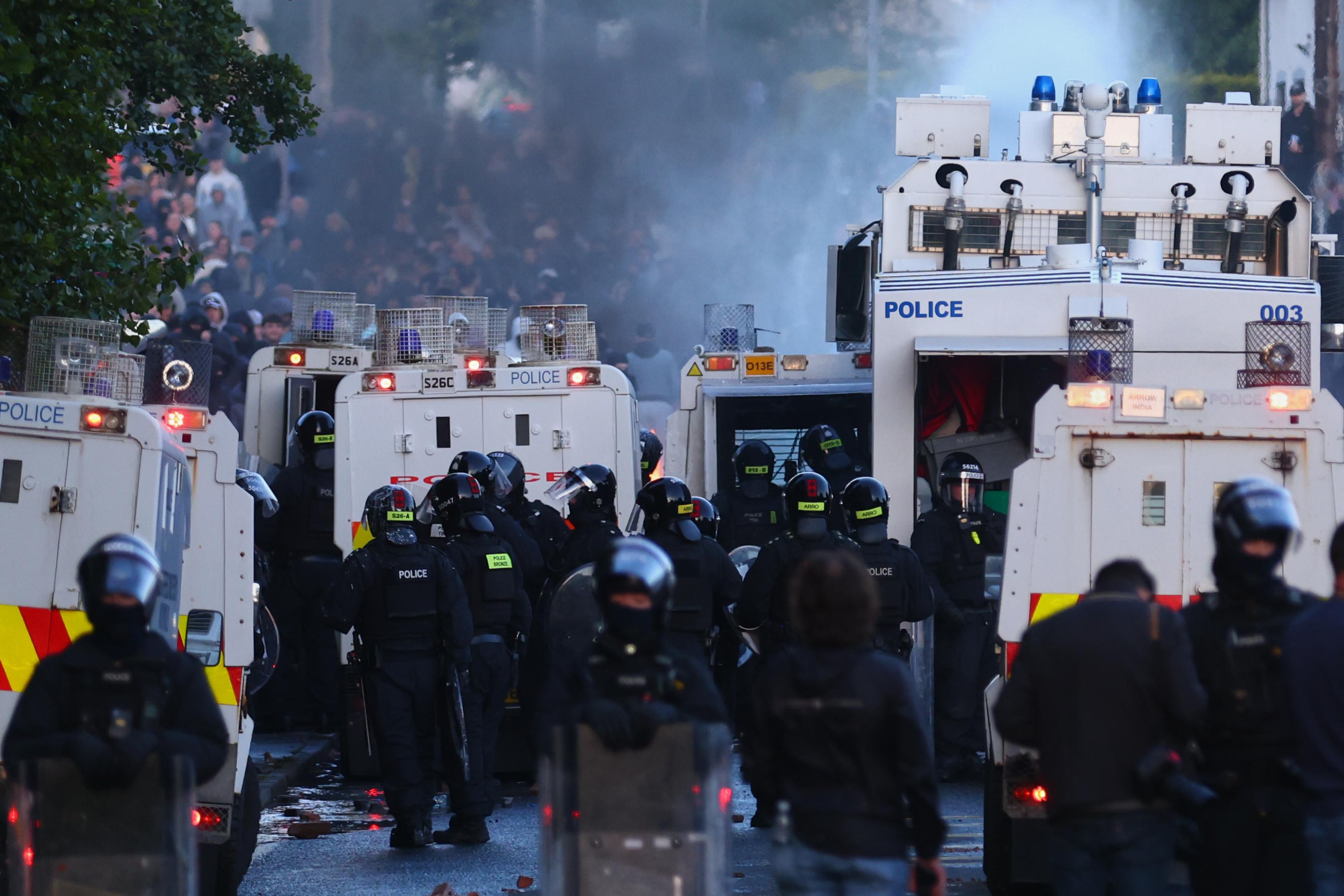
The centre of Belfast had a surreal look yesterday. The streets were empty. Many shops and restaurants were closed. In the City Hall square, the city's geographical and social center, there was not a soul. Only a few police vans patrolling the area.
It was a strange sight in a city located almost as far north as Moscow, where at this time of year, night doesn't fall until after 10. But the residents of Belfast were not in a celebratory mood. The city was experiencing its worst wave of violence since the so-called Troubles, the euphemism for the civil war between Catholics and Protestants that ravaged Northern Ireland until the late 1990s.
Those were the years when the emblem of terrorism in Europe was the IRA, a simultaneously Catholic and Marxist organization, supported by the USSR's allies but funded by US Catholics, which trained ETA and became a true guerrilla in the UK, combated literally with blood and fire.
This time, the violence did not have the generalized, religious, and tribal nature of those conflicts. But a significant portion of the citizens understood it. "This had been simmering for a long time, at least a year. We have had months with foreign men trying to kidnap children," explained a taxi driver while taking this correspondent to the Kinnaird neighbourhood, the epicentre of the disturbances and also where the trigger occurred. It was on Monday night when 30-year-old Sudanese citizen Hadi Alodid, who had entered the UK from Ireland, repeatedly stabbed 44-year-old Northern Irishman Stephen Ogilvy in the face, neck, and torso.
Alodid, who had arrived in Ireland as a refugee, has been charged with attempted murder. Northern Irish and British authorities claim to be unaware of the motivation behind the attack. But just asking any Belfast resident would yield the same response: "It's clear what he wanted: to decapitate him." The implicit reference is to the beheadings carried out by the ultra-fundamentalists of the Islamic State, a parallel that authorities reject but has not gone unnoticed among political leaders.
"We must stop granting asylum to those who wish to decapitate young people," wrote Rupert Lowe on Tuesday, founder of Restore Britain, an ultra-nationalist party barely three months old that, according to polls, could garner close to 10% of the vote in the upcoming by-elections in Makerfield. Elon Musk, owner of X and the world's richest man, retweeted the message. The role of social media has been decisive in the current explosion of violence. On Tuesday, a list with names and addresses of immigrants and pro-welcoming individuals was circulating in Northern Ireland. The Northern Irish police described it as a "target list" and deemed it "absolutely unacceptable."
Authorities could label it as they wished. But reality was ahead. A five-minute drive from City Hall, a charred stretch of road marked where a vehicle had burned the previous night. At 19:58 in Kinnaird, a taxi was set on fire. Ten minutes later, the police reported using water cannons to disperse protesters committing violent acts in the Newtownabbey neighbourhood, while a van was ablaze and officers deployed their hoses.
During the night, protesters with covered faces tore bricks from the exterior walls of homes and smashed pavements with sledgehammers to hurl the fragments at riot police.
The feeling in Belfast is that this will last for days. Tuesday's events were anticipated: people stayed at home knowing that the atmosphere was highly charged. Protesters unleashed what appears to be blind violence that crosses old sectarian boundaries. In Northern Ireland, the division between Catholics and Protestants persists, and some interpret that the most active groups in the anti-immigration protests are predominantly unionists - Protestants, supporters of the region remaining part of the UK - in contrast to Catholic republicans, who advocate for union with the Republic of Ireland. Kinnaird is a predominantly Catholic neighbourhood. But in Tuesday's disturbances, homes of lifelong Northern Irish residents, both Catholics and Protestants, were also set ablaze.