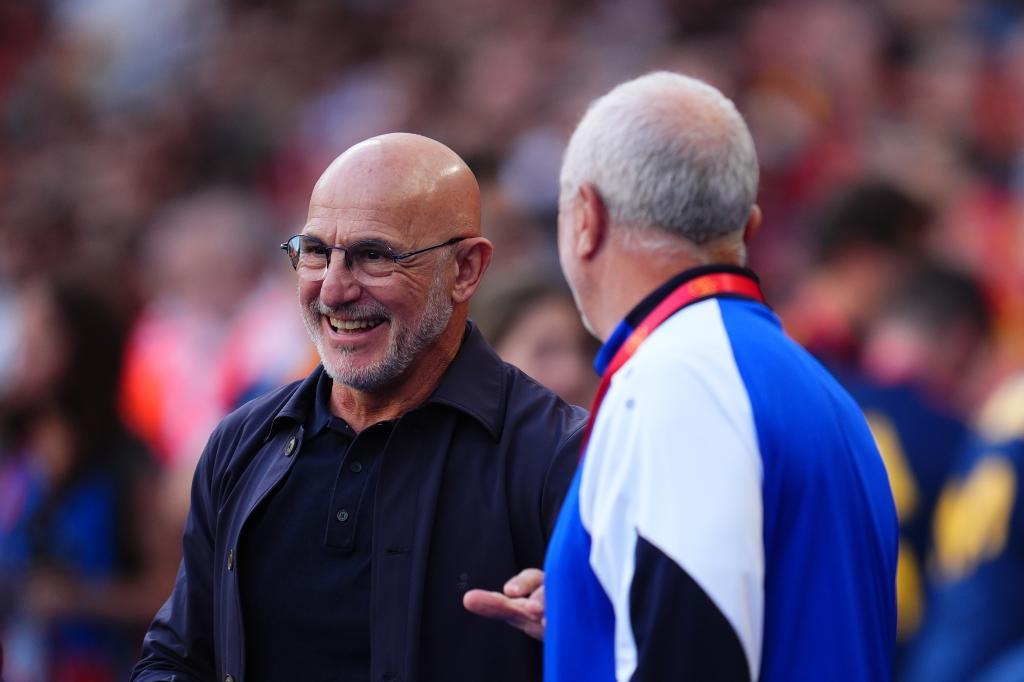
Next Sunday, on the 21st, Spain will play the second match of this World Cup against Saudi Arabia. That day, at the Atlanta Stadium, the coach, Luis de la Fuente, will turn 65. It is the age when most people retire. "Who wouldn't like to coach the national team in the 2030 World Cup?" he responds when asked about the future, explicitly stating that he has no intention of stopping working. It might be thought that he is, if not the oldest, one of the podium. But a look at the list of coaches is surprising.
Among the 48 coaches directing in this World Cup, De la Fuente is the ninth oldest. Ahead of him are Dick Advocaat (Curacao, 78), Miroslav Koubek (Czech Republic, 74), Hugo Broos (South Africa, 74), Carlos Queiroz (Ghana, 73), Marcelo Bielsa (Uruguay, 70), Javier Aguirre (Mexico, 70), Carlo Ancelotti (Brazil, 66), and then Luis de la Fuente.
His longevity confirms a pattern that, coincidence or not, Spain has been repeating since it started its first major winning cycle, from 2008 to 2012. During that time, the first Euro Cup was won with Luis Aragones, who on June 29, 2008, was 69 years old, becoming the oldest winning coach in the tournament's history. The World Cup had Vicente del Bosque at the helm, who on July 11, 2010, was 59 years old (six months shy of turning 60), and the same happened in the Euro Cup. The coach from Salamanca, on July 1, 2012, was already 61 years old. After a journey materialized in Lopetegui and Luis Enrique, the appointment of Luis de la Fuente returned Spain to the podiums. If we exclude the 2023 Nations, their major title, the 2024 Euro Cup found him at 62 years old. In other words, except for Del Bosque, by just six months, all have been in their sixties.
"Undoubtedly, experience is a plus, and everyone knows the admiration I have for Vicente del Bosque and Luis Aragones. In any case, I believe that one should not look at the ID card. My coaching staff and I are very up-to-date, and if you talk about knowledge of the raw material, with all due respect, I will tell you that nobody knows their raw material like we do," says the coach, who has had several conversations with Del Bosque, also when he took over the position.
"That doesn't mean anything! The age, I mean. What matters is the ability, whether you are 30 or 70," intervenes Del Bosque, the only one who has lifted the World Cup that begins today. The similarities between the three are evident: they took over the team at the end of their careers, introduced modifications to what was being done (Luis with the great revolution, Vicente with evolution, and De la Fuente with a return to a dynamic and modern style) and they won. Above all, they won.
However, the current coach has twisted the plot. Both Luis and Del Bosque boasted of an important track record upon their arrival. Aragones had the League with Atletico Madrid (1977) and four Copa del Rey titles (1976, 1985, 1988, and 1992). Del Bosque, at Real Madrid, achieved two Champions League titles (2000 and 2002) and two La Liga titles (2001 and 2003), among other successes. De la Fuente, unlike them, arrived amidst suspicions from a large part of the fans and the press.
He had no club titles, although he had been at the Federation for nine years and had already won two Euro Cups, one U-19 and one U-21, and added a silver at the Tokyo Olympics. He carries that mistrust deep inside, and occasionally it slips out in a response. These days, he seems much more relaxed. He does not hide his ambition to win the World Cup, walks confidently in front of journalists because he knows that what he has achieved is undeniable.
And, besides, he has not made some of the mistakes that the other two did. Luis Aragones had a tough World Cup in 2006 for taking, half-heartedly, Raul and Xavi, two figures of the time. Vicente had an even worse time in 2014 when he chose to maintain confidence in the old guard (Xavi, Xabi, Casillas, Villa, Torres, etc...) and experienced one of the worst disasters remembered. De la Fuente did not. Behind his friendliness, De la Fuente hides a tough coach. For this World Cup, he did not bring Morata or Carvajal, two of the captains from the Euro Cup, out of gratitude for their services. This decision is combined with not bringing back Sergio Ramos despite pressure from part of the press, changing the team from top to bottom, leaving behind some who had been his people in the youth teams (Ceballos, for example) for not integrating into what he calls 'the family', and a few other examples. One could say he learned from the mistakes of others.
P.S. The only Spanish coach without gray hair who won was Jose Villalonga, who on June 21, 1964 (the day of the Euro Cup final in Madrid) was 44 years old. A youngster.