A long and dark shadow looms over the Madrid Olympic Shooting Federation (FMTO). It's a Saturday in April, exam day. The applicants for the F license, the sports shooter license - which ultimately grants access to owning a gun at home, are shooting on the other side of a long hallway. Gunshots can be heard in the distance, behind a door. In the hallway, there are also shots, but they are not made with guns, but with a Bic pen.
Let's break it down. The targets of the applicants who have already completed their exam are taken to that hallway, a place crowded with wood, plastic, old targets, and dust. From there, they will be taken to another area, the so-called "classification area," where the referees are.
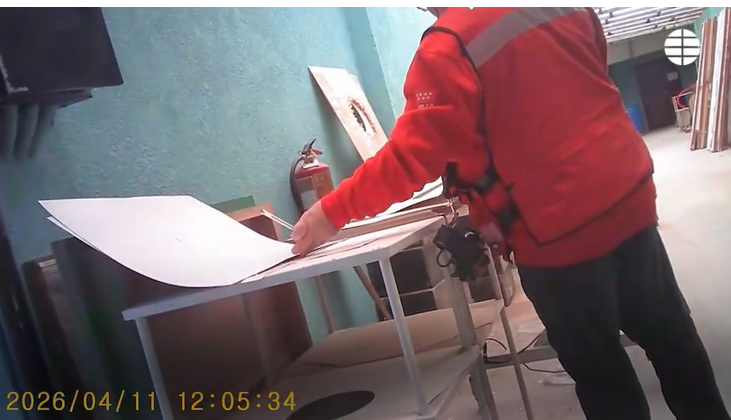
According to a video obtained exclusively by EL MUNDO, at a table in that hallway, standing, the vice president of the federation, Enrique Vaquero, looks at the targets and seems very busy. To pass, applicants must shoot at a target measuring 55x52 centimeters from a distance of 25 meters. They must score at least 50 points, or they will not obtain the license.
The vice president looks at the pile of targets and counts the points. He stacks the approved ones to his left. But when one doesn't make it, he bends down, reaches behind some wood, and takes out a new target. To make them unique, all exam targets have a mark in the lower right corner: a numerical code identifying the participant and a federation seal.
The vice president places the new target next to the failed one, takes out a pen, and, looking at both, writes something in the lower right corner of the new target. Then he takes a federation seal from his fanny pack and quickly stamps it.
Finally, he moves the new target to the stack of approved ones, but there is still one last matter to address: the original target must be disposed of. He grabs it, tears off the corner with the participant's data and puts it, deep down, in a trash can full of plastic and things. He hides the rest of the target behind other planks.
After performing that same maneuver several times - as many as there are failures, it seems - he hands the stack of targets to a federation employee and they are taken to the "classification area," where they all arrive as approved.
Several things stand out from this suspicious story: first, the calmness and method with which the man operates when replacing the targets. Before anything else, he can be seen punching holes with a Bic pen in the targets that he later hides behind the boards. It doesn't seem to be the first time, nor the last.
It's curious that the pass rate for months in the F license exams is 97%. And another suspicion: for years, it was also very common for 100% of those taking the D and E licenses for long guns to pass. In this case, the target is much smaller, more difficult to hit.
Until one day, as federation members recall, a high-ranking officer from the Civil Guard Weapons Inspection decided to escort the targets from the shooting range to the classification area, and on that day, 100% failed. From that day on, a larger target was used for the exam, and practical classes before the exam began.
Another striking peculiarity: not much time can pass between when the targets are removed from the exam and taken to the classification area, as they must necessarily pass through that hallway where the alleged fraud occurs. That's why the whole maneuver seems almost timed.
And one more detail: only one person can have the federation's official seal, but that person is not the vice president. Why does he have one and stamp it on the targets then?
Other issues that exacerbate this massive granting of gun licenses with the consequent potential danger must be highlighted. In the Community of Madrid, going through the federation is mandatory to obtain a gun permit. The F license ensures possession of a pistol faster than other licenses. In just one month, it is possible to obtain it: one theoretical class, three practical classes, and the final exam.
The Madrid Olympic Shooting Federation is issuing about 60 new F licenses every month, despite hitting a target at 25 meters with little experience not being easy, as anyone who has shot a handgun knows.
The license management brings in 650 euros to the federation, plus the fees from those who become members. Additionally, while with the F license, it is only possible to buy 100 bullets per year at gun shops, at the federation itself, you can buy 100 bullets a day!
It is assumed that all those bullets must be used on the same day they are purchased by shooting at targets, but... "sometimes family clans of eight people come, each buys 100 bullets with their licenses, have a coffee, and leave," some federation members express with understandable concern.
This newspaper called the federation yesterday to inquire about this alleged fraud. Its executive director, José Manuel Barranquero, stated that "the federation will investigate" to verify the veracity of this accusation. Furthermore, its president, Andrés Martínez, mentioned that "the board of directors knows nothing about these events" and that, if confirmed, "explanations will be requested from the director of the F license, Ignacio López". However, he preferred to leave out the vice president, the alleged perpetrator of the fraud (and a member of the board of directors).