A car with a plastic bag instead of the front right door glass marked the spot where Stephen Ogilvie was stabbed by Hadi Alodid on Monday night, in an attack that has sparked the biggest wave of violence in the capital of Ireland, Belfast, in almost three decades.
On one side are the state housing units that accommodate low-income individuals. On the other, the Thorndale Shelter, run by the Christian organization Salvation Army, an institution that carries out social work similar to Caritas in Spain. It is a working-class area, with low incomes, overlooking emerald green fields typical of Northern Ireland's nature. "Not a place you should walk at night," comments a local in a pub on the neighboring Kinnaid Avenue.
Next to the pub, a house displaying three flags: the Republic of Ireland flag, the Sinn Féin flag -the party of Catholics in that territory, former armed branch of the IRA terrorist organization-, and the flag of Palestine. A clear political and social statement. It is a working-class, Catholic neighbourhood -or, as they say in Northern Ireland, "unionist", meaning in favor of integration with the Republic of Ireland- where people were betting on horse races broadcast on TV in the pubs yesterday afternoon. But nearby, in Tiger's Bay, the 'loyalist' area begins, Protestant and in favor of remaining in the United Kingdom.
The great paradox is that, probably, neither Alodid nor Ogilvie are Catholics. The former is of Sudanese nationality, from a strictly Islamic country that, until a decade and a half ago, was accused of committing genocide against Christian and animist communities that eventually gained independence. And Ogilvie is a Scottish surname. The 'Scotch-Irish', or 'Scottish-Irish', arrived in Ireland in the 17th century. They were fanatical Protestants employed by the British government and landlords to conquer the local Catholic population. Many of them later emigrated to what is now the United States, where they form the social and cultural base of Appalachia and the Southern states. And also of Trumpism.
Neighbours insist that Alodid and Ogilvie lived in the same block, one of the two five-story houses in front of the Thorndale Shelter. There, while it was still daylight, Alodid stabbed Ogilvie in the neck, face, and chest, whose life, according to authorities, is not in danger but, according to unconfirmed reports, may be in a coma.
That was the spark that ignited the powder keg. Since then, Belfast has been on high alert like never before since Protestants -with the help of the British Armed Forces- and Catholics were shooting at each other in the streets. "The 'troubles' stole my childhood and adolescence. I don't want this to happen to me now in old age," said Paul, a 71-year-old retiree, at his home in Sandyknowes Park, a traditionally Protestant neighbourhood on the outskirts of the city.
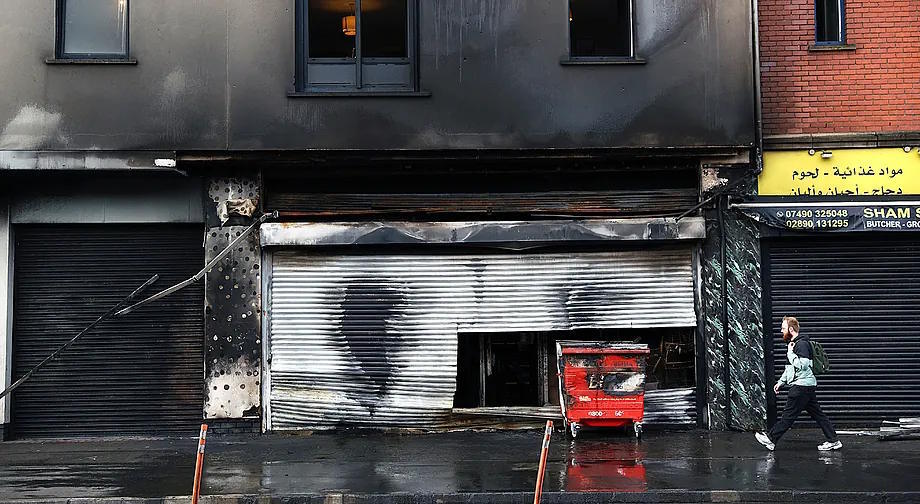
On Wednesday night, a well-coordinated group of protesters clashed with the police, stole a van, set it on fire, and crashed it into Paul's house wall. The wall is cracked, and two columns are missing the pyramid-shaped stone tops. The protesters, all young boys with covered faces, who appeared at seven in the evening, tore them off to throw at the law enforcement. Across the street, only the charred frame of a house remains. "The owners were lucky because they only used it as a storage space," explained Paul.
Since the violence erupted on Tuesday night, around 25 people have been left homeless in Belfast, according to official data. Most of them are immigrants. The protesters usually know which houses to set on fire. The Minister for Northern Ireland, Hilary Benn, has described the ongoing events as "racist vandalism". Moreover, it is well-organized vandalism. Anti-immigration groups communicate through Facebook and WhatsApp. They follow a tradition from the era of religious violence: starting their actions after finishing work and dinner. Meanwhile, the police have resorted to past tactics: rubber bullets and water cannons. Violence against immigrants erupted a year ago in nearby Londonderry, that time due to a rape committed by two Romanians. Now it seems as prevalent as during the war between Catholics and Protestants.
The major difference now is that Catholics and Protestants are united against immigration, flowing from the Republic of Ireland, with which Northern Ireland has no border, despite Brexit, precisely to prevent a return to the tribal violence of the 'troubles'. Mike, a painter whose father "spent three years checking under the car because the police mistakenly told him he was on the terrorists' hit list," believes that these violent riots may be organized by "people who were part of the IRA and 'paramilitaries'," referring to the two main organizations -one Catholic, the other Protestant- from the past religious violence.