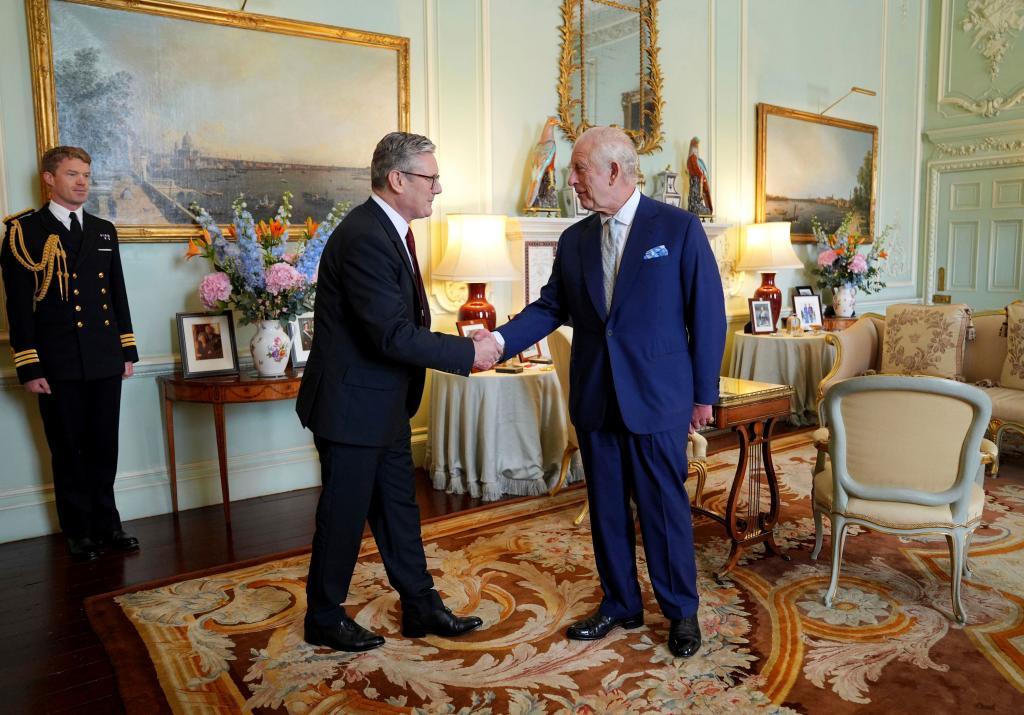
It probably didn't sit well at Buckingham that historian and renowned expert in the British Monarchy Ed Owens described Charles III as "the 23rd member of the Starmer Cabinet", seemingly questioning the scrupulous non-partisan neutrality that the Crown must always adhere to. However, the joke better describes the extremely close symbiosis that has characterized the relationship between the king and the outgoing prime minister Keir Starmer during his term. If the personal chemistry between the two has been evident, even more significant has been the mutual strategic convenience they have displayed since the Labour leader received the mandate to form a government from the head of the Windsors on July 5, 2024. Therefore, it must have saddened the sovereign yesterday when the Downing Street tenant informed him, as required, of his decision to resign shortly before announcing it to the nation.
Although Starmer was known in his youth as a prominent left-wing lawyer and activist who professed strong republicanism and advocated for the abolition of the Monarchy, his rise to power already hinted at a good rapport between the Labour leader and the successor of Isabel II. And it has been more than fulfilled.
Starmer became the third prime minister during the reign of Charles III. He barely had time to get to know the conservative Liz Truss, the 45-day leader, although in the short time they cohabited, the newly crowned king suffered a strong snub when she forbade him from attending the Climate Summit in Egypt, implying that as head of state, he should refrain from meddling in issues like this that had become his flagship as Prince of Wales. The king must have cared little about losing sight of the inept politician so soon. Rishi Sunak, her replacement, showed much more deference to the Monarchy. However, although initially seeming to fit well with the new reign by having an Indian-origin and Hinduism-professing premier in Downing Street, in line with the multiculturalism that the sovereign strongly advocates, Sunak's lack of empathy and his lack of skill in addressing the scandals accumulating within the Tories amid growing social discontent due to the economic crisis led the monarch to keep a convenient distance from him, not to mention that the end of his term was inevitably marked by the king's cancer diagnosis.
Starmer came to power like a breath of fresh air, propelled by an overwhelming majority that heralded an era of profound change -soon frustrated-. However, concerning the Palace, the Labour leader began his tenure as a full-fledged monarchist, acclaimed by his supporters in a conclave dominated by the national anthem and with Labour leaders singing the God Save the King at the top of their lungs, much to the horror of the ousted Jeremy Corbyn. Above all, despite being a left-wing politician, Starmer had many more points in common with Carlos III than his right-wing predecessors. It was an open secret that the monarch agreed with the new Labour agenda on many issues: environmental policy -a major concern of the king, where he did not find enough support from the Tories-, housing, the UK's relationship with the European Union, or immigration.
Hence, a solid cooperation was quickly forged between Buckingham and Downing Street, fueled by the personal feeling of the two leaders. The prime minister was particularly moved by the dignity and sense of duty shown by the sovereign, who insisted on fully resuming his institutional agenda less than three months after starting his treatment, against medical advice.
However, the turbulent geopolitics strongly influenced Starmer's term -especially with the return of Trump to the White House- and also the relationship between the Executive and the Crown, with the former relying on the royal family to assist in complex international relations as had not been seen in the UK for a long time. For all British governments, without exception, the extraordinary soft diplomacy of the Windsors has always been one of their most potent arsenals in foreign affairs. But with Starmer in power, Charles III had to perform diplomatic feats as significant as shouldering the preservation of the special relationship between the UK and the United States. The Labour leader did not hesitate to ask the Crown last year to extend an invitation to Trump for an unprecedented State visit to London -despite having already made one with Isabel II as host- breaking Buckingham's tradition. In fact, a scene like Starmer in the Oval Office last February handing the royal invitation to a childish, puffed-up Trump had never been seen before. The Labour leader also did not hesitate to once again rely on the good offices of the king and send him to Washington last May to mediate in the worst bilateral crisis in the last half-century, despite the royal visit to the US being surrounded by pitfalls, posing a very challenging task for the Crown and facing the widespread rejection of British citizens due to coinciding with the Iran war and Trump's harshest insults to the UK. Ultimately, it must be said, the visit was a brilliant success for Charles III, providing some relief to Downing Street.
As Starmer's downfall became inevitable, with the countdown to his ousting, the prime minister overstepped his powers in a move that put the Monarchy in one of those uncomfortable situations so frowned upon in the British system. It happened last month; Starmer scheduled the opening of Parliament and the solemn Speech from the King for a date with which he, in vain, tried to buy time amidst the Labour infighting to secure his head. This deeply unsettled Buckingham. Although surely the phlegmatic Carlos III would opt to exchange better memories at the start of his farewell yesterday to his third prime minister, awaiting the fourth, Andy Burnham, incidentally dubbed the king of the north.