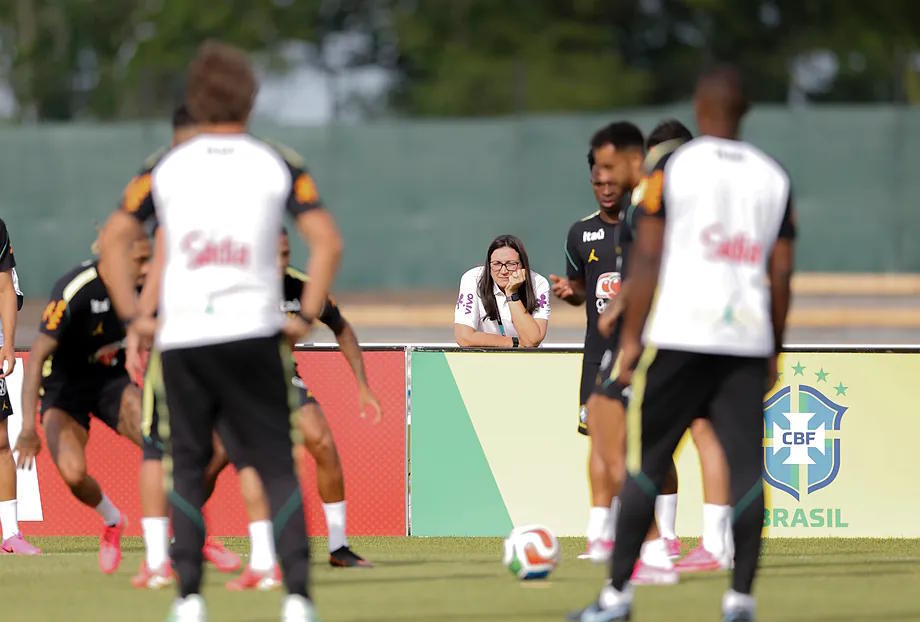
"I am the psychologist," repeated Tite in 2018 and 2022. Until now, talking about therapy or mental health in football was a dream, even more so in Brazil, a country of traditions, and in its national team, convinced by history that to win all you needed was to "play beautifully." All of that has changed. The five-time champion, in a context of maximum pressure and anxiety to compete in a World Cup they haven't won since 2002, has hired Marisa Santiago, now a psychologist for the national team and part of Carlo Ancelotti's coaching staff.
"Marisa is working very well with us. Today the team was calmer and more focused. More composed with the ball," said the Italian in a press conference after defeating Haiti on matchday two. Carletto, a veteran of many battles, has been repeating for weeks at the New Jersey training camp that "the mental aspect will be almost more important than the footballing one." The atmosphere in Brazil is complicated. Now, just before the match against Japan in the round of 16, the Canarinha's environment is on cloud nine, fueled by the two resounding victories against Haiti and Scotland.
But before that, after the 1-1 draw against Morocco in the World Cup opener, the criticisms were fierce. "When things go well, they go very well. But when they go wrong, they go very wrong. There is no middle ground," explain sources close to the Brazilian team's locker room. In this volatility, Marisa Santiago is gaining importance, hired by the CBF in March 2024, when Ancelotti was not yet the coach, and with a much more significant role since the Italian took over.
At The Ridge hotel in Basking Ridge, New Jersey, the CBF has set up a workspace for Santiago, where she meets with players individually or conducts group sessions, depending on what she observes in training and throughout the day, and on the players' requests. Some players are regulars at these talks, which do not necessarily happen in that room, others have tried it, and several are still hesitant to take the step. A bit like what happens in football in general.
Santiago watches the training sessions from the sidelines, without stepping onto the field or interfering with Ancelotti's staff, led by his son Davide, but when the session ends, she checks if any player has any needs. Never before had Brazil had a psychologist so close to the team.
"Let Brazil compete naturally"
Specialized in cognitive-behavioral therapy, Santiago had developed much of her career in volleyball before working for Atletico Mineiro and Bahia. The CBF defines her mission as "helping Brazil compete naturally." Since the 2014 World Cup semifinals and the 7-1 loss to Germany, the 2018 and 2022 World Cups have left a sense of anxiety in the South American entity. Too much self-demand. Ancelotti, a group manager as well as a football coach, has managed to rearrange the pieces so that the locker room feels once again that they can win the World Cup. And he has also done it with Santiago's help. "We work on group cohesion, leadership, how to deal with anxiety, pressure, controlling thoughts... Anything that can affect the technical and tactical performance of the player," Santiago states in comments to the CBF, emphasizing that "we are not here to diagnose disorders or provide therapy, everything is focused on performance, not diagnosis."
This mental aspect is crucial for the good atmosphere within the national team since the start of the concentration. The call-up of Neymar, for example, instead of boosting egos and causing friction, served to further unite the group around one of the great idols of this generation. And the decision to have families close by and be able to see them the day after matches, as other teams like Spain do, has relieved the players.
The players themselves acknowledge the need to focus on mental health. "We are a generation that has often been greatly affected by criticism. The psychologist helped me balance the pressure," stated Bruno Guimaraes.