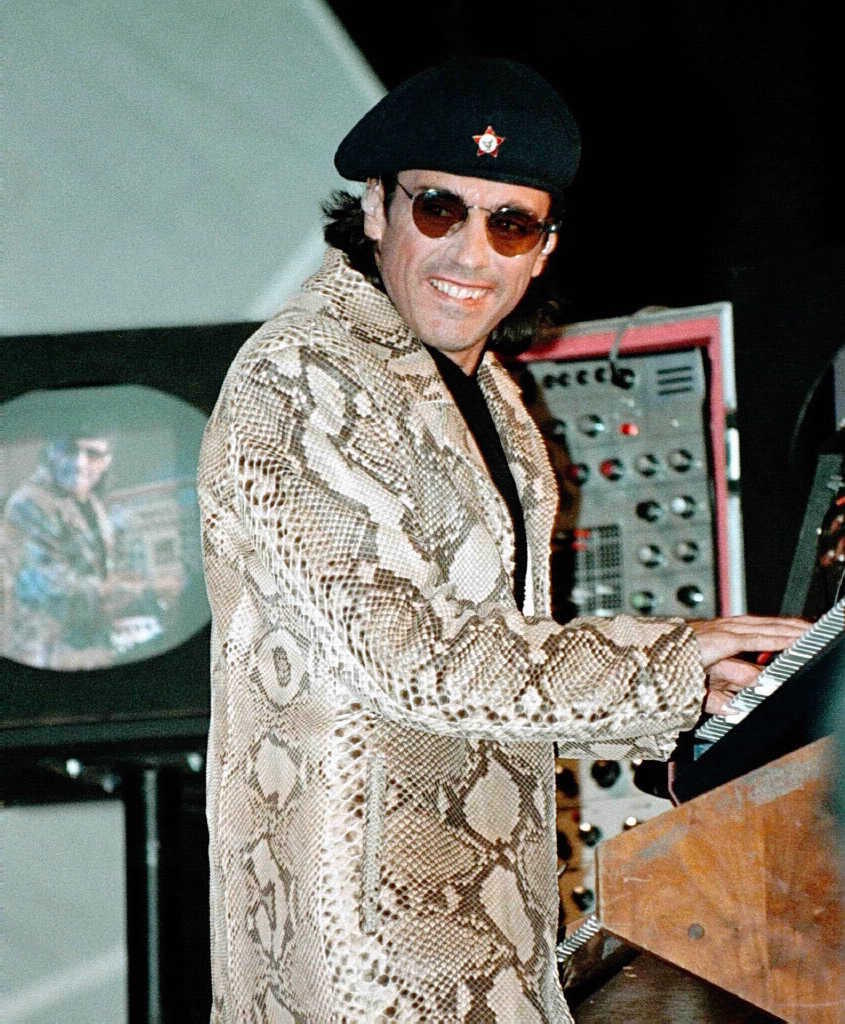
Jean-Michel Jarre (Lyon, 1948) has the enthusiasm of a child with new synthesizers. The French musician is making the leap to Spain these days to celebrate the 50 years of the emblematic album Oxygène. The pioneer of electronic music will offer one of the most anticipated concerts of the summer at the Noches del Botánico in Madrid (July 3 and 10), also celebrating the 50th anniversary of Amnesia in Ibiza (July 5), at the FAR cycle in Valencia (July 8), and at the Starlite festival in Marbella (July 13).
Tireless at 77, alternating his massive performances with the preparation of a new album (the 35th in his career), Jarre briefly reviews his musical journey and advocates for the uniqueness of artists in the era of artificial intelligence. A revolutionary since his youth, he acknowledges embracing AI and asserts that it will have a "very positive" effect on humanity in general and on music in particular.
An admirer of the "Spanish soul" and a fan of Rosalía, the universal Frenchman calls on Europe not to fall behind the future championed by China and proclaims himself an "optimistic subversive" in the face of the dystopian prophecies - both in politics and in art - that dominate the headlines these days.
It's 1976, Abba fills the dance floors with 'Dancing Queen' and suddenly, a French composer stands out with what some call "the sound of the future"... What comes to mind when you think about the unexpected success of 'Oxygène'?
Nostalgia is not my thing, but it's amusing to recall the impact that Oxygène had back in the day. It was like an UFO landing from another planet in the disco era. I also remember what my mother said when she saw the album design with Michel Granger's painting: "My son, how can you title an album with the name of a gas and with a skull on the cover?" [Laughs]. When I was preparing it, I wasn't really thinking about creating "the music of the future", I was simply experimenting in my kitchen with my first synthesizer, exploring a type of music that went beyond traditional music theory. Electronic music gave us the possibility to become craftsmen, mixing textures and incorporating sounds and noises.
Were you ever tempted by rock, like many in your generation?
I played in rock bands as a teenager and attended many concerts at L'Olympia in Paris. I liked rock, but when I listened to those English bands, I thought: this is the Anglo revolution, but what is my revolution? We were in the context of May '68, you know, and there was a need for rebellion... For me, the experience at GRM (Groupe de Recherches Musicales) and my contact with Pierre Schaeffer and Pierre Henry were fundamental. It all started with the concept we then called musique concrète, which was the foundation of electronic music... Unlike rock, jazz, or blues, we were facing a genre that was born in Europe, in countries like France and Germany, with roots in surrealism and with a rebellious attitude similar to Marcel Duchamp's approach to music. It's something Europeans should be proud of.
Your music has not only been embraced in the Anglo world but has earned the label of universal and continues to attract tens of thousands of followers worldwide. What's the secret?
I suppose it's about staying true to your roots... There's a difference between being universal and being international. International are Coca-Cola and McDonald's, homogenizing everything. Universal are artists like Rosalía, for example, who break boundaries embodying the spirit of Spanish and Latin culture, unafraid to experiment. Rosalía, to me, is also an example of an artist's uniqueness in the AI era. Art has nothing to fear as long as there are artists willing to break the rules and be disruptive in their own way, like Almodóvar, Dalí, Picasso, and many Spanish artists have been.
Is AI a threat or an incentive for music?
I am absolutely convinced that AI can be very positive for humanity in general, and also for art. It's a fantastic tool that not only allows you to create but also to protect your own work... That being said, I'm not naive and I believe that rules of use will be necessary. For protecting intellectual property, for example.
What would you say to those who think AI could be the final blow to human creativity?
Today's debate about AI reminds me of the early 20th-century discussions about the steam engine when a British newspaper warned that the human heart could explode at 50 kilometers per hour. It also reminds me of the Vatican's anathemas against the printing press and against everyone being able to read books... Every invention has served to democratize knowledge and provide people with tools they didn't have before. Fire is dangerous, yes, but it has improved our civilization. Electricity also has its risks, but it has been positive for humanity... I remember how electronic music initially put orchestras on guard, to the point of boycotting performances by unplugging our instruments when we played in opera houses. It was once thought that photography would end painting, and cinema would end theatre... We can rest assured: AI won't end the Stradivarius or the acoustic guitar.
Have you used AI in the shows you bring to Spain?
I have incorporated it into the visual aspect and scenography of the shows we will see these days in Ibiza, Madrid, Valencia, and Marbella. I currently see it as a multi-armed collaborator, with whom you can also have a dialogue and achieve unexpected results. I like to turn the acronym around and refer to AI as augmented imagination. At least that's how I see it. I look forward to showing the audience how, with the help of AI, you can create something poetic, surreal, organic, surprising, unexpected...
Are you also using it in the musical aspect?
I've just come from London, from sessions for my next album, which will be released in 2027 or 2028. I am working with AI on my next album, not to copy, but to experiment, to try out new textures, as I have always done with new technologies. I see AI as the 21st-century super synthesizer. I believe that over time, it may serve to create new musical genres and new ways of expressing ourselves.
It's been 50 years since 'Oxygène'... and another 50 since Amnesia. How do you explain that the godfather of electronic music took so long to perform in Ibiza?
I had several opportunities to perform outdoors in Ibiza, but they never materialized. The chance to celebrate the double anniversary at Amnesia sparked my imagination, due to the significance the venue holds for electronic music and its philosophy of forgetting the past and the future and celebrating the present moment... I think it's going to be a very special moment. I still see my instruments as a kitchen where I continue to experiment. Let's hope this time we can prepare a good paella [Laughs].
What's the difference between performing in a venue and doing it in front of over a million people?
Not much, beyond adapting technically to the space. For me, the goal is always the same: to achieve an osmosis with the audience, to reach a mutual exchange of vibrations that, if all goes well, leaves you with a sense of fulfillment in the end... In this era of mobile phones, tablets, and screens, we have a physical need to stand shoulder to shoulder and share experiences with other human beings.
You performed in front of the pyramids of Egypt and at NASA's 25th anniversary. You were the first Western musician invited to give concerts in China in the 80s and hold the Guinness World Record for the most attendees at a concert (3.5 million) in Moscow. Do any of those performances stand out to you?
It's hard to pick one. The concert last year in Samarkand was truly special, as was the closing of the Paris Olympics. The experience in China was unique. I also have great memories of the Rendez-Vous in Houston. But perhaps the one that left the biggest mark on me was a concert in my hometown, Lyon, that same year, 1986, due to the visit of Pope John Paul II.
"I go to China a lot, and every time I return, it's like coming back from the future. I would like Europe to create its own AI tools, to continue exporting its creative capacity"
Are technology and emotion compatible?
I believe they are, and I think I've been demonstrating it for over 50 years with live concerts. I've spent more time with my instruments than with human beings [Laughs]. It's interesting to see how we have progressed technically since then, from those analog devices to AI, but emotions don't change: we are still moved by the same things.
How do you keep the creative spirit alive at 77?
The secret is to keep curiosity intact. That's something you can see in the eyes of artists. Every time I've embarked on a new project, I've tried to approach it with the enthusiasm of a beginner. The excitement I feel now for my new album is the same as I felt back then with Oxygène, even though it's a very different project.
And how do you nurture your enthusiasm and faith in the future?
Let's say I'm a subversive optimist. In every decade, I've experienced that end-of-the-world feeling for one reason or another. Over time, the perception of decades improves: it happened in the 60s, it happened in the 70s, it happened in the 80s, which are now everywhere... I want to believe that humanity will know how to make good use of the incredible tools we have in the 21st century. I go to China a lot [Jarre is emotionally connected to actress Gong Li], and every time I return from there, it's like coming back from the future, given their commitment to technology and innovation. I would like Europe to wake up, to create its own AI tools, to continue exporting its values and creative capacity to the world.