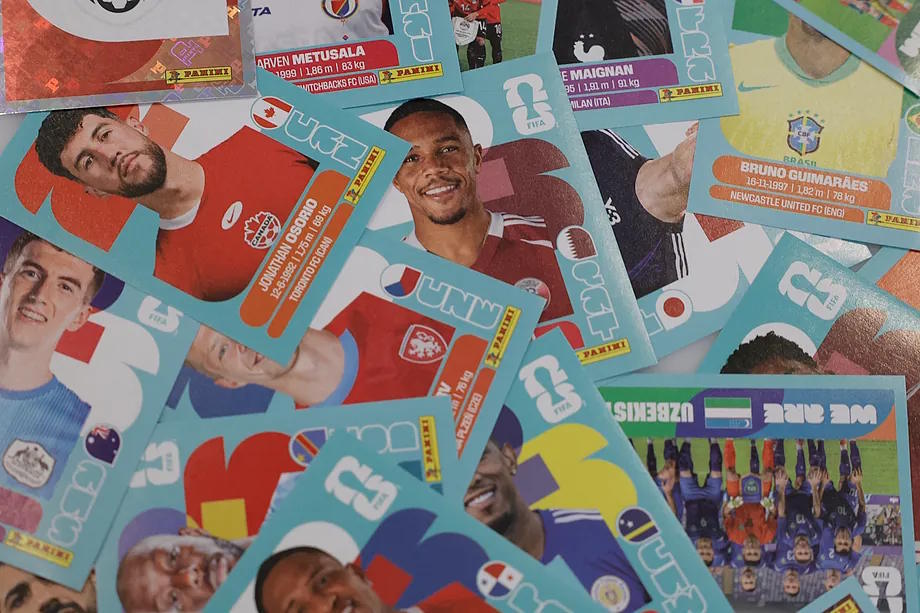
What started as a hobby and an act of veneration ended up becoming a cult object where the speculative market determines the value of investment in collecting. We are talking about the Panini World Cup sticker album, which originated in the final years of Mussolini's fascism.
When a housewife named Olga Cuoghi became a widow of Antonio Panini, a heating technician who died of cancer in 1941, she was left in charge of eight mouths to feed. She worked as a seamstress, but three years later, she decided to buy a newspaper kiosk on Corso Duomo, in front of the Archdiocese of Modena (Italy).
On January 6, 1945, the business took its first steps. If in the United States, cinema had become an escape, in Italy, it was football. Giuseppe, Benito, Franco, and Umberto, the four Panini brothers, saw in this sport their own Holy Grail. A decade later, they created the Fratelli Panini Newspaper Distribution Agency, led by Benito.
In mid-1961, they launched the first Panini sticker album, featuring two AC Milan players: the cover featured Swedish forward Niels Liedholm, and the first printed sticker was midfielder Bruno Bolchi. 15 million envelopes were sold, and this number doubled the following year. The famous silhouette of the stickers worldwide refers to the bicycle kick that Carlo Parola performed in 1950, for which the Panini brothers bought the rights to the photo.
At the end of the 1960s, Giuseppe and Benito bought batches of handmade football player stamps that the Nannina publishing house had been unable to sell. The following year, they created a good marketing strategy where they put two stickers in white envelopes with red borders, selling millions of them. The next step was to do the entire production.
The peak of their adventure came when in 1970 they signed an agreement with FIFA for the first World Cup album held in Mexico. The cover featured Pelé, consisted of 50 pages where the 271 stickers were glued with glue, and the most sought-after players were Pelé and Beckenbauer, among others. Four years later, they launched stickers.
In 2017, the complete original album signed by Pelé reached 12,000 euros in an auction on the Catawiki auction website. Currently, eBay sells another one without an autograph for just over 29,000 euros.
In the early seventies, the Panini brothers joined forces to run the company: Giuseppe was the manager, Franco was the administrator, Umberto was in charge of the machinery, and Benito of distribution. The most valuable assets, besides the stickers, were the trading cards, rigid cards with images and double-sided text that were not adhesive.
With the desire to find financial partners to take the company public, in 1986, the Panini brothers sold 25% to the company Sabaudia de Carlo De Benedetti and 10% to Mondadori. But after Benito's death and several disagreements, the rest of the Panini brothers decided to divest a majority stake in the company.
British media mogul Robert Maxwell, whose daughter Ghislaine is serving a sentence in the Epstein case, bought Panini in 1988 for 170 million dollars. Three years later, the veteran businessman died mysteriously in the Canary Islands.
From that moment on, Panini passed through different hands such as the Italian groups Bain Gallo Cuneo and De Agostini and the American Marvel, which, after its bankruptcy, got rid of the sticker division. In 1999, a significant part of the sticker empire was acquired by Fineldo S.p.A., the Italian financial company of the Merloni family, which appointed Aldo Augusto Sallustro as CEO.
The Merloni family withdrew from the company's share capital by selling their 26% stake to sisters Anna and Maria Teresa Baroni along with Sallustro, who passed away last year. Their heirs, without specifying who they are, remain in the background.
Today, Panini has 1,200 employees spread across 150 countries who have released in 2026 the largest collection in World Cup history with 980 sheets from 48 teams -previously 32- distributed over 112 pages, representing a 53% increase compared to Qatar 2022.
Although there are no official figures yet, numerous international media outlets claim that Panini has released 2 billion envelopes -each costing 1.5 euros and containing seven stickers-, estimating sales of 25 million albums worldwide, ranging from 5 euros (standard) to 15 euros (hardcover), and expecting to reach around 1.5 billion euros in global sales. According to mathematician Miguel Santos on the radio show A vivir que son dos días, completing the album costs an average of 1,500 euros.
Fans are willing to pay fortunes for some stickers. According to official sales through auctions and private sales, the most expensive to date is Messi's rookie card from the Panini Mega Cracks 2004-05 collection sold for 1.5 million dollars. It is followed by Ronaldo's 2018 Green Kaboom 1 of 1 with Juventus for 1.35 million and Pelé's 1958 Alifabolaget rookie card nº 635 for 1.33 million dollars.
On May 7, FIFA announced that Panini will lose the exclusive license for the World Cup from 2031 as the rights have been granted to the American company Fanatics.