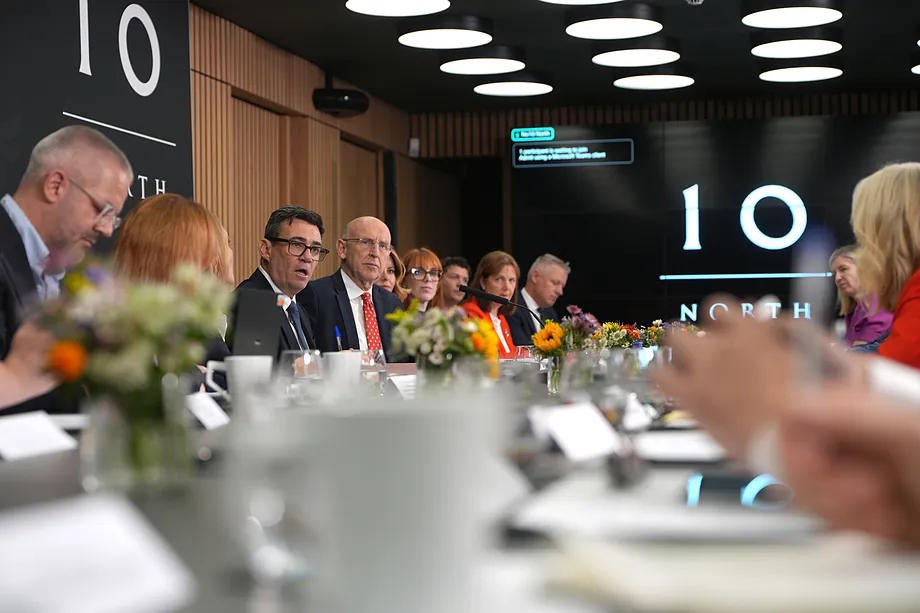
British Prime Minister, Andy Burnham, told his colleagues on Friday: "I think this could be the best day of my life". Neither his marriage, nor the birth of his three children, nor his elevation to the position of head of government four days earlier seemed to match the joy of his first day of teleworking as head of government at Heron House in Manchester, where he developed much of his political career. From now on, the building will be his office one day a week.
Burnham's decision to go to Manchester is a sign of interest in projecting an image close to the voter, but also that his interest lies in domestic politics, unlike his predecessor, Keir Starmer. The problem is that, in the Europe of 2026, no leader can afford that luxury. And even less so at Heron House, where the Prime Minister's offices share space with a unit of GCHQ (Government Communications Headquarters), the British electronic intelligence service. If the spies intercept any particularly serious communication from a world leader or an especially dangerous terrorist, theoretically, they will only have to take the elevator to inform the Prime Minister... if he wants to see them, of course.
Burnham's indifference to foreign policy has been evident in his appointments. He has chosen a Foreign Secretary (Ed Miliband) more interested than him in renewable energies and multilateralism; a Defence Secretary (Wes Streeting) who disagrees with his European policy; and a Chancellor of the Exchequer (John Healey) who wants to spend much more on Defence than the Prime Minister. The first two lack experience in their roles and, as far as is known, interest in them. In return, they have plenty of ambition.
However, Burnham has moved quickly. The new Government has spent its first weekend demonstrating continuity with Starmer regarding commitment to NATO, closeness to the United States under Donald Trump, using rearmament as an opportunity to reindustrialize the country, and unwavering support for Ukraine. The latter, despite waning public support for Kiev.
Support for Ukraine was evident at the summit on Monday. The day before, Streeting had stated that, "when history is written, Europe will thank President Donald Trump for forcing us out of our complacency and making us stand up." According to The Times, London wants to invite US Secretary of War, Pete Hegseth, who seems to have strong support from Trump, to visit the country and participate in a future NATO security summit in London, an objective set by the British Government.
These measures reveal the continuity between Starmer and Burnham and also the initiative of Streeting, a centrist who aspires to be Prime Minister one day but has only held the position of Health Secretary and has never shown interest in Defence. Streeting is the only frontline politician who has openly called for the UK's re-entry into the EU, giving him a strong negotiating card in collaborating on Defence projects with Brussels. He has said that if Defence spending does not reach 3%, he will resign. That is why John Healey left Starmer's Government in June. However, there is a crucial difference: Healey left because the 3% target would not be reached by 2030. Streeting has not set a deadline for his goal, which in practice dilutes the strength of his commitment.
Healey also wields significant power in Defence. Not only because he was a highly respected head in that Ministry, but also because he now controls the money tap in his new key position as Chancellor of the Exchequer. Judging by the comments last week at the Farnborough Airshow - the world's second-largest aerospace fair - on the outskirts of London, Healey is willing to increase military spending. This includes the GCAP, the expensive Anglo-Italian-Japanese fighter-bomber project that is currently the leader in the European aerospace industry following the virtual collapse of the Franco-German-Spanish FCAS.
The third pillar is Foreign Secretary, Ed Miliband, who did not want that role but ended up with it due to Healey taking his preferred position. With him, British diplomats once again face a situation they have experienced several times in recent years: a Foreign Secretary not enthusiastic about foreign policy.
Miliband is a staunch advocate of decarbonisation, which in his previous role as Energy Secretary until last week, made him the number one enemy of British oil and gas companies for his refusal to expand drilling in the North Sea. However, the conflicts in Ukraine and Iran may give him a second chance. With the Russian oil industry seriously damaged and the Straits of Hormuz and Bab el Mandeb (the latter in the Red Sea) periodically opened and closed by the United States, Iran, and its allies in Yemen, he has an opportunity to turn his climate policy into a security policy, as reducing dependence on fossil fuels currently has a stronger defense argument geopolitically than environmentally.
This also opens a door for collaboration between the UK and the EU, which is at a standstill at the moment, partly due to Brussels' decision to cancel the annual bilateral summit scheduled for July 22 due to the change in Government.