Hicham El-Ghayati, 17 years old; Abdullah Al-Hafi, 17 years old; Salam Makoh, 22 years old; Mohamed Afasi, 9 years old; Nada Al-Shiba, 14 years old; Marwa Aheithour, 16 years old; Ismail, 16 years old; Omar, 24 years old...
In recent days, social media is filled with the names of women, men, and children whom their families in Morocco have not been able to locate since Thursday. They suspect they were part of the over 60,000 migrants who participated in the largest assault on the border of the autonomous city in its history, and none of them are among the majority who have been returning after retracing their steps to Tarajal.
The switchboards of the city's funeral services are overwhelmed with calls from Morocco sharing a common denominator: the search for information about relatives missing since last Thursday. "The calls don't stop," say the sources consulted.
Dozens of Moroccan families are spreading messages on various platforms with photos of their missing relatives, all with a call for help and a plea for information, a sign that they are alive, and a phone number on the other end where they hold their breath.
Among the missing whose families have issued an SOS, the majority are men, especially young men with an average age around 20, but there are also minors whose whereabouts are unknown. Like Mariam, who at just 15 years old, according to her family, may have jumped into the water last Thursday, perhaps with one of the floaters that later flooded the shore, in that human tide that inundated Tarajal beach.
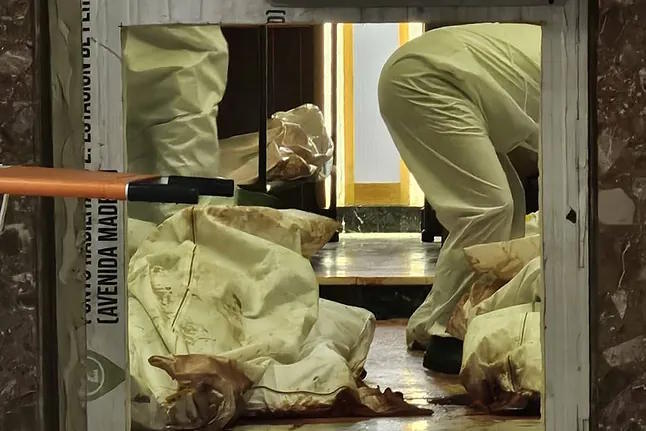
The messages on social media - many of which have been compiled by the local newspaper El Faro de Ceuta - exude desperation from families who have not seen their loved ones for days, tirelessly calling inactive or out-of-coverage phones, fearing the worst news: that those they seek are not on the streets of Ceuta - where several thousand still remain - but in the facilities of the former Military Hospital, where the bodies are already piling up, as seen in the exclusive image from EL MUNDO accompanying this information.
The vast hospital complex, not far from the border with Morocco, is currently the epicenter of the greatest humanitarian tragedy Ceuta has ever faced and one of the most serious recorded in Spain in relation to the migratory phenomenon. Part of its facilities has been transformed into a macro morgue.
Specialists from the Civil Guard working on the identification of the deceased victims of the Ceuta migrant avalanche.CIVIL GUARD
Out of the 60,000 people (some sources mention 80,000 or more) who stormed the border between Thursday and Friday, around a hundred have lost their lives, although official figures vary depending on the source.
The Government Delegation in Ceuta confirmed to EL MUNDO yesterday that the number of deaths counted by the central government remains at 72, specifying that these are the ones recovered "in Spanish waters". However, the Ceuta government's figure rises to over 90.
The difference, according to sources from the autonomous city, is that the central government only counts the bodies recovered since Thursday, when the major influx occurred, while the government of Juan Jesús Vivas counts them from Monday, when they alerted to the increasing irregular entries of migrants swimming through the Tarajal breakwater, a preview of what was to come.
In addition to these deaths, another eleven have been acknowledged by Moroccan authorities, bringing the total figure to over a hundred, and no one, not even the central government, rules out the possibility that more bodies washed ashore in the coming days on the beaches of Ceuta.
All the bodies located and rescued in Spanish waters are concentrated in the hastily improvised macro morgue at the Military Hospital, where several cold storage rooms with panels and compressors have been installed within 24 hours to accommodate and preserve the bodies until they can all be examined by forensic experts and, ideally, identified and returned to their families or, if not, buried in the Muslim cemetery of Ceuta, where urgent expansion works have already begun on Monday.
A team of six forensic experts - two from the Legal Medicine Institute of Ceuta and four reinforcements from the Iberian Peninsula - are working tirelessly to perform autopsies, with over a dozen already completed. According to sources from the operation, it is expected to take two to three days to complete all of them.
Simultaneously, the Criminalistics Service of the Civil Guard is working to identify as many deceased victims as possible, using a novel system, Identisat GC, which allows fingerprint data to be sent instantly and via satellite without the need for a mobile phone, speeding up the process of consulting databases, especially in Morocco, where most of the migrants involved in the influx and the deceased came from.
As reported by the Civil Guard, identification is generally possible with just the fingerprint, but forensic protocols also require genetic confirmation through DNA testing.
For this, the collaboration of families is essential to provide genetic samples that can be compared with those of the bodies stored in the morgue of the Military Hospital, the same families who have been praying for days for the phone to ring and on the other end, their son, nephew, or brother to be safe and sound.
Meanwhile, they seek help, launch a digital SOS, and, as emphasized by El-Tayyeb Al-Mardy's family, "may Allah reward them for their help."