Filled with tattoos, with the stature of an old Saxon warrior and a bushy beard, John Gwynne (Singapore, 1968) has no trouble blending in among the thousands of readers crowding the Celsius Festival in Avilés at its 15th edition. At least until someone recognizes him as the author of some of the most influential sagas in contemporary fantasy, a name that for years has inevitably been associated with those of Joe Abercrombie, Robin Hobb, or Brandon Sanderson when their nearly two million readers discuss who has taken up Tolkien's legacy. However, seated at a table, he speaks calmly, smiles often, carefully chooses his words, and his blue eyes have a serene expression that contrasts with the warriors, axes, giants, dragons, and battles that fill his novels.
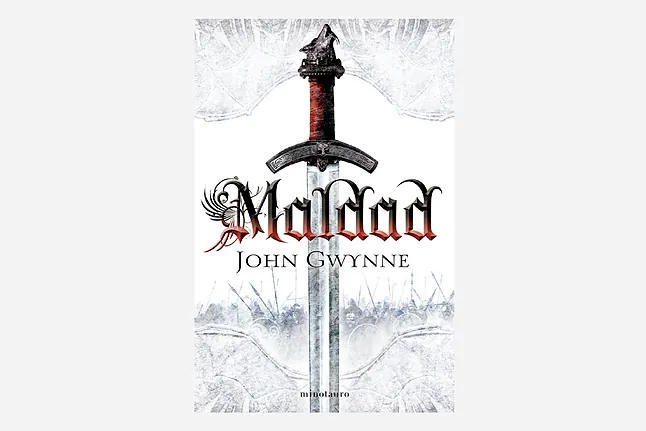
Also with Malice (Minotauro), the book with which, after the success of his trilogy Blood and Bone, inspired by Norse mythology, he begins to be published in Spain The Faithful and the Fallen, the tetralogy that has made him one of the essential authors of the fantasy genre.
The story begins in the Lands of Exile, a territory where the echoes of an ancient war between celestial and demonic beings - inspired by John Milton's Paradise Lost - continue to resonate beneath an apparent peace. There, a boy named Corban begins to discover that the old prophecies may not be as clear as everyone believes and that the fate of the kingdoms depends less on the chosen ones than on those who make seemingly insignificant decisions. But just like with his admired Tolkien, it only takes a few pages to realize that, behind that monumental architecture, Gwynne is talking about something else.
"My main goal is always to entertain, I try to recapture that feeling I had as a reader when a book could completely absorb me and make the world disappear for a few hours," Gwynne says, "but I also try to write stories and characters with emotional depth so that those who read them take away more than just entertainment. I always come back to the same themes. Family is the most important thing for me, that's why all my books talk about family, love, friendship, loss, mourning, and also hope."
For over 20 years, Gwynne was a professor at the University of Brighton. He was already in his 40s, had four children, and had no intention of becoming a novelist when he started writing at night. Malice, he says, was never meant to be published. "I was writing it as a hobby and thought of giving it to my children as a gift. I liked the idea of leaving them something they could read someday when I was no longer around. In essence, it was a way to pass on some things that I found important about how to live."
That origin illuminates much of the novel because even though the pages are populated with fortresses, armies, and creatures born from ancient legends, the real battle always takes place elsewhere. Gwynne does not seem particularly interested in the great predestined heroes, but in the effect that an almost imperceptible decision can have on the lives of others. "One of the main themes throughout the saga is that even the smallest decisions have a huge impact. Sometimes we feel we have no influence on the world, but small decisions are like a stone falling into a pond and creating ripples that extend much further than we imagine," he argues.
Perhaps that is why Malice ends up being a novel much more concerned with goodness than with the evil announced in its title. Its characters survive because someone decides to remain faithful, because someone protects a child, because someone keeps a promise when no one could blame them for breaking it. "That was exactly what I wanted to convey. You can build immense scenarios and an epic story, but in the end, it's the small everyday decisions that change things," he insists. "I remember watching Gladiator, hearing 'strength and honor' and thinking that I also wanted a phrase that summed up what I was trying to convey to my children," he recalls. Thus was born 'Truth and Courage', a motto that eventually becomes the war cry of the protagonists. "For me, it means something very simple, that truth matters because lies are like poison and courage does not necessarily mean being stronger than others, often it just means having the courage to defend what one believes is right."
There is a scene that repeats itself over and over in his novels: someone wields a weapon, someone falls, the battle ends... but what truly matters begins afterwards. The dead weigh heavy, the survivors carry them, and no victory comes without a cost. Violence never appears without consequences. "I have always been fascinated by the great historical epics. As a child, my father would sit me down with him to watch Spartacus, Ben-Hur, and movies like that, but growing up also means understanding that war and violence are terrible, even though they are part of the human condition," he reflects. "That's why I try to write them in a way that feels real, not glorious. I remember the impact that Braveheart had on me because it was one of the first movies to show combat without embellishment. Then came Saving Private Ryan and that opening sequence almost became a reference point. I write many battles, but I never want to glorify combat."
His appearance invites imagining a different kind of response. As we mentioned, Gwynne is a burly man, with huge hands, exactly the type of figure one would expect to find among the warriors of his novels carrying an axe on his back. However, when he speaks of them, it is almost always to refer to care, responsibility, or equality. "It is a very important theme for me, and I try to show it more than explain it. I try to avoid that traditional and toxic masculinity where the man is always the hero and the woman exists to be rescued. We are all human, and life is much more complex than that. Strength has little value if not accompanied by responsibility," he asserts firmly. "True epic is doing good in the small everyday details."
"I avoid that traditional and toxic masculinity where the man is always the hero and the woman exists to be rescued"
Gwynne experienced another event that further shaped his understanding of heroism. In 2021, his daughter Harriet, who had a severe disability, passed away, and her life had forever changed that of the entire family. The writer does not seek to extract an uplifting lesson from that tragedy, but it is impossible not to perceive its imprint in books where care weighs as much as combat, and loss never appears as a mere narrative device. "Losing your parents is terrible, but you know that it will happen someday. No one, however, can prepare for losing a child. I was on the verge of quitting writing when Harriet died. It was a very difficult time."
He did not. On the contrary, that absence eventually found a place in his literature. His new series, to be published in the Anglo-Saxon market in November, includes a disabled girl directly inspired by her and a family trying to protect her amidst chaos. "Now I understand grief much better, and that inevitably influences how I write about it. But I didn't want to write a sad book, I still believe that, as long as we are here, we must live fully and make the most of each day. No matter how great, pain does not cancel the possibility of continuing to find beauty in the world."
Precisely that optimism, those ideals of kindness and beauty are some of the things in which Gwynne most resembles the master Tolkien. For years, fantasy seemed determined to prove that it had reached maturity by moving away from him. The anti-heroes arrived, the cynicism, the bitter endings, and an increasingly brutal violence. Gwynne deeply admires that evolution - "Joe Abercrombie seems to me an extraordinary writer and George R. R. Martin changed the genre forever" - but does not believe that moral complexity requires giving up hope. "Grimdark has been a trend that has greatly enriched fantasy, as it showed characters full of contradictions and moved away from that simplistic view of good and evil, but hope is also part of the human condition. We are imperfect, we constantly make mistakes, and yet we are still capable of doing good. I think now, in these times of uncertainty, many readers are looking for precisely that, hope."
Perhaps therein lies one of the reasons for his great success. In a time dominated by fear, polarization, and a technology that seems to question everything, millions of readers find refuge in stories of forests, oaths, swords, and old gods. Gwynne smiles when asked if artificial intelligence will ever be able to replace that storytelling impulse. "It's a bit scary, of course, but it's also a very useful tool. What I don't believe is that it can replace something that has been part of us for thousands of years. We used to gather around the fire and someone would start telling a story. Homer did exactly that. All cultures have used stories to understand the world, to transmit experiences, and to teach the younger ones. I believe that need will never disappear."
Perhaps that's why he's not too concerned about his readers extracting a certain ethics from his novels. He never intended to write conduct manuals, he insists, but he also doesn't hide what convictions underlie his fiction. "I always come back to the same two words: truth and courage. If my books manage to convey, even a little, the importance of telling the truth, of having the courage to do what is right, and of treating those around us with decency, I will feel that all this has been worthwhile." It doesn't seem like a bad definition for a work that talks about dragons, gods, and giants, but that,