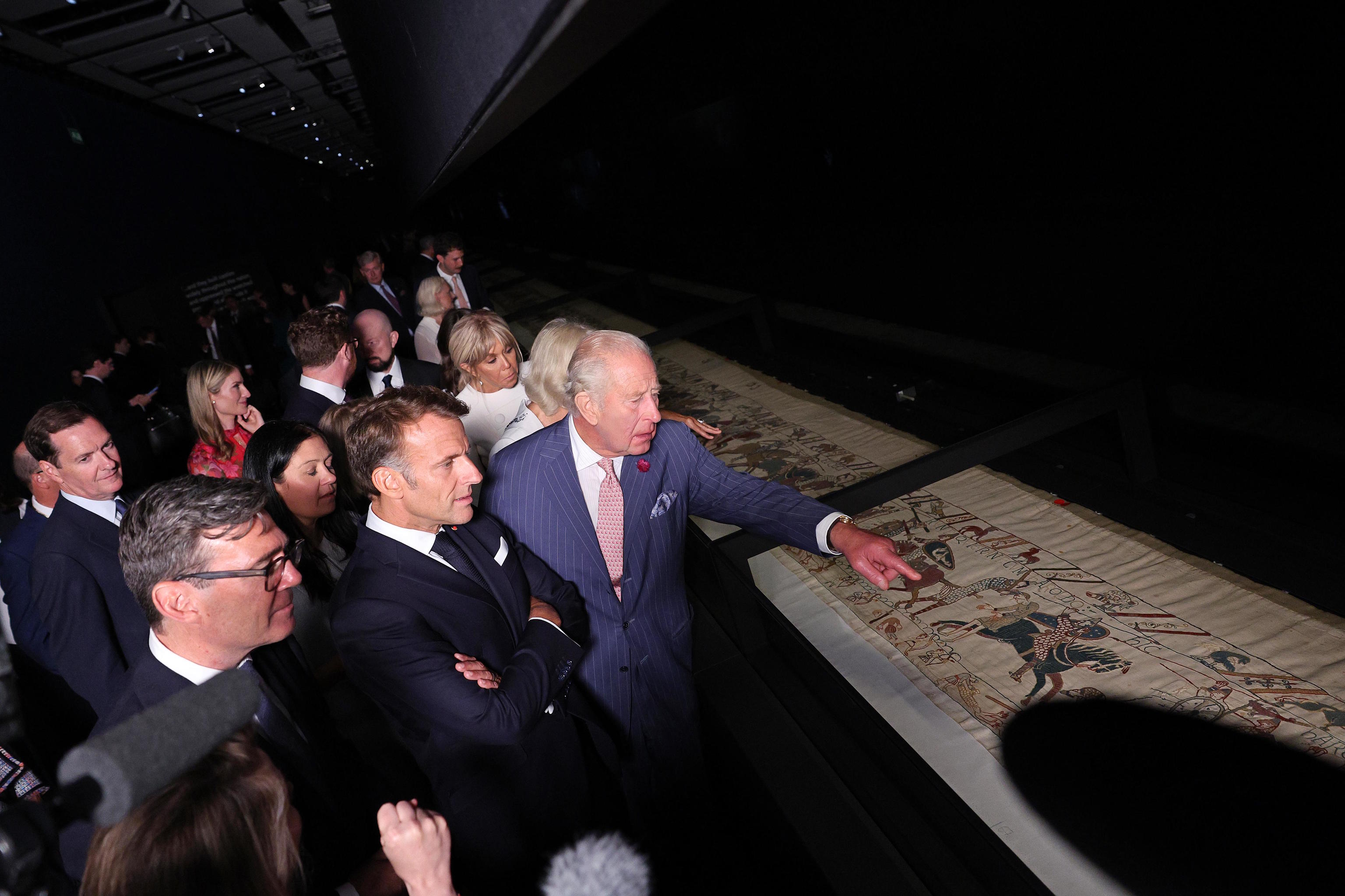
The UK head of state presided over the opening of the presentation of this fragile and historic masterpiece at the British Museum on Wednesday night, where he glimpsed the intimate connection with his ancestors among the wool threads spun by widows, daughters, and other victims of the French conquest.
The British sovereign was accompanied at the grand presentation event by the President of France, Emmanuel Macron, as well as their respective wives, Queen Camilla and Brigitte Macron. During the solemn ceremony, the British monarch, who directly descends from the first Norman king, William the Conqueror, highlighted the importance of the loom. In his opening speech, the monarch stated: "It tells the story of the origins of what I like to consider as the French branch of my family's history in these islands."
For Carlos III, the arrival of this artwork in London should serve to mark the restart of the "entente amicale" (friendly agreement) between France and the United Kingdom. Meanwhile, French President Emmanuel Macron emphasized the profound symbolism of the event, pointing out that it represents an undeniable rapprochement, not only between the capitals of Paris and London but more broadly between the UK and the European Union as a whole.
The temporary arrival of the tapestry on British soil has not been a straightforward process. As humorously recalled by the former Conservative minister and current chairman of the museum's board, George Osborne, the exceptional loan of this masterpiece usually housed in the Bayeux Museum —located near the French coast of the English Channel— is the direct result of the negotiating efforts of up to three consecutive UK Prime Ministers: Theresa May (2016-2019), Keir Starmer (2024-2026), and the current Prime Minister Andy Burnham, who has been in office since last July and attended the event with his wife, Marie-France van Heel.
The high anticipation generated by the exhibition has led to tickets, priced between around 30 and 40 euros, selling out within minutes each time the British Museum releases a new batch of passes.
Various cultural analysts have compared the stark representation of violence and destruction symbolically depicted in the Bayeux Tapestry with Pablo Picasso's iconic painting Guernica. However, the impact of this exhibition goes beyond the purely artistic realm. Internal sources at the British Museum suggest that the feasibility of the temporary return of the Bayeux jewel to England could serve as a guide and precedent for the complex negotiations of a loan agreement with Greece regarding the controversial Parthenon Marbles.
In a time of international tensions, King Carlos III joked about the historical nature of the piece: "The Bayeux Tapestry, or the Canterbury Embroidery, as it could well have been called, tells a conflict." Nevertheless, the sovereign concluded his speech by highlighting the reconciliatory value of art in our times: "Yet here it remains today, almost a thousand years later, as a cherished symbol of trust, at a time when, unfortunately, trust seems to be scarce among nations."