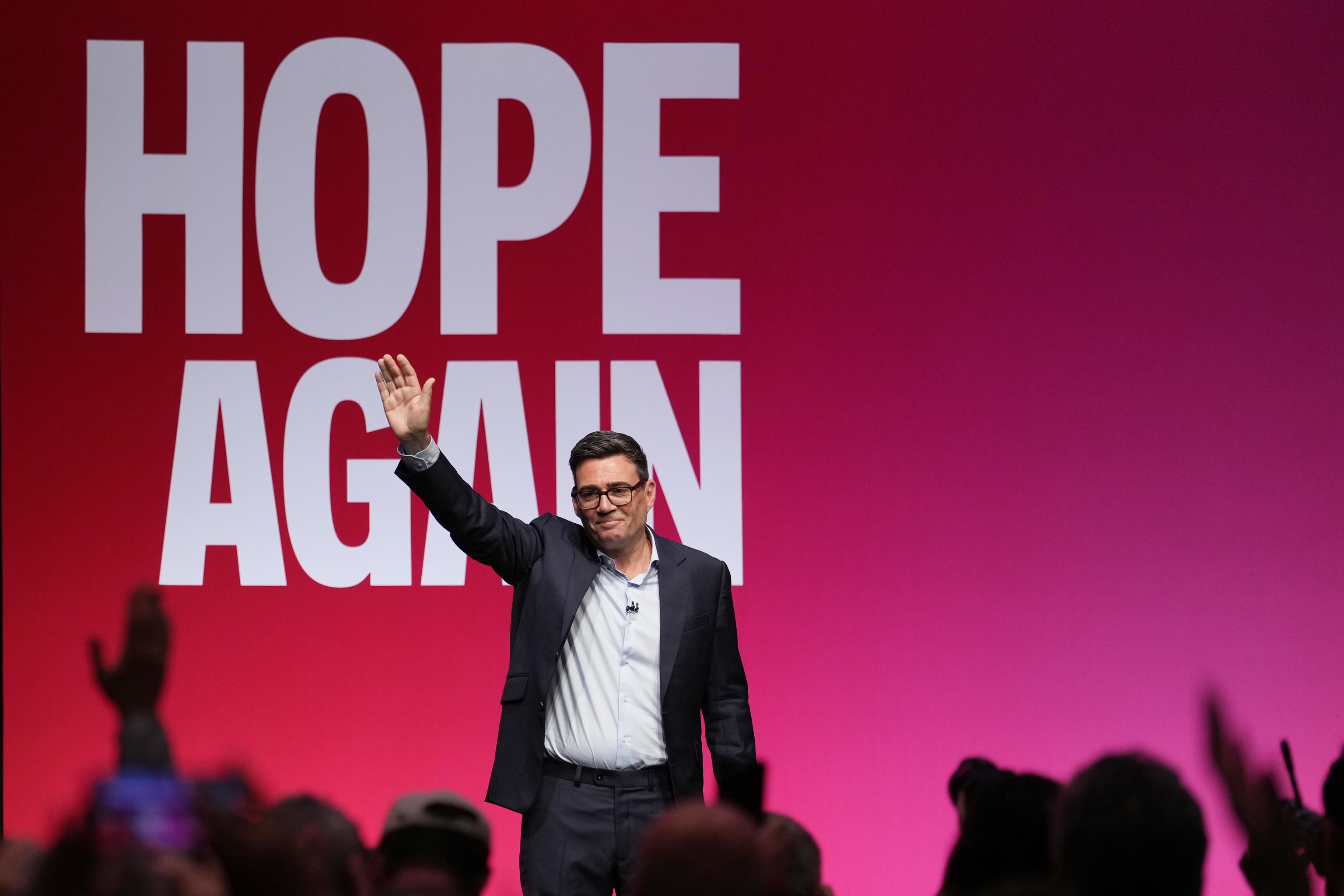
British Prime Minister Andy Burnham launched a risky bet at the Labour Party Annual Conference: an approach to the EU, an expansion of the Welfare State for retirees and people with disabilities, and a moderation of pension increases.
It is a politically complicated mix that the Conference attendees bought into. It also helped that the riskier parts of the project, which are the cut in pension increases and the expansion of care for the elderly and disabled, are scheduled for 2030 or later, meaning that for them to be implemented, voters will first have to re-elect him. The only thing that will happen now - specifically in November - is the presentation of options to strengthen the relationship between the UK and the EU.
Burnham's plan could be summarised as "promises for after re-election". The key is how much can be achieved in the first three years, and how the debt markets that finance the UK will react to those numbers. But as there are no clear numbers for now, the debt has not moved. The message was particularly clear for pensioners: lower pension increases but, in return, a national personalized care system that will be funded with reduced pension spending.
Thus, Burnham conveys that he is a politician with ideas and initiative, something that was previously the domain of the ultranationalist and Brexit ideologue, Nigel Farage, whose party, Reform, is in second place in the polls, behind Labour. It is the establishment copying populism. And it is working in the UK, where the Prime Minister has revived his party's electoral prospects in two and a half months at Downing Street.
In his speech - long and emotional - the Prime Minister demonstrated that he knows how to keep an audience engaged, which, however, was already favourable to him from the outset. He focused on domestic policy and the economy, as is usual for him. In foreign policy, he proposed a "long-term relationship" with "our European partners" that will "change" the current situation and stabilize it. This implies a closer bond with the EU. The details are, in principle, reserved for Burnham's summit with the President of the European Commission, Ursula von der Leyen, in November.
What remains for his re-election is the promise to change the British electoral system, which is majoritarian to such an extent that a party can win 33.7% of the votes in an election and secure 63.2% of the seats in the House of Commons. This is not a theoretical exercise: these are the results of the 2024 elections, which brought Burnham to power. For reference, the Spanish Socialist Party (PSOE) obtained 34.6% of the seats in the Congress with 31.7% of the vote in 2023.
The same goes for the National Care Service, which could be translated as National Care or Service. This is something Burnham has talked about on other occasions: the creation of a state structure to provide care for the elderly, disabled, or occupationally disabled. The UK already has such systems, but they are scattered across different administrative units of the State.
So, the question again is how they will be unified and expanded. The cost of a public care system could range from £6.5 billion to £18 billion annually, although Burnham has rejected the latter figure. The UK's public deficit was £129 billion in the last fiscal year.
With a public debt of 94% of GDP, London cannot afford that. And here came the decisive element of Burnham's speech: a lower increase in pensions. However, starting from 2030. Considering that the next general elections must be held no later than August 15, 2029, the promise hinges on Burnham's re-election. Again, the Prime Minister did not delve into details. In the initial years, the savings will be minimal, but they will grow to £17.5 billion by 2040.