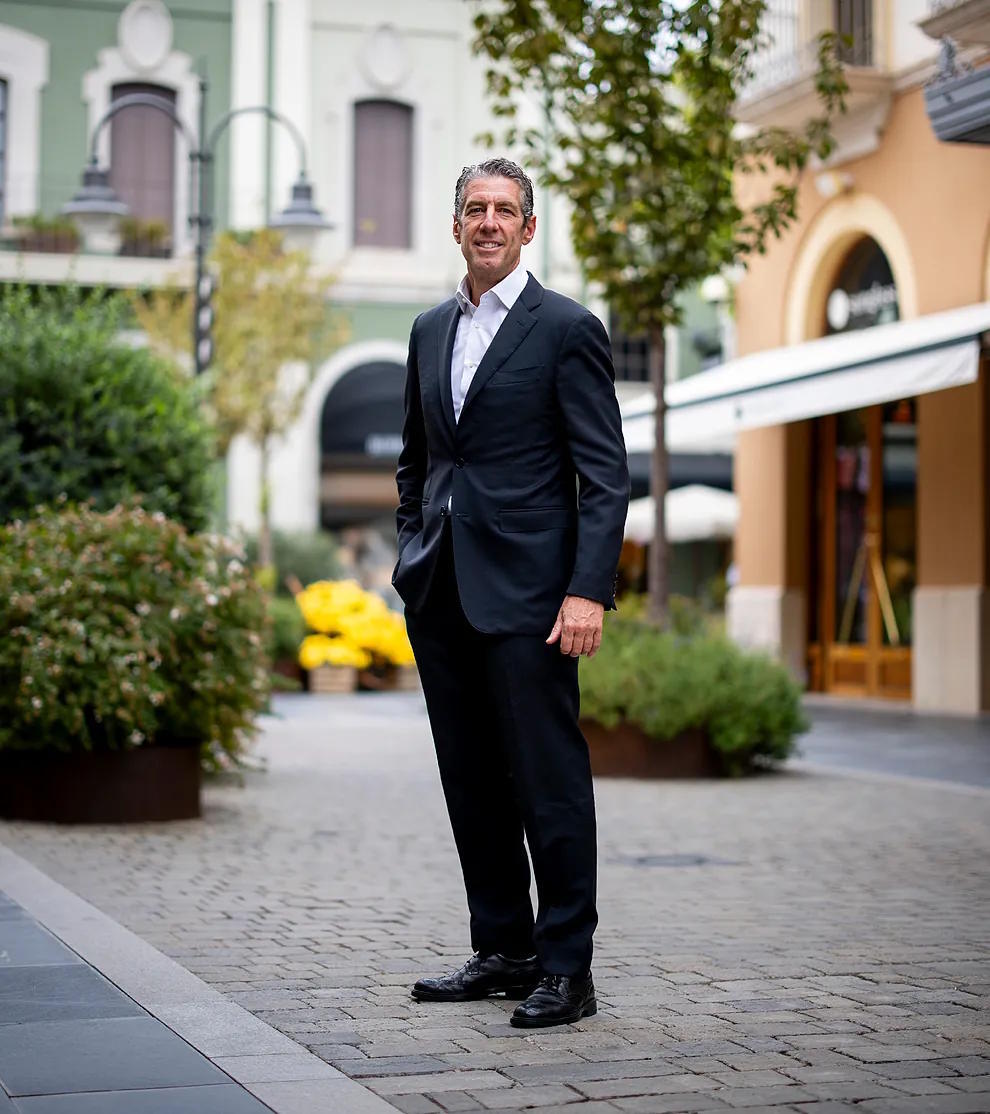
When Value Retail bought the land of Las Rozas Village in the late 90s, the municipalities in the northwest of Madrid had not yet experienced the real estate boom that would transform them in the following decades. Today, they are among the wealthiest in Spain, and that project has become one of the major shopping tourism hubs in the capital. The British company, specialized in the development and management of luxury outdoor shopping destinations, gathers its 12 centers in Europe, China, and North America under the brand The Bicester Collection. In Spain, it manages Las Rozas Village and La Roca Village in Barcelona, where top brands sell with discounts of up to 60%.
Michael Goldenberg, a New Yorker based in Barcelona and CEO of the group, witnessed it from the beginning. He arrived in 1996 when the company was taking its first steps in continental Europe and founded its operations in Spain. Now, 30 years later, Las Rozas Village is gearing up for the largest investment in its 26-year history.
The project, named Phase IV, will mobilize 106 million euros. It will add around 4,000 square meters of commercial space, 33% more than at present, and 29 luxury boutiques, bringing the Village to a total of 133 commercial units. The construction will start in October and will continue until November 2029. Along the way, the expansion will generate around 350 jobs, bringing the total number of professionals working in the center to around 1,750. But it's not all about shops. The Apartment, the private retreat for the most loyal customers, will expand, and eight personal shopping suites will be added, along with a service for shopping without carrying bags and a new restaurant. Underground, over 1,000 parking spaces will be added. The first boutiques will open their doors in September 2028.
"We had been looking for the space to expand for a long time, and now the opportunity has arrived," explains Goldenberg. Las Rozas Village is currently 40% smaller than its counterparts in Paris and Barcelona, although it already surpasses them in productivity. "With this expansion, it will have a size in line with its position," he summarizes.
Behind this leap is also the transformation of the capital. "Madrid is already a global attraction. It has culture, art, gastronomy, and content like a major city such as London or Paris," Goldenberg argues. It is no longer a European destination where some Americans were attracted by art; it is now a city in the premier league of global tourism. The group precisely seeks such locations. "We don't have 30 projects in each country. We aim for the top of the pyramid, the best customers, and the best locations," he explains.
The national customer, Goldenberg assures, remains the foundation and has not declined, thanks to the good moment of the Spanish economy. The Village particularly notices it on holidays and long weekends when visitors from other cities take the opportunity to visit Madrid. Where he sees the significant change is in international tourists. As he explains, Latin Americans are now the main nationality, both those living in Madrid, which he describes as a hub for foreign residents, and those visiting. He mentions that the weight that Chinese customers had has shifted towards Mexico and the USA. "We have compensated for the loss of China with other countries," he details.
The conflict in the Middle East, he acknowledges, has indeed affected this year. It not only slowed down visitors from the region but also many travelers from India and other Asian countries who arrive in Europe with a stopover in the hub of Qatar, two markets in which the group had very high expectations. Nevertheless, Goldenberg is starting to notice the recovery of customers from Gulf countries.
Regardless of their origin, international tourists are not only looking for major global brands. "Tourists want authentic local products, brands they can't find in their own country," explains Goldenberg, sitting in Joselito, the space that the Iberian ham brand has within the Village, which epitomizes the appeal of Spanish products. National brands are, in fact, one of the main differentiators of Las Rozas within The Bicester Collection.
To retain such a diverse clientele, the offerings are constantly refreshed. Contracts with brands are annual, which is uncommon in the sector, and each year, between 20% and 25% of the space is new. To attract the Generation Z, "less loyal to brands and more guided by trends," the Village incorporates trendy brands with temporary stores for six months. "Some work well, and others don't," he admits.
The conversation shifts to luxury, a sector undergoing significant transformation. After years of steep price increases that excluded many customers, brands are reevaluating their positioning and focusing on the experience. "You can buy almost everything online, but in your free time, you want an experiential purchase," he states. "We are an extension of that."
He argues that the pandemic accelerated this shift. After months at home, people returned to stores seeking personal interaction, and brands responded with fewer stores but much more curated experiences. In this new landscape, Villages play a key role. According to McKinsey studies cited by Goldenberg, they are one of the main entry points for new customers into the luxury market.
Many discover a major brand here at a more affordable price and continue to purchase it when they return to their country. That's why he is not concerned that the concentration of brands will diminish the appeal. "If we had ten projects in Spain, I would be more worried," he acknowledges.
Less is more for Value Retail as well. London paved the way, followed by Barcelona, Paris, and Madrid, the first four of the 12 Villages the group has built in three decades. Goldenberg describes it as a discreet and long-term investor, more of a partner to the brands than just a landlord, which saw double-digit growth until the pandemic.