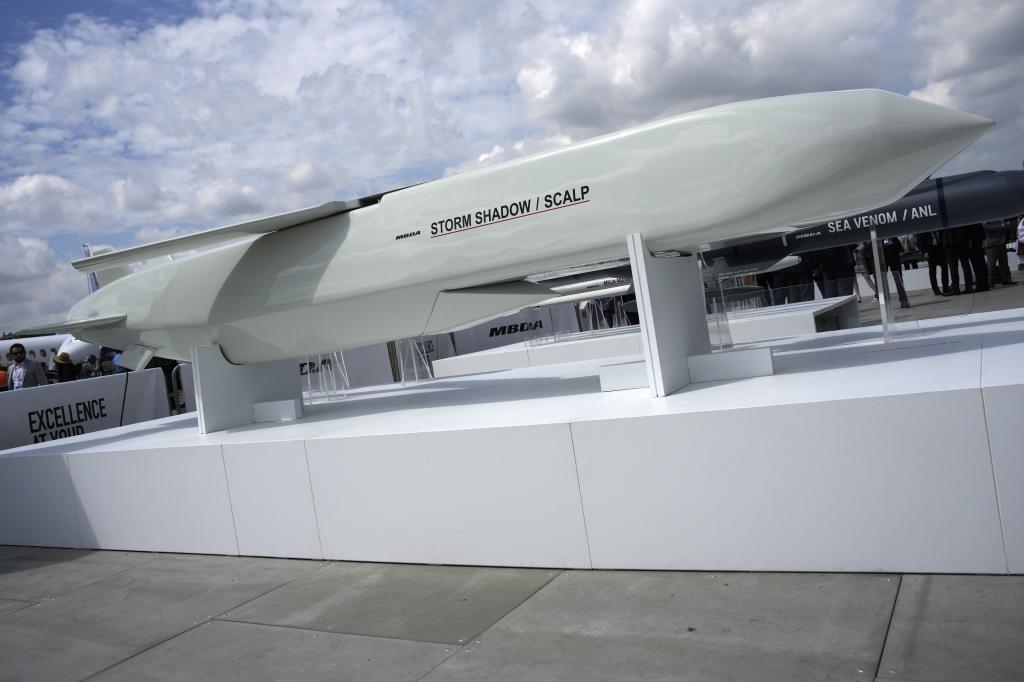
The city of Stevenage, 20 kilometers north of Greater London, seems to have no more connection to geopolitics than having pretended to be Washington in the movie Spy Game, directed by Tony Scott, starring Robert Redford and Brad Pitt, which was filmed there 25 years ago. That, and having Ken Follett as a neighbor, the author of intrigue bestsellers who started his career in espionage genre with titles like Triple, Eye of the Needle, and The Key to Rebecca.
However, Stevenage is also a key city in the war in Ukraine. The city's largest employer is MBDA, the Franco-British-Italian missile company whose products include the Storm Shadow (in the UK) and SCALP-EG (in France), which played a crucial role in Ukraine's defense in 2023 and 2024. Although the figures are secret, it is estimated that the UK has delivered several hundred units to Kiev, while France has officially transferred around 140.
On Thursday, British Prime Minister Andy Burnham - the same who called Russia an "enemy" on Sunday - decided to deliver more Storm Shadow missiles to Ukraine after meeting with the country's president, Volodymyr Zelensky, in London. The news, reported by Bloomberg news agency, has not been denied and seems to be part of the UK's strategy, as well as the EU's, to increase military aid to Ukraine due to the progressive alignment of the United States with Russia in the war.
Initially, Burnham's plan makes sense. The Storm Shadow missiles are Franco-British, not American, thus increasing Ukrainian strategic and tactical autonomy. However, the reality is more complex, highlighting the weakness of European defense in relation to the US. The key is that the missile has key components, such as the map of Russia used for guidance, which is American, giving Washington veto power over the use of that weapon on the battlefield.
This is how the Joe Biden administration prohibited Ukraine and the UK from using that weapon against Russian territory, although all restrictions were later lifted. However, with Trump's arrival at the White House, things changed. Since August 2025, the Pentagon has the right to veto missile launches against Russian territory.
This casts doubt on the operability of the new missile shipments to Ukraine, especially because the Storm Shadow, with a range of 250 kilometers and a warhead with 110 kilograms of explosives, could be very useful for Kiev to continue bombing Russian refineries. However, it seems unlikely that Trump would approve such missions, given his belief that these bombings are causing the rise in diesel and heating oil prices in the US, despite data from, for example, commodity trading giant Vitol showing that the Iran war - launched by the US and Israel - has removed almost as much fuel oil from the global market as Ukrainian bombings on Russia.
The dispatch of British Storm Shadow missiles is a bridge to Ukraine manufacturing the French version of these missiles, the SCALP-EG, which has been authorized by Paris and London. However, like many other aid programs to Kiev, this process will be lengthy. It is likely to be several years before Ukraine achieves a sufficient missile production capacity for its military needs. One of the major problems of Ukrainian defense, especially regarding missiles, is its lack of industrial capacity to produce them in the necessary quantity.
Furthermore, this does not eliminate US control over the missiles. Therefore, London has a third leg in its strategy: three weapon systems that have not been disclosed - but seem to be missiles - that have been in development since the summer and would not require any Washington authorization to be fully operational.
The three systems were agreed upon by Zelensky and Keir Starmer, Burnham's predecessor, who has continued the program. The only information known about them is that they are already being tested in both the UK and Ukraine, where London maintains a small military contingent, one of whose members died in a Russian bombing in 2025. They are projectiles with a range of 500 kilometers, double that of the Storm Shadow, but less precise. Their great advantage is that they are much cheaper and easier to build.
However, these solutions are only temporary fixes, following the most effective guidelines for helping Ukraine: collaboration with Kiev, technology transfer, and authorization for Ukraine to decide what it wants, how it can produce it itself, and in what situations it will use it.
The same applies at the European level. The decision by Elon Musk to restrict access of Ukrainian frontline units and drone and missile launchers to his Starshield satellite communication network has no solution. The EU is considering opening its GOVSATOM satellite network to Ukraine - formed by, among others, Germany, France, Italy, and Spain - which could also be reinforced by other satellite constellations, such as Eutelsat OneWeb and SES. However, this would not happen before 2027, and by then, it could be too late for Ukraine. In addition, the response time of GOVSATOM is slower than that of Starshield, and its satellite network consists of 600, compared to Starlink's almost 7,000 satellites used by Starshield. The UK and the EU are trying to escalate aid to Ukraine. But it is not clear whether they have in their arsenals a replacement for what Elon Musk and Donald Trump are taking away from that country.