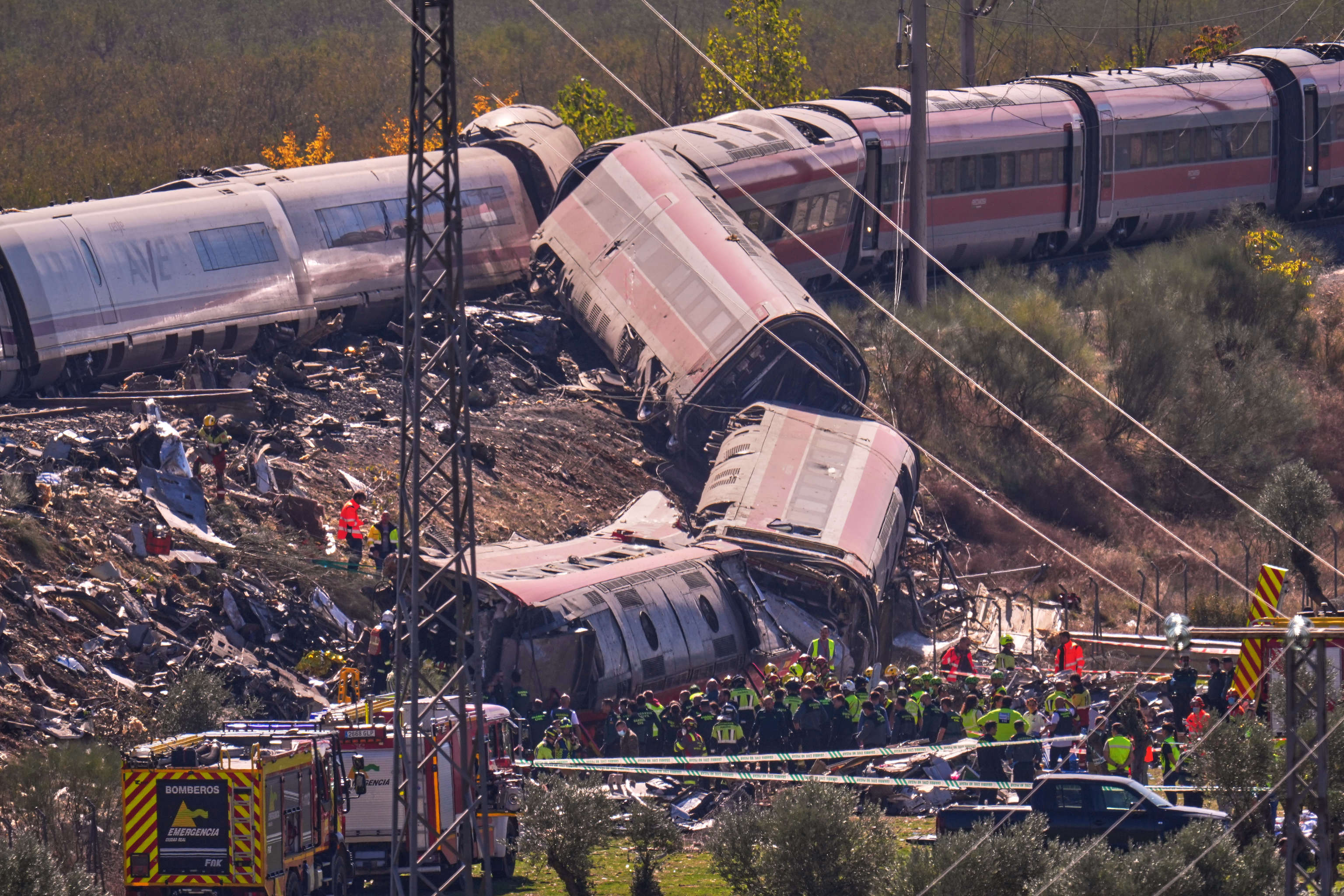
Barely nine months after the Adamuz tragedy, which left 46 dead and opened an unprecedented crisis of confidence regarding the state of the railway network, Spain woke up again this Wednesday to the news of a catastrophe on the tracks. This time, in the province of Toledo, where a Renfe AVE train collided from behind with an Iryo train that was stopped near Urda, on the high-speed line connecting Madrid and Andalusia. The accident left at least 68 dead — according to the latest reports — dozens injured, and a country once again shaken by a catastrophe that struck the Government in the midst of the election campaign for the general elections on November 29.
The day, which was supposed to be marked by political activity a month before the elections, was abruptly suspended due to the magnitude of the disaster. The accident occurred shortly before nine in the morning. The AVE that had departed from Madrid-Puerta de Atocha at 08:00 and was scheduled to arrive in Seville at 10:39, carrying 397 passengers, collided from behind with the Iryo, which was also traveling towards Santa Justa with 147 travelers on board and was stopped on the track. The violence of the collision caused several carriages to derail, two of which fell down an embankment, complicating rescue efforts by emergency services.
The death toll grew as the hours passed. In his first appearance before the media, around three in the afternoon, the Minister of Transport, Óscar Puente, confirmed more than 60 dead and around fifty injured, attributing the accident to "a decision that is clearly erroneous" and "inexplicable" from the Adif control center.
The preliminary reconstruction of events provided by the minister is as follows: around eight-thirty in the morning, there was a failure of the LZB safety system, a mechanism for continuous monitoring of train movement that allows control of speed and distance between trains and orders braking when safety conditions require it. This computer failure caused at least six trains to stop over a stretch of about 60 kilometers of the line. The breakdown forced the use of an alternative signaling system, the Lateral Signal Blocking system, with support from the ASFA system, which maintains protective mechanisms but does not provide the same continuous monitoring of speed and distance as the LZB.
At that point, according to the minister's account, the decision that triggered the tragedy was made. At 8:36, the AVE was authorized to resume its journey, even though the Iryo remained stopped at the entrance to Urda and a red signal indicated that the section was occupied. "That is the decision made from the control center and is the origin of the accident," said the Transport Minister, who described the disaster as "truly unbelievable."
According to the Government's reconstruction, at 08:41 the Iryo received the instruction to** resume its journey** "normally", but at 08:48, five minutes before the accident, the train driver called the control center and warned that she was unable to "restart the system." The AVE traveled about 25 kilometers before colliding with the Iryo from the rear at 8:53, according to Puente, who avoided quantifying the exact speed at which the collision occurred but specified that speeds of up to 200 kilometers per hour can be reached on that section.
"What happened in the 17 minutes between the order for that train to depart and the collision is not precisely known," admitted the minister, who had previously listened to some of the recordings of the communication between the control center and the drivers of the six trains that stopped, noting — according to his account — that despite incorrect instructions being given to resume movement, at least one driver corrected the control center and indicated that the resumption should not be carried out at normal speed, but at "sight speed," a mode of operation applied when there is a possibility of an obstacle on the track and the train must proceed with special caution.
The official version of the Government, in any case, raises one of the main questions: how is it possible that for a quarter of an hour the control center screens showed a train heading at full speed towards another that was stopped and no one intervened or raised the alarm?
Both the operator identified by the minister as responsible for the collision due to that "erroneous" and "inexplicable" decision and all members of the shift at the control center were questioned yesterday by the Civil Guard, with the initial investigation focusing on the management of train movement after a system failure. Unlike Adamuz, where initial technical investigations pointed to a possible prior fracture of a rail, in this case, the Government considered "human error" from the outset to be the origin of the tragedy. Puente implicitly supported this theory in his appearance and ruled out resigning.
In a subsequent press conference, the head of the Executive, Pedro Sánchez, promised to get "to the bottom" of the causes of the disaster and warned that if negligence or failures in safety systems are proven, the Government will act "with total firmness." He also acknowledged that "it is unacceptable for a country like Spain" to suffer two accidents of this nature in the same year. Although he pointed out that the indications suggest different causes, he assured that the necessary measures will be taken to reinforce safety and regain public confidence in the railway system.
The tragedy completely disrupted the electoral landscape. After suspending his agenda, the leader of the Popular Party, Alberto Núñez Feijóo, called for an "immediate government investigation" into the accident and a "complete review of the entire railway network," arguing that respect for the victims does not prevent demands for accountability: "The pain does not force us to be silent."