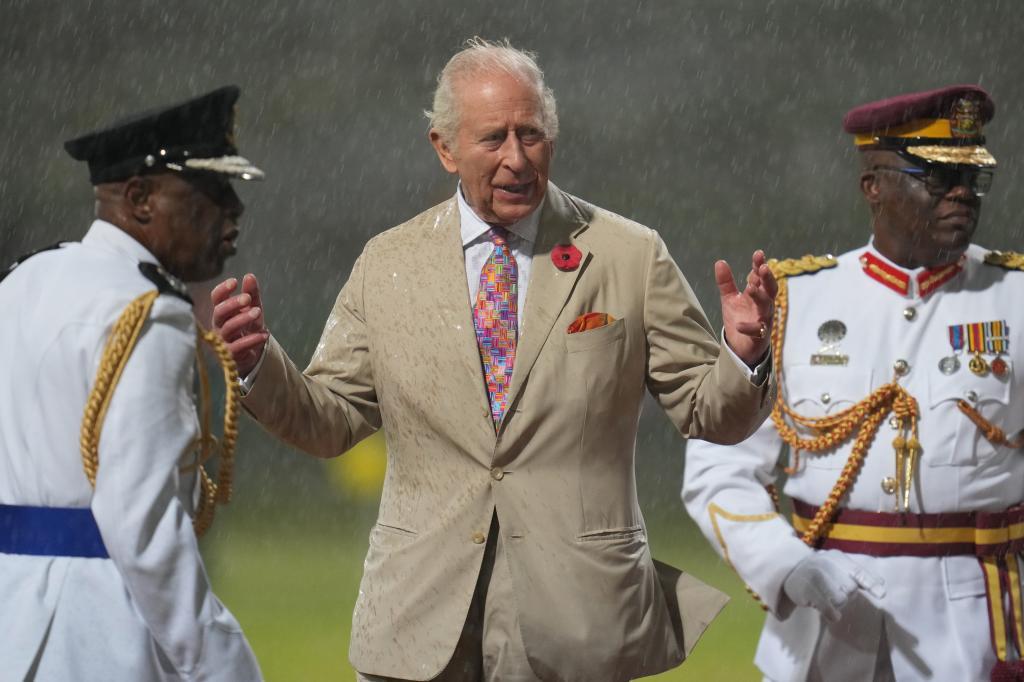
"I couldn't care less about the king. Can someone tell me if he is coming to apologise for the slavery imposed by the British, or if he is coming to give us money for what they did to our people? If he isn't coming to do that, if the guy doesn't breathe again, I won't care." This harsh sentiment was expressed by former Bahamian minister Leslie Miller about Charles III just days before the British sovereign began the tour he is currently undertaking across several Caribbean nations. This is the most delicate undertaking since he ascended the throne in September 2022. Because, although he is visiting some countries of which he is also head of state, they are not receiving him solely with honours and gestures to please him. On the contrary, the king is encountering, as expected, an incessant demand for the holder of the British Monarchy to apologise for the role of the institution in the scourge that the slave trade represented for centuries. This is a very thorny issue that has pursued the Windsors in recent years, and it has been particularly inflamed by the demands of Caribbean nations, led by Jamaica, for economic reparations from London for the most serious crime against humanity in history.
This issue will inevitably centre the 28th summit of heads of government of the Commonwealth presided over by Charles III in the final stop of his tour of the region, Antigua and Barbuda, where leaders from the 56 nations that make up the alliance, which primarily includes countries linked to the old British Empire, began to arrive yesterday.
Charles III will speak with "unwavering honesty" and "sincere sadness" about the enduring pain of the transatlantic slave trade, Buckingham Palace announced yesterday, in an attempt to quell criticism regarding the lukewarm manner in which many believe he has addressed this issue during his visits to Bahamas and Guyana. Both the king and the British government fear that this issue will overshadow any other agenda items to be addressed at the meeting of so many leaders, and they are concerned that it could derail the summit at a time when London is more interested than ever in deepening relationships within the Commonwealth due to the influence the organisation grants the United Kingdom as global geopolitics is so shaken and other powers like China or Russia are rapidly advancing in signing agreements with countries once in the orbit of the Windsors.
The British Prime Minister, Andy Burnham, has declared himself "open" for the first time to the possibility of the United Kingdom formally apologising for its role in slavery, which represents a shift in the stance maintained by successive governments in the country. However, Burnham clarified in an article in The Guardian that "economic 'reparations' are not the 'appropriate response'". "I do not believe that today's Britons can be held responsible for historical injustices, however atrocious they may be, that occurred in another era, under different laws in which they had no personal involvement," he added in the article.
Two years ago, during the Commonwealth summit in Samoa, Charles III acknowledged that certain "painful aspects" of the past continue to resonate in relations between the United Kingdom and the rest of the member countries of the British Commonwealth of Nations, in a veiled reference to the painful chapter of slavery and colonial past. However, since then, Caribbean countries that are part of the organisation have not ceased to articulate strategies in pursuit of reparations for the human trafficking perpetrated by London. Jamaica recently submitted a request to the king to send a series of questions regarding the United Kingdom's responsibility in the infamous practice maintained for centuries to the commission of Her Majesty's Privy Council, which acts as the highest court for former colonies that still maintain ties with the British legal system.
Kingston's demand to the monarch coincided with the same day in 1781 when the ship Zong, registered in Liverpool, set sail from West Africa with 442 enslaved black people on board. During the voyage to the Caribbean, when water supplies began to dwindle, the captain ordered the crew to throw overboard 132 men, women, and children after calculating that it was more profitable to file an insurance claim for the "lost property" than to sell the surviving slaves at a reduced price upon arrival in Jamaica due to the effects of dehydration. This is just one of many atrocities that could fill a book on the trade of human flesh. But suddenly, on the island that retains Charles III as king, as well as in other neighbouring nations, these chilling facts from the past have become arguments that centre the current political debate.
"It is right that we acknowledge the great suffering and injustices of the past", the king emphasised in one of his first speeches upon arriving in Nassau, the capital of the Bahamas, on Tuesday. Days later, during his visit to Guyana - where he broke ties with the British Monarchy by embracing the republican system in 1970 - the head of the Windsors visited, not by coincidence, Independence Park in Georgetown, the site where in 1823 between 15,000 and 20,000 enslaved Guyanese rose up in arms and staged the largest slave uprising in the Americas, brutally suppressed by the authorities dependent on London who dominated the area.
Britain abolished the slave trade in 1807, although it was not until 1834 that the enslavement of human beings in its territories was prohibited. Something mortifying for the groups demanding reparations from the metropolis today, and facing the door slammed shut in the form of arguments like the one expressed by Burnham, is that the abolition law from Westminster in the 19th century involved financial compensation to British plantation owners who were no longer able to exploit enslaved black people to work their lands, and the United Kingdom did not finish settling the debt incurred to cover those payments until 2015.
Lucrative business for the reigning dynasty
Last February, historian Brooke Newman published a monumental book detailing the horrific and lucrative ties of the British Monarchy since the late 16th century with the slave trade. The documents that prove how successive holders of the Crown personally enriched themselves through the transatlantic trade of blacks captured in Africa are another of the most fervently cited arguments to demand from the current king, Charles III, the act of contrition that has yet to arrive.
The British Royal Family is no exception in this regard. Pope Leo XIV apologised for the Catholic Church's long delay in condemning slavery, describing it as "a wound in Christian memory" in his first encyclical, published in May. In the same month this year, the French National Assembly unanimously approved the formal repeal of the Code Noir of 1685 — the decree signed by Louis XIV which regulated slavery and defined slaves as movable property. And President Macron described the silence maintained ever since in the face of such a crime against humanity as an "offence". However, Paris is also sidestepping calls for reparations from nations such as Haiti. And, in October, King Willem-Alexander of the Netherlands went much further than any other contemporary monarch by stating that he feels "a responsibility, towards society and the descendants of enslaved people, to clarify the role my family played in colonial history". This came after the findings of a study by Leiden University were made public; the study, supervised by an independent committee and commissioned by the monarch himself, was designed to determine the specific responsibilities and personal enrichment of the House of Orange through the slave trade over the centuries.