It is hard to believe that today there exists in Europe a country so radically unique, remaining untouched by the globalising wave as if it were a Gallic village in the Roman Empire. A place where McDonald's and Starbucks have yet to arrive (what is that?), and yet is only three hours by flight from Madrid, with the local currency being the euro. Montenegro is a small pill with a great concentrated load inside: its entire population is equivalent to that of the city of Seville. To traverse it from end to end along the coast would take just three hours by car, taking a ferry to avoid the nooks of Kotor Bay. What is needed is to take the journey with special calm to discover, first, and savour, afterwards, the peculiarities left behind by Ottomans, Venetians, and Austro-Hungarians, from palaces to kebabs, from minarets to Orthodox churches, always looking out to the Adriatic Sea.
As one of the most regular air connections throughout the year, it links Spain with Dubrovnik, in Croatia, just half an hour from Montenegro; the most common route starts in the western part, travelling along the coast towards its eastern border.
The entrance to the Kotor Bay has been one of the defensive bastions of the area for centuries, with its fortress, Kanli Kula, being so impregnable that its translated name would be Bloody Tower. Tamed over time, this fierceness now makes the fortress a good starting point to explore a city that boasts of being the sunniest in the country, although nothing guarantees a radiant day. At Kanli Kula there is now an amphitheatre with views of the bell tower and the sea, a place to descend the stairs to the lower part of Herceg Novi, where the churches are located, that of Archangel Michael, with a mosaic above the door, Orthodox, or that of Saint Jerome, Catholic.
From the area of the striking clock tower, the most representative monument of Ottoman origin, there are views of the marina, where young people practice water polo in a pool in the sea, an activity that is a bit more than a sport and a bit less than a religion. So if one is given the choice between the local Jadran Herceg Novi or VK Primorac of Kotor, there is no hesitation: "Go Jadran!".
Travelling along the coast of Kotor Bay is an attraction in itself, not just a means of transport. There are ferries that help shorten the route when the goal is to arrive as quickly as possible, but it is better to avoid them if possible and opt for a leisurely drive, taking in the fjord-like landscape, with the intense, dark green of the mountains (hence the name of the country) above the always calm waters of the bay. And play at spotting Venetian towers, churches, or discovering banana trees among the vegetation of this area with such a special climate that maintains relatively warm temperatures almost all year round.
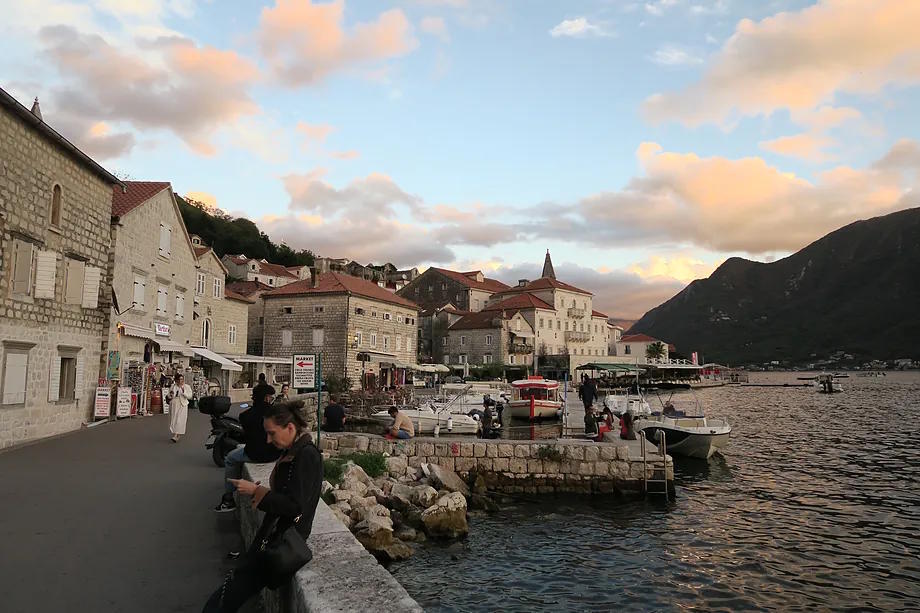
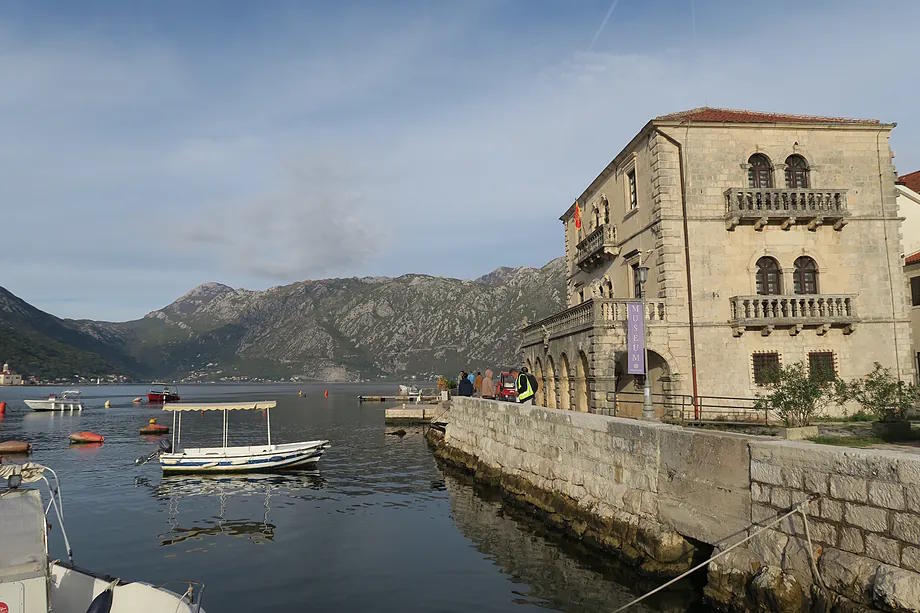
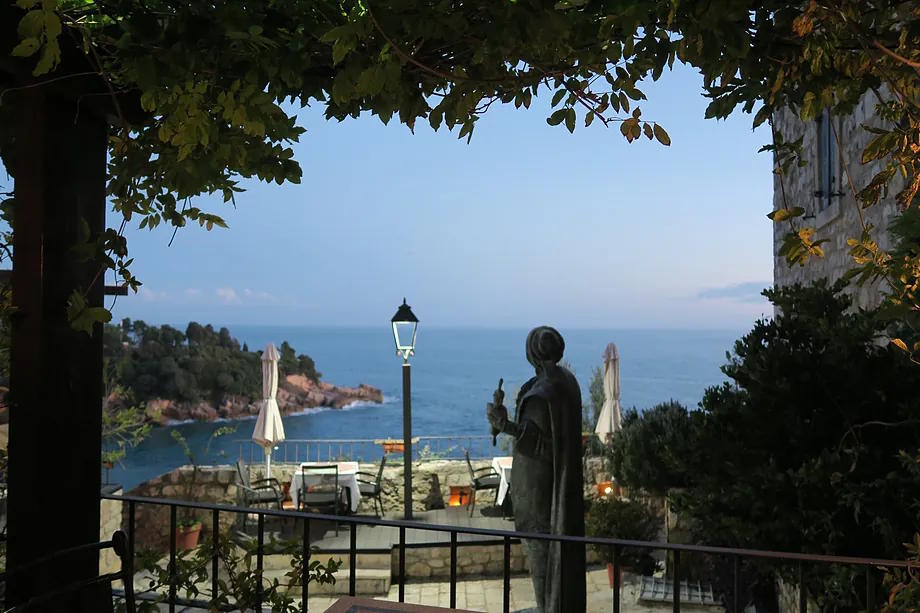
The next stop on the coastal route seems to have been created over centuries for none other than Bad Bunny to sing here about "I should have taken more photos": every corner is a postcard, usually dominated by the slender tower of the Church of Saint Nicholas, in the centre of the village. On either side of the temple, the promenade, where small palaces succeed one another, several converted into boutique hotels, the city museum, and a string of restaurant terraces literally on the edge of the sea where they continuously serve portions of fish, octopus, and seafood washed down with local white wine.
There is always room for small docks to peek out for good views, the best at dawn and dusk, and to take one of the small boats that go to the artificial island on which the church of Our Lady of the Rocks was built. Its origin is debated between legend and devotion: locals say that in the 15th century, two brothers found the remains of a painting on a rock in the sea. Around it, they began to build an islet with large stones and sunken sailboats. This arduous work is represented in the Fasinada, a procession of boats that leave Perast every July to throw stones on the island and contribute to its growth.
At Our Lady of the Rocks, one can see the painting accidentally found by the sailor brothers and a large collection of ex-votos on silver plates. And from this church with a bluish dome in the middle of the bay, in a haven of tranquillity where only distant voices from the village or the occasional engine of a boat can be heard, one has the best view of Perast. I should have taken more photos, indeed.
The Romans must have seen something in this tucked-away corner of the bay to found a city that, over the centuries, would become one of the most important transit points and of trade between East and West. But it was the Kingdom of Venice that gave it, between the 15th and 18th centuries, its peculiar medieval city structure squeezed into a triangle enclosed between the sea and steep mountains, with elegant palaces and an Italianised romantic touch.
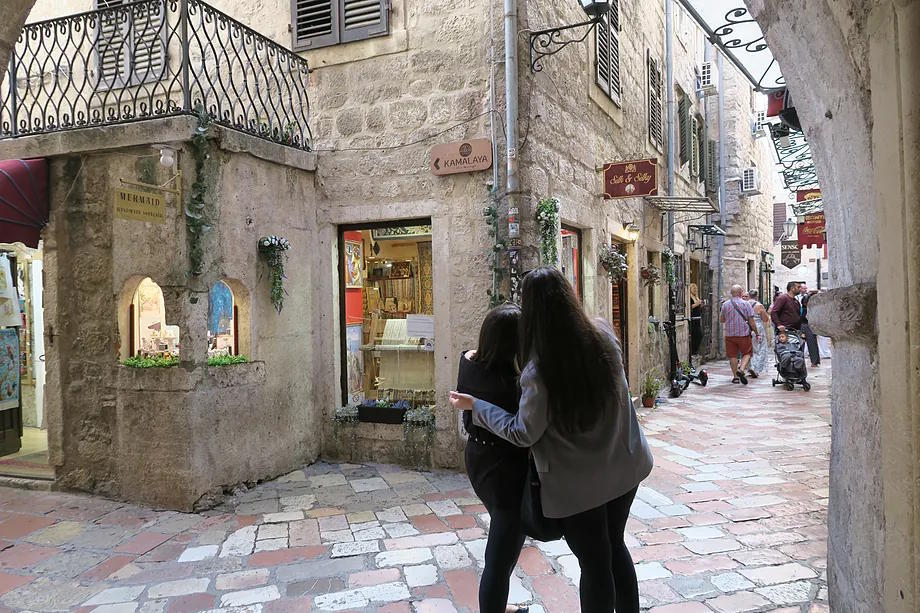
Where to start? It is not an easy question. Perhaps entering through the Sea Gate, built, like Venice, by reclaiming land from the waters of the Adriatic. Under its arch, a warning phrase from the father of Yugoslavia, Tito: "We do not want what is foreign, we do not give away what is ours". The entire old town of Kotor, cobbled, pedestrian, and a UNESCO heritage site, deserves every minute of the time invested in it. Better if it does not coincide with the arrival of cruise ships in the bay, or outside of high season. The Arms Square is the nerve centre of Kotor and the place to which one will inevitably return even without wanting to when getting lost wandering through the medieval chaos. The stout clock tower is slightly tilted due to the last major earthquake that shook the area in 1979.
Next to the main square, other palaces follow that do not turn the city into a museum, as, although earthquakes and tourism have expelled residents from the old town, it remains a living environment, with shops and local nightclubs.
In the Square of Saint Tryphon is the Catholic cathedral, dating from 1166. At that time, the sea reached the very feet of the temple, which has housed relics since the year 809.
After the essential wandering, it is time to climb the wall for views of the sailboats in the bay. Or to dare with the steep slopes towards the fortress of Kotor, which offers a view as beautiful as it is vertical of the medieval city. And to end the day, one must indulge in the Italian customs that have such deep roots, like having an Aperol or enjoying an ice cream.
It will be hard to part from the elegance of Kotor, it surely will be, but there is an incentive just a few kilometres down the coast, at the exit of Budva, an eminently summery city: Sveti Stefan. This false island (it appears to be one, but a bridge connects it to the mainland) is now a luxury hotel that has resumed its role as a holiday stage for great global celebrities, as it was during the Cold War, when Sophia Loren, Willy Brandt, or Marilyn Monroe, among others, stayed there. A few years ago, it was the venue for the wedding of tennis player Novak Djokovic. Sveti Stefan, like the stars, is only meant to be contemplated by mortals from the top of the cliff.
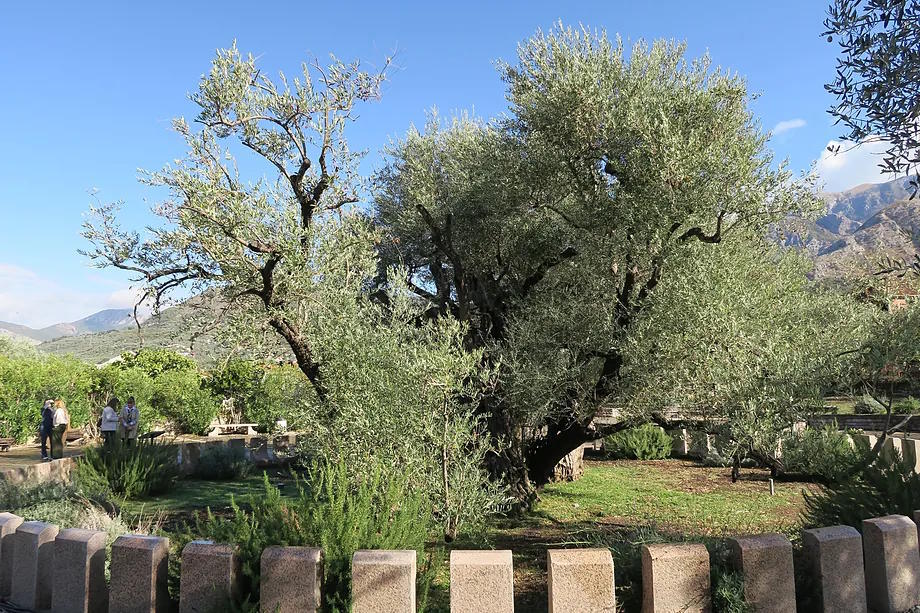
BAR, THE ROCK AND THE OLIVE
The next stop on the route takes you to Bar, land of olives since time immemorial, as remembered by the ancient Mirovica tree, with a certified age of around 2,500 years. The old tree continues to bear fruit, and each year a very select premium oil is produced from just a few dozen kilos of olives that are milled in local presses. And very importantly: those who visit the old olive tree should walk around it three times to gain health, love, and fortune... in whichever order one prefers.
The old town of the city, Stari Bar, has a rural charm that anticipates the more eastern spirit of the country. If Kotor was Venetian in air, Bar leans towards the Ottoman legacy. This is evident in its cobbled street that ascends towards the fortress like a backbone up the cliff. In the pomegranate juice vendors. In the patterns of the carpets and in the music that escapes from the windows of the houses. Two cats fight at the gates of the citadel. Along the Montenegrin coast, visitors will encounter dozens, perhaps hundreds, of empowered cats who see themselves as rightful inhabitants of the streets, balconies, or windows.
The citadel is the origin of Bar, nestled among mountains in an easily defensible location. From this vantage point, one can see the olive fields climbing up the hill and even an aqueduct.
ULCINJ, NEAR ALBANIA
This is where Montenegro ends. Just a few kilometres further lies Albania. To this locality, where local legend claims Miguel de Cervantes was imprisoned by the Ottomans, Montenegrins have been coming for decades to enjoy the sea. Its beaches are the most extensive and accessible in the country, vast sandy stretches where one can enjoy the warm waters of the Adriatic. It is advisable to take in a general view of its tranquil bay from the Palata Venezia hotel, which offers splendid views.
CETINJE, FORMER CAPITAL
Inland, on the borders of the Lovcen National Park, lies the spiritual capital, Cetinje, where autumn already spreads its palette of colours over the forest, creating one of the most beautiful scenes of the year. The small city was the first royal seat but was relegated due to its less hospitable environment for living decades ago. Today, it is a small urban nucleus where tranquility is almost always in the air, and one can find a moment to savour local cheeses and prosciutto.
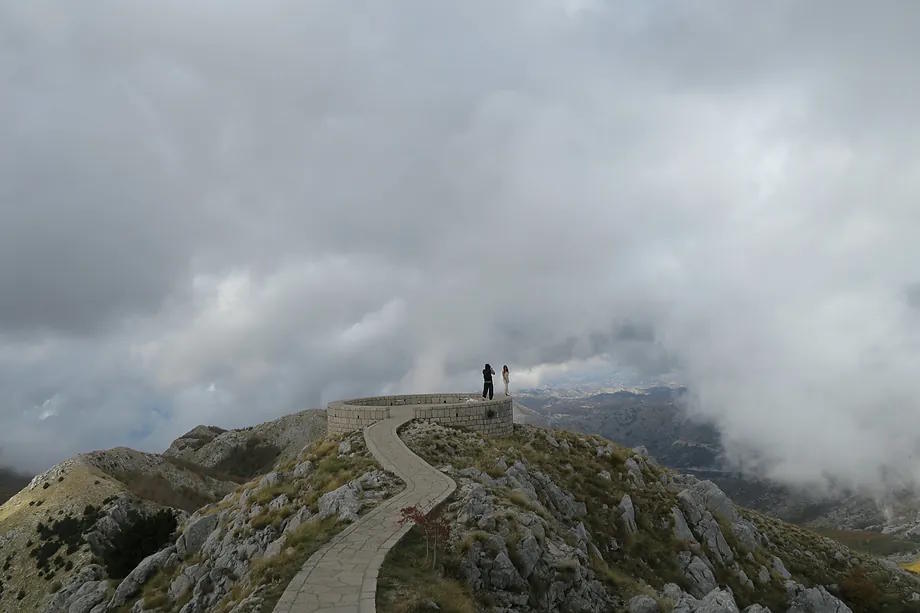
Its National Museum is an interesting visit to learn about the history of the brief Montenegrin monarchy, which occupied the throne between 1910 and 1918. In the Lovcen park, one reaches the mausoleum of Petar II Petrovic Njegos, a reference of national identity, after ascending 500 small steps to the tomb with a viewpoint from which, on clear days, one can dominate more than two-thirds of Montenegrin territory. It's time to wrap up warm; the sea lies down below, over 1,500 metres away.
And if this appetizer of Montenegrin mountains feels insufficient, one always has the option to dare to tackle one of the natural giants of the country, the peak Bobotov, in the Durmitor National Park, in the north. At cloud height, with lakes, mountains, and forests at your feet, no one can help but feel, even if just for a moment, like the king of the world.