f someone thinks of winter, luxury, snow, and champagne, they think of St. Moritz, the exclusive Swiss enclave nestled in the Alps where the international jet set and celebrities of all kinds escape to ski with the arrival of the first snowflakes. Think of the entire royal family of Monaco (and most European royals), George Clooney, John Travolta, the Beckhams, the Agnellis, Claudia Schiffer, Robert De Niro... That's today, but in the past, it was frequented by Alfred Hitchcock (who discovered it during a shoot and spent his honeymoon and several New Year's Eves here), Coco Chanel, Elizabeth Taylor, Sophia Loren, Charlie Chaplin, Audrey Hepburn, John Lennon, Brigitte Bardot, the Onassis family, and even the Kennedys. Even the Romanovs used to visit during the summer season before being assassinated by the Bolsheviks.
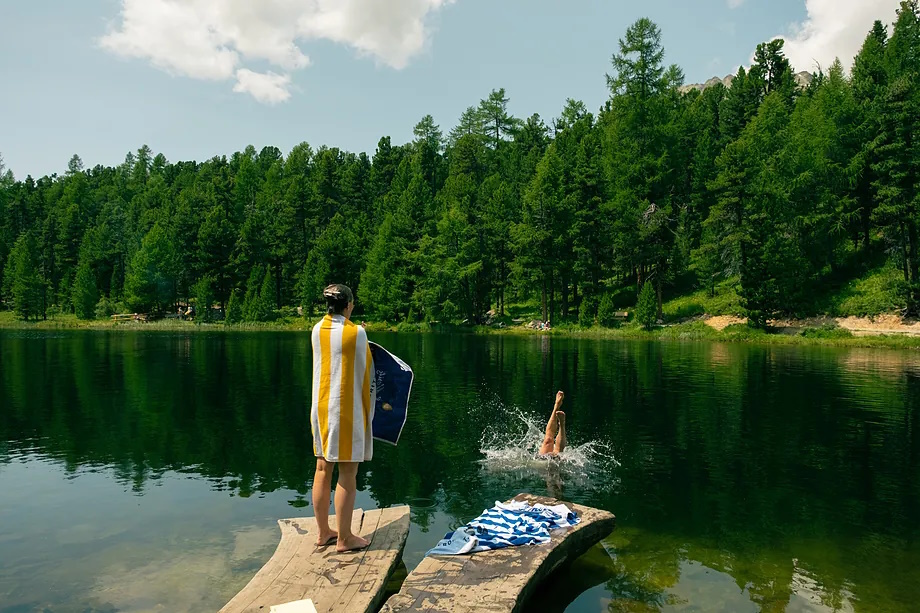
Forget the typical snowy postcard image. St. Moritz, at 1,856 meters above sea level, is also the ideal place for summer vacations. Its so-called "champagne climate," golden (due to the sun shining 322 days a year here, hence the town's symbol), cool, and dry, makes the snow spectacular in winter, ensuring an ideal temperature during the summer months, with temperatures around twenty degrees, perfect for practicing all kinds of outdoor sports, taking a dip in its picturesque lakes, or strolling through the cobbled (and somewhat steep) streets of the old town among the highest concentration of the most expensive boutiques on the planet.
Before becoming a luxurious ski destination, travelers used to come only in the summer to enjoy its thermal springs, which have existed since 1411 BC with almost miraculous therapeutic properties. Well, a local hotelier, Johannes Badrutt, thought in 1864 that why not take advantage of tourism throughout the year and made a bet with four British fans of this beautiful alpine corner. "If they returned in good weather and did not like the experience, he would refund all the money paid," says Susi Wiprächtiger, a local guide, who wears a red scarf tied around her neck with the logo of St. Moritz, the aforementioned sun. The English came, saw, and stayed. "They arrived at Christmas and left at Easter," she adds.
Word of mouth did its job, kicking off the so-called international winter tourism, as that same year the St. Moritz ski resort was inaugurated, considered the oldest in the world. The first ski school in Switzerland would open just 12 months later. And then, the first European curling tournament, ice skating, snow polo, two Winter Olympics...
The arrival of the Rhaetian Railway in 1889, whose Albula/Bernina route through the Alps over 130 kilometers is part of the UNESCO World Heritage, would eventually catapult this idyllic refuge in the canton of Graubünden to fame. It is considered one of the most beautiful train journeys in the world, crossing picturesque forests, mountains, lakes, rivers, gorges, charming villages, green pastures dotted with cows, sheep, or goats, bridges, tunnels, and viaducts like the Landwasser Viaduct, a marvel of engineering with its curved structure of six arches that seem to float over a dizzying gorge.
It is best to get the Swiss Travel Pass to travel unlimitedly by public transport throughout the country. For those who prefer it, there are the panoramic carriages of the tourist Bernina Express, romantically dubbed "the slowest express in the world." St. Moritz also has a heliport and an airport for private jets just minutes away (the closest ones from Zurich and Milan, are about a three-hour drive), although arriving by train is the most authentic way to start your stay in this cradle of alpine luxury.
Right in front of the station, strategically perched on a hillside, is the best possible base of operations, the Grace La Margna, a recently renovated five-star hotel with unique 360º views of Lake St. Moritz and the Upper Engadine Valley that began its history in 1906 with a classic Art Nouveau style, the same style that the station boasts, as it was the same architect, the already prestigious Nicolaus Hartmann, who designed both. After being closed for decades, the renovation carried out by the London-based Divercity Architects has brought a meticulous expansion by adding an annex building, Grace Wing, as well as a state-of-the-art spa housing a 20-meter indoor pool overlooking the mountain.
This way, "it becomes the first hotel to open its doors here in over 50 years, maintaining the juxtaposition between the old and the modern through the preservation of original elements such as granite pillars, wooden panels, the open fireplace, or the ornate plasterwork, the same ones that welcomed travelers over 120 years ago," explains Jarik Tschirky, executive assistant manager, in perfect Spanish (he was born in Mallorca, although to Swiss parents).
With 74 elegant rooms and suites (the Grace Penthouse, 215 m2, with a private terrace with a 165 jacuzzi, is impressive) with huge windows, it belongs to the exclusive portfolio of Small Luxury Hotels and has brought a breath of fresh air to the population by moving away from the prevailing baroque style in other luxury hotels in the area "so that the guest feels at home," adds Tschirky.
This relaxed atmosphere is evident in the unpretentious reception, with a minimalist air; in the daring photographs of artists like Tony Kelly that decorate the walls; in the N/5 bar, the heart of the place where you can order a signature cocktail or a dinner based on platters, tapas, and snacks (in winter, it is one of the key spots for après-ski); on the charming terrace facing the lake or in the restaurant The View, with obvious views of the valley and a Mediterranean sharing menu that includes dishes such as Balfegó tuna tartare (the best in the world), tomato risotto, eggplant-filled ravioli, Milanese veal with truffle and cheese, or the delicious tiramisu prepared in front of the diner.
On the street level is the Stüvetta Moritz, specializing in typical Swiss fondues, which, yes, are appealing in the summer around here. When it comes to pairings, one must seek advice from Benjamin Zimmerling, Best Swiss Sommelier 2025, who encourages guests to "dare to play by pairing a red wine with fish or a white wine with meat." Everything is allowed, in his opinion, "as long as you know the wine and understand the chef's style."
Furthermore, his favorite combination mixes "champagne with French fries." Seriously? "The carbonic acidity and minerality of the drink perfectly balance the richness of the potatoes, which are large, crispy on the outside, and soft on the inside here," he proudly and convincingly explains.
It's time to explore the historic center, carved out of cobbled streets and beautiful squares such as those of the Town Hall or the school dating back to 1886, Catholic and Protestant churches where concerts by Bach, Verdi, and Puccini are held, or the Chesa Veglia, the oldest farmhouse in the city still standing, built in 1658. The name, "old house," refers to the Romansh language spoken here, one of the official languages of Switzerland. In contrast is the avant-garde Chesa Futura, a block of luxurious bubble-shaped homes designed by Sir Norman Foster, another regular visitor to St. Moritz with his wife, the Spanish Elena Ochoa.
Another of the most striking buildings is the "crooked tower" of the 12th-century church of St. Mauritius, which is more inclined than the Tower of Pisa itself, 5.5 degrees compared to 4 degrees for the Italian tower. Swiss chocolate lovers should visit the Läderach or Hanselmann confectioneries, dating back to 1894, with their Belle Époque style and legendary nut cake. A few steps away is the Tourist Office, whose avant-garde interior sells beautiful designer souvenirs; none of the horrible magnets and T-shirts we are used to.
If you're looking for premium tea, coffee, or caviar (that's all they sell), you have to visit the ultra-glamorous Glattfelder space. For luxury shopping, there's Via Serlas and the adjacent Veglia and Maistra streets, where you'll find brands such as Louis Vuitton, Prada, Dior, Bulgari, Hermès, and more.
St. Moritz is also an interesting cultural destination with a long list of art galleries—led by the powerful Hauser & Wirth, which is Swiss in origin and has offices in Zurich, London, New York, Hong Kong, and even Menorca—and museums such as the Engiadinais (which rescues the history of the valley in which we find ourselves), Berry, and Segantini, which pay tribute to the artists of the same name, both references in Alpine painting.
Not to mention the Design Gallery, with its retrospective of beautiful old black-and-white photographs of the municipality, traversed by one of the longest escalators in the country.
Among so many attractions, there are countless festivals when the good weather arrives. From running to polo to jazz, with free concerts from 5:30 a.m. (yes, in the morning, and you have to reserve your place well in advance because it fills up) to 11:30 p.m. in bars, terraces, squares, and lakes. Not to mention Open Doors Engadin, which opens the doors of more than 80 historic buildings through guided tours.
Outdoor sports enthusiasts can enjoy the Engadin Swimrun, a competition that alternates between mountain running and swimming in the surrounding lakes. These lakes are also perfect for paddle surfing, kayaking, or sailing with the help of nautical centers such as Segel Club, on the shores of St. Moritz. In winter, things change, of course, with polo matches, ice skating, ice cricket, and even horse racing.
In the surrounding area, you can go hiking (starting with the philosophers' trail that Nietzsche himself used to follow, whose house still stands in the nearby hamlet of Sils-Maria), cycling, or horseback riding, as well as playing golf (there is a nine-hole course) or take the funicular to Heidi's hut in Chantarella, as Johanna Spyri set the adventures of the most famous Swiss girl of all time in Graubünden. The latest film inspired by her was shot here in 2015, as were some of the 007 films (from The Spy Who Loved Me to A View to a Kill) and House of Gucci, the biopic about the late designer, who owned several chalets here and therefore visited frequently.
We ended our experience at the Alp-Schaukäserei Morteratsch cheese dairy, just a few train stops from St. Moritz, on the outskirts of the small village of Pontresina. There, you can not only taste the best Swiss specialties through a generous Alpine brunch (from Gruyère to Emmental or the tasty Appenzeller, with its secret herb seasoning) at long tables surrounded by nature, but also see how they are made right before your eyes.
And all this amid displays of folk dancing and cows grazing peacefully just a few steps away. "We do everything by hand, as in the old days, so our production is small but of exceptional quality, supplying hotels and shops in the area," says Rafael Weyrich, one of the farm's managers, as cowbells ring in the background.