In 2017, the Cannes Film Festival featured Claudia Cardinale on its poster. A 1959 photo shoot of the actress dancing on a rooftop in Rome suddenly acquired the character of an emblem, a myth, a dream. In the new red-tinted image, on the facade of the Grand Théâtre Lumière, she - disproportionate, happy, and perfect - seemed to be the living image of a cinema always new, eternally renewed, and necessarily alive. And yet, something didn't add up. The Claudia Cardinale of 2017 was not the same as in 1959. Modern photoshop had lightened her arms, stylized her waist, and slimmed down her thighs, ankles, and calves. They even fixed her naturally wild hair. She took it well, excused the festival, and moved on.
But the damage was done. Beyond changing canons or the supposed updates claimed by the authors of the outrage (because that's what it was), the unforgivable part was seeing how the most prestigious film festival had not understood anything. They failed to grasp that Claudia, the Cardinale who died on Tuesday night at the age of 89, was first and foremost completely different from everything. What made her different was precisely her hunger for difference, her rebellion, her denial of the norm, the impossible modernization of a timeless woman. She was an atypical star in each of her decisions. And she remained so until the end.
Considered by many as the Italian Brigitte Bardot, she was defined at the time as sweeter than Sophia Loren and less artificial than Gina Lollobrigida. A striking beauty, almost hurtful, and ageless, caught between a deceptively innocent look and a hoarse voice of flint. This was her from the descent of the stairs after the bath in The Girl with the Suitcase (1961) to her last appearance in credits in 2022. Like her character in The Leopard, Cardinale was the noblest of commoners and the most outspoken of aristocrats.
One of her last roles brought her to Spain. Under the direction of Fernando Trueba, she filmedThe Artist and the Model. Cardinale plays a understanding wife who one day takes in a young vagabond who will end up posing for her husband. It's not infidelity, but close. She only appears in a few scenes, enough to make it clear that there is no retouching possible for a gaze that does not admit definition, rule, model, or photoshop.
In fact, from the beginning, Cardinale made it clear that she had nothing to do with anything or anyone. She never even intended to be an actress. Her career began after winning a beauty contest she had not entered. At 18, she was crowned the most beautiful Italian girl in Tunisia (where she grew up). The prize was a trip to the Venice Film Festival, and as soon as she set foot on the Lido, she knew that everything was starting anew. In some recent interviews, she confessed that she received multiple offers and rejected all of them without exception. "When a man pursues you, if you say yes instantly, he leaves soon. If you say no, he desires you for a long time. It's the same with cinema," she recalled.
Perhaps her many refusals had something to do with the fact that she was pregnant (she later confessed she had been raped) and would soon give birth to a child; a child who, after marrying producer Franco Cristaldi, would effectively become her younger brother. Under the protection of one of the most powerful figures in the effervescent Italian cinema of that time, Cardinale became, as mentioned, the Italian Bardot, and her life became strictly controlled, from her hairstyle to her weight, without neglecting every second of her social life. Everything changed in 1963 after working with Mario Monicelli, Pietro Germi, Alberto Calvancanti, Luigi Zampa, or Valerio Zurlini.
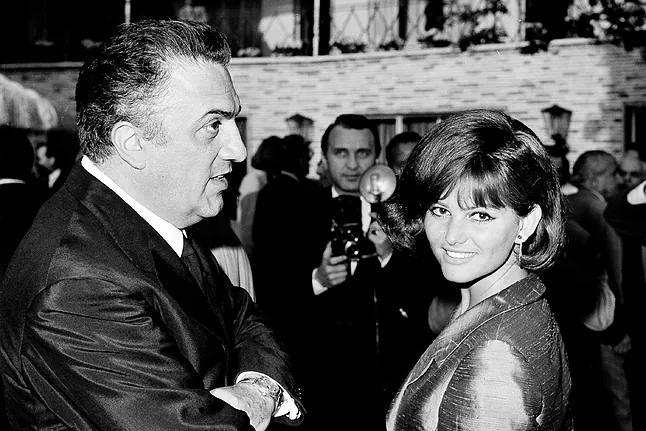
Over 60 years have passed since she filmed the two definitive classics of Italian cinema, and the image from the Cannes poster, the real one not retouched, remains intact. In both 8 1/2 by Fellini and The Leopard by Luchino Visconti, she embodies the idealization of an unattainable desire. In the first, she plays a coveted movie star and ethereal muse who seems to exist on a higher plane than the chaos surrounding Fellini himself in the tormented Marcello Mastroianni. In the second, she is a woman desired by both the decadent aristocrat played by Burt Lancaster and his nephew Alain Delon. Cardinale filmed both movies almost simultaneously between the surreal black and white of one and the sumptuous recreation of a world crumbling in 19th-century Sicily. "Federico wanted me blonde. Luchino, brunette. With Fellini, there was no script, everything was improvisation. When he was filming, all the actors came to see him because it was magical. The set was like a circus. He couldn't film without noise. With Visconti, it was the opposite. It was like doing theater. We couldn't say a word. What a serious man!" she remembered not long ago. The first won the Oscar, and the second won the Palme d'Or. And all this, without forgetting that before the year ended, she would complete The Pink Panther under the direction of Blake Edwards.
She tried her luck in Hollywood without much enthusiasm. She could be seen in The Professionals (Richard Brooks, 1966) alongside Burt Lancaster, in Don't Make Waves (Alexander Mackendrick, 1967) with Tony Curtis, or in Circus World (Henry Hathaway, 1964) with John Wayne and Rita Hayworth. And so on until the failed attempt of The Red Queen (1971) supported by Brigitte Bardot in one of the most adorable absurdities that cinema has seen in a long time. Unlike many of her colleagues, Cardinale, always different, eventually found her own path.
In 1975, she broke her contract with Cristaldi, freed herself from old slaveries, and despite the countless bad movies that fill her filmography throughout much of the 70s and 80s, she managed to shake off the sexualized gaze of photoshop enthusiasts, who, despite everything, never completely disappeared. "I always wanted to travel the world, and I did it," she confessed. Her work with Werner Herzog (Fitzcarraldo, 1982), with Marco Bellocchio (Henry IV, 1984), with the aforementioned Trueba, or even with Manoel de Oliveira (Gebo and the Shadow, 2012) when he was already 103 years old, speaks volumes about the inherently different spirit of an actress different and alien to norms. "I never undressed, and I never did anything to change my face. I like being who I am because time cannot be stopped." Word of Cardinale.