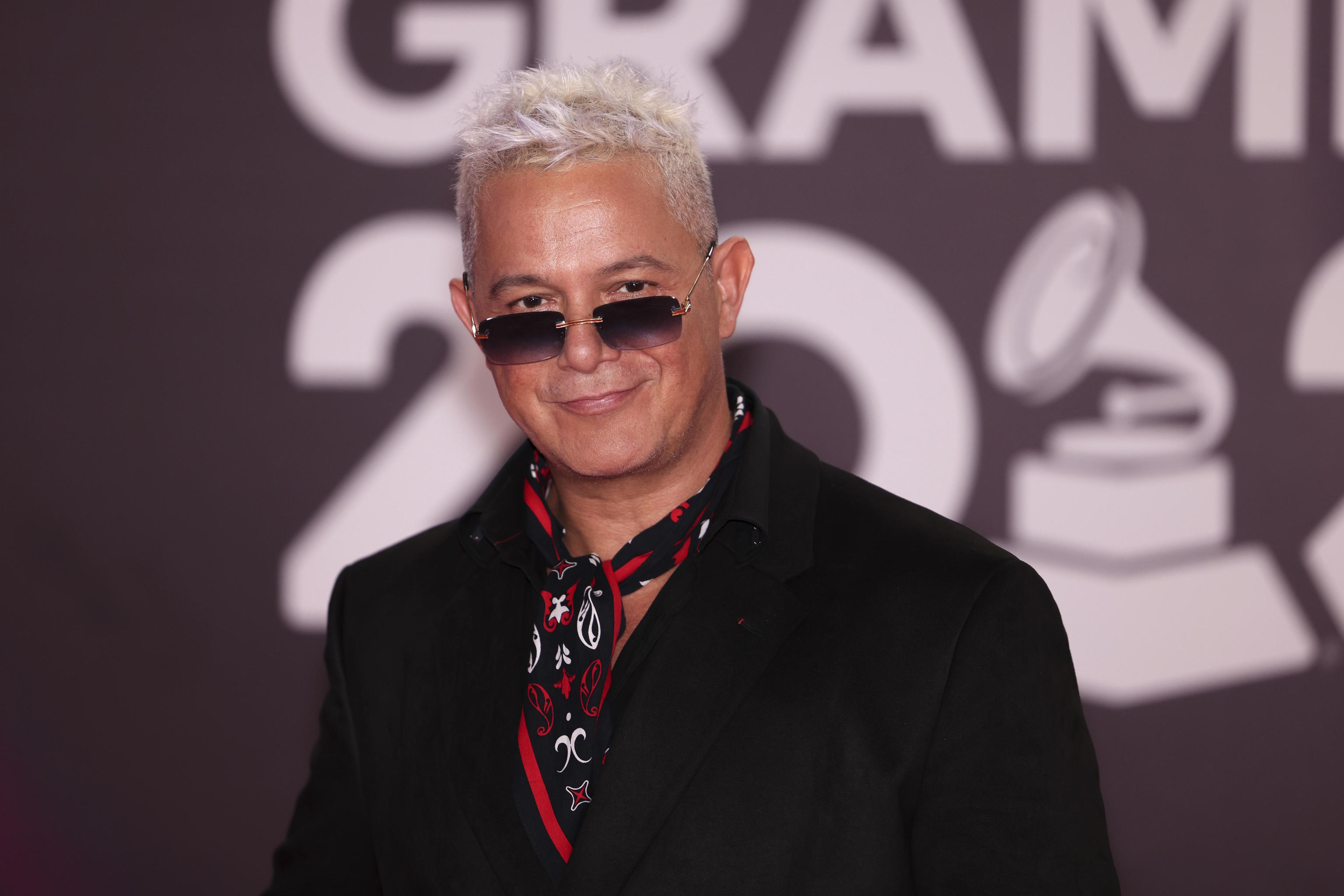
Alejandro Sanz (Madrid, 1968) can't hide his radiance. He shows a genuine closeness and relaxation that are very hard to find in a celebrity of his caliber. He wasn't like this for many years, but he enjoys a successful life change that pulled him out of a hole and brought him back to the top. He has just won two Latin Grammy awards, including the big prize for Best Record of the Year for 'Palmeras en el jardín', he comes from a happy tour in Mexico before touring Spain in 2026, and he is releasing a new album, '¿Y ahora qué +?'.
Just over a year ago, you rebooted after a difficult period in your personal and professional life. What is the balance?
It has been a fantastic year, very fruitful in all aspects. We released the EP ['¿Y ahora qué?'], went on tour to Mexico, and now we finished with those two Grammys and the album release. I am very happy, to be honest. I have completely regained the excitement for music that I had lost and have enjoyed every second on stage like I hadn't in many years. Actually, the change goes beyond just the professional aspect. I have rediscovered my playful and family side, which helps me a lot. I work fewer hours, but I am much more productive because now I also give myself space to live. Before, I didn't do that and lived exhausted. That has changed.
Have you changed many habits?
Many, I live in a completely different way, much more relaxed. And I have also done something at concerts that may seem silly, but it's not: I have gotten rid of all the quirks and superstitions I had before going on stage. I have become a total rationalist because those obsessions burden you with unnecessary tension. You have to do 600 things exactly the same before performing, and it generates absurd anxiety.
What did you do?
I had to place all the little pictures of my deceased loved ones, count how many times I crossed myself before going on stage, put the water bottle in the exact spot, do a specific vocal exercise three times, and the rest in a set order... And if I missed something or it didn't go well, I started over from the beginning. It was a circus. And then, something went wrong during the concert, and you blamed it on the water bottle being placed incorrectly. You think it helps you focus, and in reality, it just loads you with tension because you have to put all your senses into it as if it were as important as the concert.
You seem extremely relaxed.
You are never extremely relaxed when facing a launch, but it is true that I am calmer than ever.
At 56 years old, with 28 Grammys, and 25 million records sold... I imagine there comes a point where you think, "What the hell do I have to prove now?".
Yes [laughs]. When you mature, you start to put many things into perspective and realize that, indeed, you have nothing to prove, hide, or fear. So, why not have fun, be relaxed, and enjoy? I am happy. That's why I said I have enjoyed every second on stage because, damn it, I'm just going to sing, do what I've been doing for 30 years, and I know I do it well. I have a band that sounds amazing, the stage is perfect... What could worry me? It's like a time when I was afraid of flying, and the pilot always told me the same thing: "The plane is fine, and I know how to fly it." It's as simple as that, but it took me a while to understand it. But now I went to Mexico, and it seemed like a different country from the past 30 years. I allowed myself to enjoy it, and all the colors seem brighter, and the flavors more intense.
How does that happiness affect your songwriting?
It's curious because it's not difficult for me now, but I know that all the dark experiences I had before somehow were necessary. I don't want to live through them again for a while, but I need them to create. In moments of supreme happiness, I haven't been able to write much, but having the painful experience close by, its fresh memory, and at the same time, being happy and satisfied with your life is very productive. I work with a joy that I hadn't remembered. I no longer do 14-hour sessions in the studio, except if a specific song warrants it. It's over for that to be my usual routine. I want short sessions, get to the point, and not overthink a melody. I did musical engineering for a long time, but I no longer have that need to feel that everything is perfect.
Now, in the midst of the global dominance of Latin music, do you feel like a reference and a pioneer?
Perceptions and realities are personal. I still see myself as an artist trying to do my job, wanting to improve and enjoy. So, I don't know what the younger artists think of me, but I see them as equals, people who are trying to do the same as me.
But you have already done it.
Yes, but that's a matter of time and age. I don't have much to do with that, and aging is not particularly praiseworthy. What I do try is not to get too comfortable. Sitting on the couch waiting won't get you 28 Grammys [laughs].
You have a personal relationship with the two musicians of the moment. You have known Rosalía since the beginning.
I have known her since she was little, we talked, she asked me for advice on some things, and I am delighted with what she is achieving. She is killing it.
Very few Spanish musicians have had such a global impact.
Yes. Furthermore, at this moment, that impact multiplies exponentially compared to when I started. Now, with social media and how people constantly carry music with them, if you do it right, you can reach a massive level of exposure, and Rosalía is doing it because she is very talented as an artist and very smart in how she wraps everything up. The girl is a genius.
With Bad Bunny, whom you recently said you stole the Grammy from, you also have a friendship.
I met him annoying me [laughs]. A few years ago, Residente asked me for the recording studio at my house in Miami to record with Benito. I lent it to them, we met, and they kept working there, but my room was right next to the studio, and at three in the morning, they were still there making noise. They wouldn't leave, so I peeked out and said, "What? Still a long way to go?" [laughs]. Since then, we have connected, and he has always spoken highly of me, I am very grateful, and like with Rosalía, I love his success. Being envious of someone else's success is very petty; we all want the same thing, and we should celebrate when another artist does great work.
Rosalía, Bad Bunny... I understand modesty, but you have to agree that you are a reference.
Well, I suppose that if you have been around for so many years, others listen to you. In music, we feed off each other, and I continue to learn from musicians much younger than me. That's wonderful. I really like feeling that I am still surprised by things because what I have done is done, I need new things. Nothing excites me more than a blank page.
Both 'Palmeras en el jardín,' the song with which you opened this stage, and 'Las guapas,' the first single from this '¿Y ahora qué +?,' openly address issues from your personal life, the one you have always tried to protect so carefully. Is this part of that liberating process you mentioned at the beginning?
Opening the windows always brings clarity. Yes, I have let the light in. 'Las guapas' is a tribute to a type of person that has been abundant in my life and does not refer to a physical attribute but an attitude. I believe we need to demystify heartbreak, which is inevitable in life. There have been women who have touched my heart and shattered it, but they did it with such grace that I can't help but dedicate a song to them.
With the perspective of constantly traveling and having lived abroad for many years, is Spain as bad as we seem to believe?
Not at all, it is a thousand times better than people think. I am very surprised by how tense we live in this country, especially with ourselves. We should forget a little about that small world of Spain divided into factions and focus on the great world that each of us is. We are bombarded every day with all kinds of political tensions, forcing us to enter that spiral. You can't even detach yourself because then they say you lack social commitment and that you are a fence-sitter. Let me live!
Do you feel like you have been forced to choose a side?
For me and for everyone. If we were to close the door a bit to anyone being able to enter our heads to push their ideas on us and sell us complete packages, we would be much happier and more sensible. It's absurd to think that you have to agree with everything from one side. If you're on one side, do you have to believe that the earth is flat and climate change doesn't exist? And if you're on the other side, the same. You have to accept a bunch of things that you may disagree with to be pure. It's very tiresome. Let us mortals, those of us who doubt, think what we want and question things. We don't need to be fed the entire ideology. And if we were able to understand that and accept differences normally, we would realize that we are a great country. The other day I heard Antonio Banderas say that he is hurt by the stubbornness we Spaniards have in criticizing ourselves and being very hard on ourselves, and I agree. We are a country, with our quirks, much better than we allow ourselves to recognize.
You told me some time ago that you became so obsessed with being the best Alejandro Sanz possible that you forgot to be Alejandro Sánchez [his real name]. How is the relationship now?
They are inseparable now, hand in hand. It is totally true that I lost perspective and forgot who I was. It's the part I mentioned at the beginning about how difficult it really is to separate both facets, but when you achieve it, you realize how unaware you were that you were making a mistake and how important it was to take care of the person and not just the artist. For many years, my life was exclusively him, Alejandro Sanz, and I ended up exhausted. My body and, above all, my mind told me "enough." That's why I've changed everything.
Are you worried about falling back into those old habits?
No, I think I have the obsession with work under control. What really worries me, because it has happened to me before, just on this last tour although very briefly, is the issue of falling back into depression. Once you experience it and discover what the feeling is like, you can recognize it, and when the first symptoms appear, you get very scared. It was very tough, and I don't want to go through that again. The good thing is that I now have the knowledge to recognize it and the resources to know how to react: I immediately call my therapist and we remedy the situation without wasting a minute.