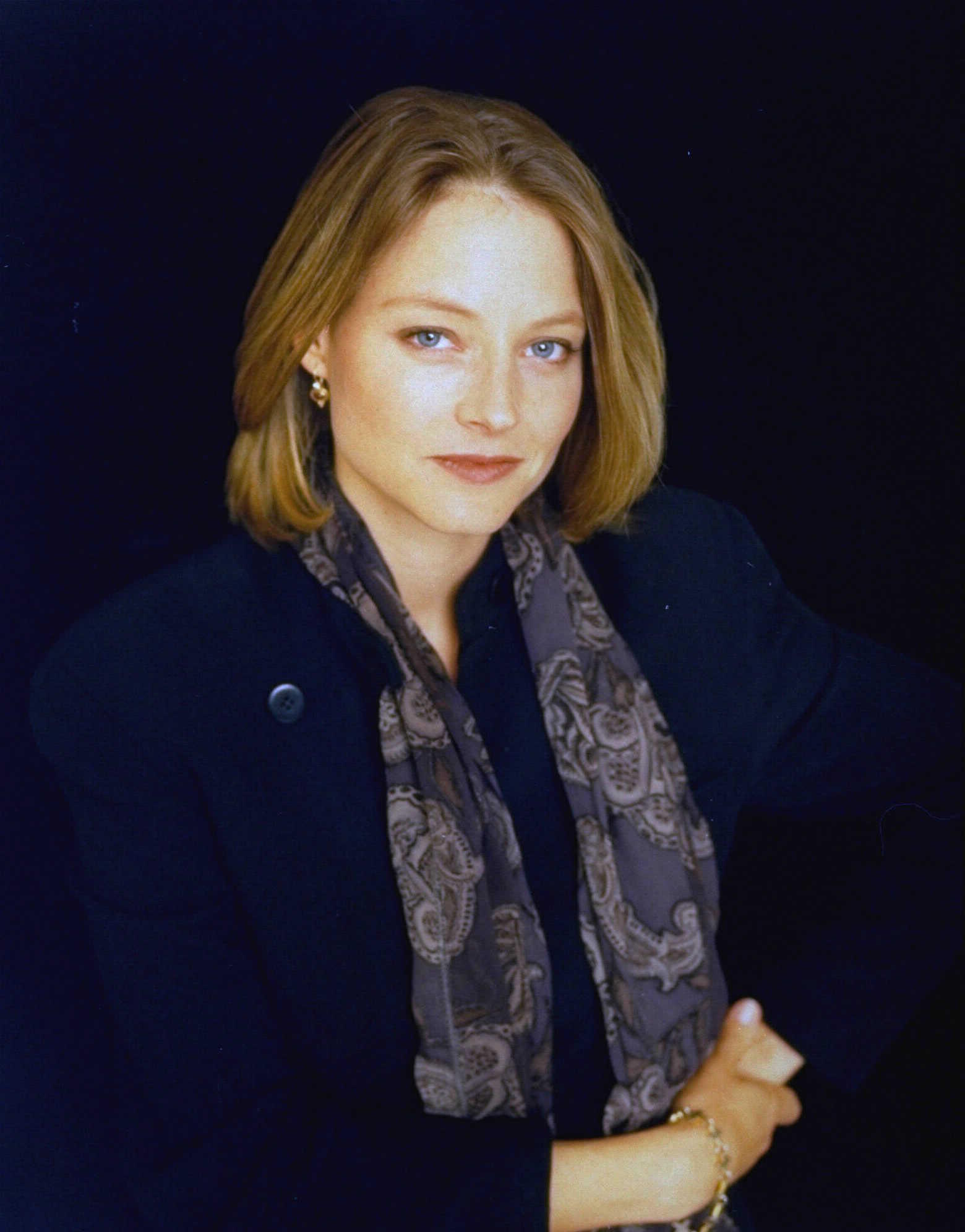
There is always a first time for everything and everyone. Perhaps the only exception is Jodie Foster, an actress who by the age at which you receive your first mobile phone today, had already entered the history of cinema with all honors. When she filmed Taxi Driver (1976), directed by Scorsese, she was 14 years old and had a career worthy of a veteran, which she had started at the age of just seven. From then until now, she has done it all, including directing; she has achieved it all, including two Oscars, and, to top it off, she has given up everything, including a break to focus on her children that almost turned into a farewell. But she has returned, and since then, she has received another Academy Award nomination for her work in Nyad (2023) and an Emmy for her visceral performance in the last season of True Detective (2024).
"I remember," she says in a central hotel in Paris, "that the first time I was in France was in Cannes to present precisely Taxi Driver. They didn't want to take me, but my mother insisted because I had started studying French. In the end, I couldn't stop doing interviews because neither Harvey Keitel nor Robert De Niro wanted to." And it is precisely her command of the language of the very French Molière and the very Romanian Cioran, for example, that has brought her back to France. "I felt like challenging myself," she comments succinctly. Indeed, even for someone who has done it all, there can still be a first time for something.
In An Officer and a Spy, directed by Roman Polanski, she plays a therapist haunted by the suicide of one of her patients. It is a drama that is also intrigue, comedy, charade, and, given the size and luxury of the Parisian apartments where it takes place, even science fiction. It is a French film entirely in French. For the first time, Jodie Foster stars in a film in which she only (or mostly) uses acute accents.
What led you to make a French film in French? Is it snobbery or is there something more?
With age, one becomes more demanding. I wanted to make a true French auteur film. I didn't want a big American co-production or mainstream film. I really just wanted it to be a genuinely French film. So I have been waiting for the opportunity. I set myself several conditions. The most important and confessable is that I wanted there to be a real story to tell. With French cinema, it often happens that films are entirely focused on the character. You see the protagonist do one thing and then another, you watch them go back and forth, and at some point, the movie ends. It's not a criticism, but I confess that I like there to be a plot, a storyline, a real purpose. The reflection of our world goes beyond aesthetics.
Watching the film, another reason comes to mind. If we look at your filmography, there are very few comedies. This one can't be said to be entirely a comedy, but your role has very funny moments. I wonder if you feel more liberated and spirited when you free yourself from English...
I wish I could boast of being funnier in French, but that's not the case. However, it is true that, for whatever reason, I haven't done many comedies, and probably the light and humorous touch of An Officer and a Spy was a plus.
As you age, the worst thing you can do is take yourself too seriously.
I would even say that, if you look at the current film landscape, you see too many people trying to be interesting. The films being made are very pretentious, perhaps because of the times we live in. I sincerely believe that being subversive today means being optimistic, fun, and advocating for humanism. Have you seen The Hand of God by Paolo Sorrentino?
Yes, in Venice.
Well, that's the answer. I don't know how it will be received in Europe, but I'm sure it will be a shock in the United States. It's a film where no one is killed, no one has any limbs amputated, and no woman suffers abuse. It's a film about mature and adult people who want to be good, who want to love and be loved.
I want those kinds of films. We need to remind people of the humanity within them.
Enough of being angry about everything.
Sorrentino will thank you for promoting his film.
Maybe he'll call me for the next one [laughs].
Now that you mention it, your recent works, not only An Officer and a Spy, but also Nyad and True Detective, seem to embody that humanistic essence you speak of. What do you think of the polarized society we live in and from which you seem to want to distance yourself?
It irritates me, basically. And I don't want to, because if I get irritated, all I do is play into the hands of those who want to irritate you. The best way to respond to the times we live in is to seek and promote a new way of communicating and a new way of celebrating the human experience. I think right now the most important thing for me is not to be the center; I am eager to listen to voices other than my own. And that's an exercise we should all do.
We need to convince ourselves and others that this is not just about us, there are many more people in the world. That's why I am now looking for supporting roles to play. My story, both in and out of my work, doesn't have to be the central one.
It's surprising to see a Hollywood star, or a film star in general, so graphically renounce their stardom. When you reach a certain age, you get bored of yourself.
The secret to growing and maturing is to move past that phase of being so self-absorbed. What's truly interesting is when you become curious about other people and other voices.
Are there differences in the film industry between working in Europe and in the United States?
Not many. The global film world is very similar. We all admire Fellini and Kurosawa. But there are some small differences. In Europe, you work eight hours. That's good. We work too many hours. I notice that in Europe, there is a concern about having a life outside of work hours. That's not as clear in my country. Things like that. As far as the film industry is concerned, I don't notice significant differences.
Have you ever been in therapy? I ask because of your character, who is a therapist, and because what you say about being optimistic despite everything is very much like therapy.
Of course, I have been, but not in psychoanalytic therapy like my character in An Officer and a Spy. Freudian psychoanalysts are a dying breed in New York. They still exist in France and Europe, but not in the United States. However, cinematically, no one has been as influential as Freud. Hitchcock wouldn't exist without him, and he remains very relevant in cinema. That's why the character interested me. But if you're going to ask me about my traumas and such, I'll tell you that I'm quite boring.
I skip that question, then. Colombian writer Gabriel García Márquez said that everyone has a private life, a public life, and a secret life. Which of these three lives is the most important to you?
We are all a combination of the three. If you dedicate yourself to what I have dedicated myself to all my life, you have to learn to separate each one very well. The only way to survive and to be a healthy person when you are as exposed to everyone as I have been is to learn to navigate well between the boundaries of one life and another and always, always keep them separate. The answer is that all three are important, but each in its place.
o you regret having become famous so soon and without anyone ever asking for your permission?
Truth is, if I could choose, I would never have chosen to be an actress. I have never seen myself as an actress. I observe myself and my colleagues, and I don't have the personality of an actress. I'm not one to want to dance on a table at a party, and I'm never the first to offer to sing. In fact, in some aspects, it's a cruel job that was chosen for me. Sometimes people ask me about the moment I decided to be what I am, and truthfully, I don't remember starting. If I were, I don't know, on a deserted island, I think the last thing I would do is act.
Does it bother you, then, not having been able to decide to do something else?
No, it's not that either. It's strange. I've lived a rather strange life. I had to come up with a system very early on to make sure I wasn't consumed by fame and to be able to do things that everyone does naturally and without thinking about it, like being happy or having a family.
I had to invent tools to not sacrifice everything, or what is really important, for something as fleeting as success.
Now I look back and I'm grateful for having learned that lesson at a young age. Many people in my profession never consider it and live obsessed only with succeeding. My learning, on the contrary, consisted of not letting myself be dragged down by everything that came with being an actress and learning that there are other things much more important.
Recently, the series Mr. Scorsese premiered on Apple TV, and you appeared there as just a little girl in a tremendous role. How do you feel when you see yourself on screen? Few can boast of having their entire life documented in film.
Yes, people see photos or home videos of themselves when they were six years old. I go to the movies and see myself. It's strange and wonderful. I was incredibly lucky to have been in the midst of the 1970s witnessing firsthand the last golden age of cinema.
I never look back on what I've experienced with anything close to resentment, but with some nostalgia for what I may have missed. Sometimes I wonder what would have become of me if I had had the chance to choose, if I hadn't been exposed as I was. But I have to admit that it passes quickly. Surely there's a university professor out there thinking, "I should have been an actor. What would have become of my life if I had pursued acting?" It's part of life to lament all the lives you always leave behind.
After all you've experienced and with four films as a director, do you still let yourself be directed?
Truth is, I direct myself a lot. You can't change in 20 minutes. But I control myself, seek to collaborate, and at most, make suggestions.
It's also difficult to learn that not all the films you make are your film, but the director's films.It's hard to find female directors throughout their filmography, and suddenly, in the last three films, all are women in the director's chair. Should this decision be understood as a political statement?
Truth is, that wasn't my intention. It wasn't a deliberate curriculum design that led me to make those films and series. I was interested in the projects and the people, and that's what made me decide. But it's true, as you say, that I spent 50 years without ever [only once] being directed by a woman. When I started in this, besides actresses, the only woman you saw on set was a makeup artist or a screenwriter. Then I started to see more technicians. In fact, I have the impression that I started directing because I was already well known, and producers already trusted me. In other words, I wasn't exactly a newcomer. I would like not to pay attention to the question and I would also like to think that the decisions I have made have been natural and based solely on the human being in front of me, not on gender. But we live in the society we live in, and I do believe that some form of quotas is necessary. It's important to break this pattern that has persisted until today and give opportunities to female newcomers. The process must start early so that everyone, whether male, female, or whatever, has the same opportunities.
The Trump administration is directly targeting companies that adopt a gender perspective and inclusive policies like quotas...
Yes, it's a reality we're seeing not only in the entertainment world. But I trust that these policies won't have a real impact. The truth is that stories told by women make money.
It's incredible that it took so long to explain to studio executives that women make up 50% of the population and that female filmmakers pose no risk.Not long ago, the #MeToo movement seemed like a point of no return. Jane Campion compared it to the end of slavery. And yet, now rights are being repealed, populism is imposing its anti-feminist agenda... Is the arrow of History turning back?
Well, you mentioned slavery. The same thing happened. It was abolished, and then came the Jim Crow laws of racial segregation. There was a whole regression because the established dominant culture didn't accept the change. So it's not surprising, I believe, that there are ups and downs. But I don't know. I'm going to continue to be optimistic and think that the course of human history is moving towards better places. In any case, humanistic films have been made under terrible regimes and continue to be made. I mean, no matter how bad things may seem, I'm convinced that there will continue to be films that help us become aware of problems or simply improve us.
In your secret life, is there something you hide that you need to confess regarding Spain?
Almodóvar. Although I don't think it's a secret, truthfully. I adore him. I am deeply happy that he exists. I consider him the great feminist filmmaker because he has been able to inhabit women's bodies in a way that very few have. Yes, he's a personal director capable of creating a very crazy universe, but the core of his thinking and his cinema is so profoundly feminist that I can't help but be very grateful to him.