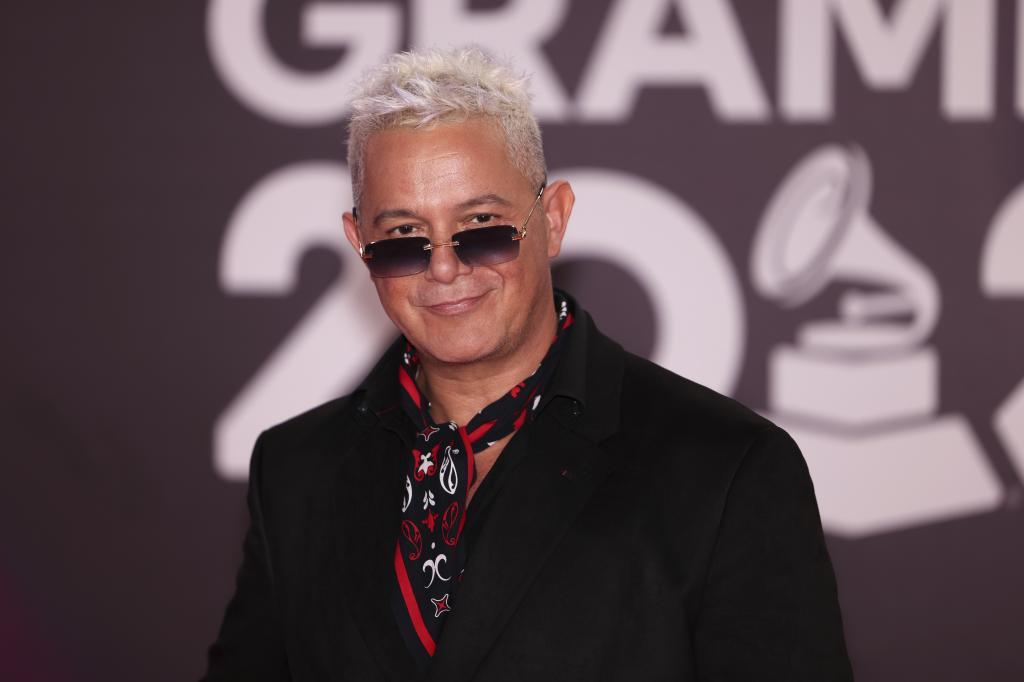
There is not much time left for Alejandro Sanz to return to where he came from. An iPad counts down. It's the last minutes of the final interview. "I love this hourglass. It's my ally," jokes the singer. Another one of our universal singers. He is promoting the documentary When no one is watching (Movistar Plus+), a journey through his biography, a first intermediate goal. This could mark the end of a stage. "Here we are always opening and closing stages. We seem like building doormen. Some close stages in one place, and others in your environment close them in another. The documentary serves as a recap and also as a photo album. There are some well-known things. Others not so much. The most interesting part is the versions given by the people involved in the process. Some are oblivious," he says about those who complement his story throughout three chapters.
Alejandro Sanz is a guy with a diluted Moratalaz, Andalusian by the way he looks at his surroundings and Latino by osmosis. In his way of pronouncing some words, his affiliation to the group of wandering artists whose nationality is the studio can be verified. Composing, recording, releasing albums, and promoting are routines. He speaks Spanish with a touch of a citizen of the world. "My relationship with current events is very toxic. I'm reading a chess book that is catching my attention. And reading [Charles] Bukowski. It's the best thing you can do in these times. We live in a circus of extremes. Everything you could find in a circus right now is in Parliament without any shame," he points out.
He came across Bukowski through Pulp, the latest novel by the American author. "It's surprising. It doesn't disappoint. I doubt very much that he could have written with that freedom in these times." Alejandro Sanz was a sort of mediator between Pablo Motos and David Broncano when they both coincided in prime time. The anecdote serves to taste the polarization. "I'm exhausted," he warns. "I wrote 12x8, a song, a while ago. The lyrics said: 'Stop informing this poor heart'. I need to rest. Polarization is the tool of the powerful. Ultimately, it's where they want to take us all. To be polarized. That way we are very manageable. There is no common sense. Just passion. You buy into one discourse or the other. And those of us in the middle are the worst. Well! We are extremists," he concludes.
Referring to the infringement of freedom of expression, or the artist's freedom, is a cliché. A chorus. Are we more constrained now than before? "Many ways of speaking that were taken for granted or valid have changed. Thought is formed with language structures. It is very liberating, for those of us who grew up in another era, to read writers like Bukowski. It's absurd, but art must have that absurd side and stay there."
The accusation against Julio Iglesias is bouncing, filed by the National Court Prosecutor's Office. Anyway, some of the videos starring the performer of Soy un truhán show a clash of civilizations. The past is very much in the past. "Everything is extrapolated. Everything is absolutely tense. Everything must be political. Like in cases like Julio Iglesias'. Let justice do its job and then we'll talk. Everything cannot be instrumentalized. I believe in democracy and justice. It is the best model, with all its flaws," he analyzes.
There is an environmental anger, something murky in the air, a repeated complaint -not a whimper-. "Someone said in an interview that we live in the best moment in Human History. I don't know if I agree, but it was like opening a window. I like to think so. Everything seems insufficient to us. The other day we were talking to someone who was where they make the boats in Africa. He said that many of the people who come from there do not live badly. They have a life... More or less. They come because they believe they will be better off. And they find that here they are not that well off either. Extrapolated to our situation, we live much better and yet we are not satisfied."
He seems a bit tired from the accumulation of questions. He jokes when he identifies a repeated one. It creates a certain closeness. He knows how to charm his interlocutor while practicing escapism. "After the holidays, it's hard to get back to work," he sighs. "No, I haven't been on vacation. But you have to switch gears for interviews. That thing of being at home all day in a robe... Then you have to put yourself here. Paco de Lucía, who was always in flip-flops all day, really hated shoes. You have to find yourself some round slippers or round shoes, he would say," he comments and settles in.
He no longer has any quirks. He is a man without quirks or superstitions. Airy, after all. "I've gotten rid of them. I swear. It's the best. I go to a concert to sing. I don't want to add more pressure." He ended up accumulating, among other things, a lot of bracelets. "I remember when they used to give me little bracelets at the beginning of tours. If the concert went well, it was because of the bracelet. In the end, you need another arm." He laughs again.