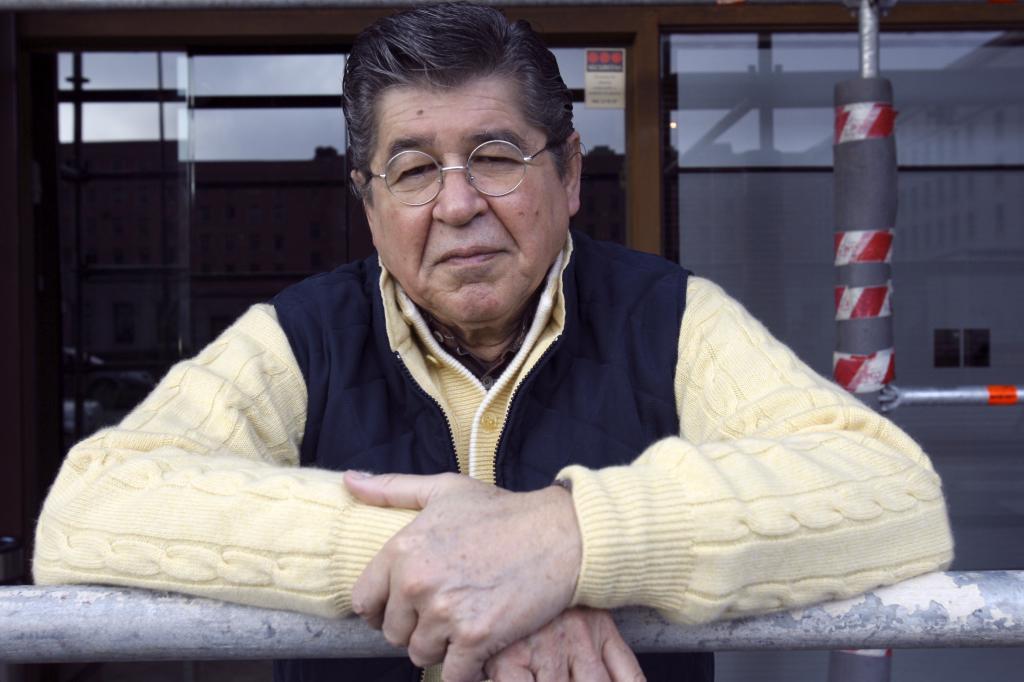
Peruvian writer Alfredo Bryce Echenique, one of the great names of the so-called Latin American post-boom, passed away on Tuesday at the age of 87. Sponsored by his compatriot Mario Vargas Llosa from the beginning, he was one of the great chroniclers of the Lima high society, the social inequalities of the country where he was born and raised, and also of identity and uprooting. A prime example of all this is his masterpiece A World for Julius (1970).
Alfredo Bryce Echenique was born into a banking family in 1939 in Lima, during one of Peru's democratic transitions in the 20th century. His education began at the Colegio Inmaculado Corazón and at the age of 15, he was admitted to the English boarding school San Pablo. He studied Law and Literature at the National University of San Marcos, eventually graduating in Literature from La Sorbonne in Paris in 1965.
To understand the beginning of his literary career, one must look back to the late 1960s and the figure of Mario Vargas Llosa. The Peruvian Nobel laureate was the first to read the manuscript of his short story collection, Closed Orchard, before it was published. He also recommended that Bryce Echenique present it to Carlos Barral, the editor of Seix Barral, to kickstart his literary career. This led to the publication of A World for Julius in 1970, his first novel and still his most celebrated work.
In this novel, with a critical and biting perspective, the writer unravels the intricacies of Peruvian aristocracy through the eyes of a child, Julius, a member of one of Lima's wealthiest families. Through the family relationships of this boy turned teenager, Bryce Echenique interweaves critiques of high society - the hypocrisy, class divisions, and even racism - that he had witnessed in his early years. Additionally, this novel, written in Paris, coincided with the rise to power of General Juan Velasco Alvarado, the nationalization of the International Bank of Peru where his father had been a manager and his grandfather president, leading to the downfall of his family.
Subsequently, he moved to the United States on a Guggenheim Foundation scholarship in the 1970s and later settled in Madrid in the 1980s, where he lived until the end of the 20th century before returning to Peru. His travels between the United States and Spain resulted in works such as The Exaggerated Life of Martín Romaña (1981) and The Man Who Spoke of Octavia de Cádiz (1985), exploring the lives of Latin Americans outside their continent. In essence, exile.
His literary career has earned him international recognition as one of the great Latin American authors of the post-boom, as well as the National Literature Prize of Peru in 1972 for A World for Julius, the National Narrative Prize in Spain in 1998 for Nocturnal Offender, and the Planeta Prize in 2002 for The Orchard of My Beloved.