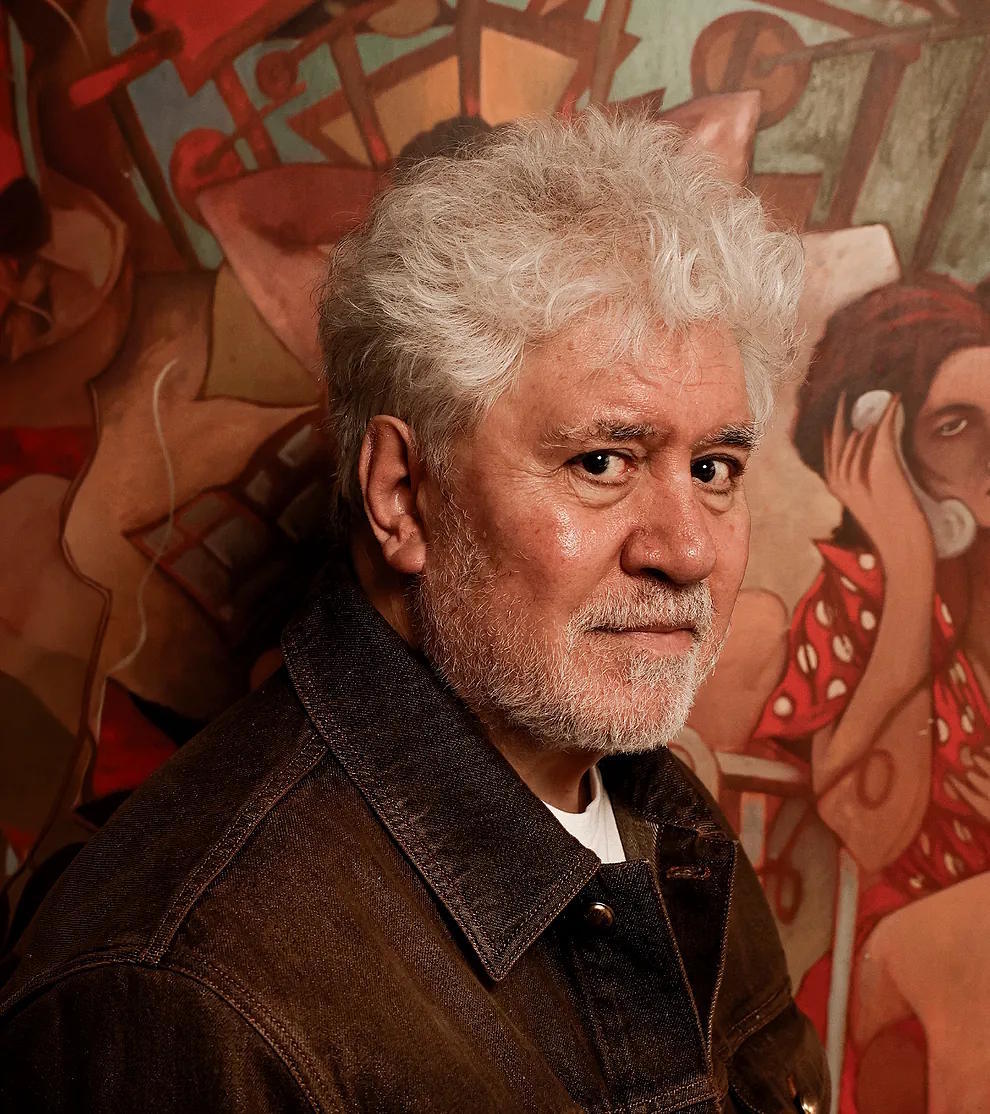
Pedro Almodóvar (Calzada de Calatrava, 1949) is having trouble sleeping again. The treatment he is following by medical prescription is at that moment when its effectiveness is diminishing. The body gets used to it, and what was once a shock is now barely tolerable. And that's when the time comes, once again, to make important decisions, to take risks, to change medication and even location, to try something different and much stronger. All in the name of regaining peace. That contradictory. It could be said that with the 24th film he is now premiering, something similar is happening. Bitter Christmas is the opposite of everything before, but at the same time perfectly identifiable, perfectly Almodóvar. Like a new medication, much more radical and painful, the film is there to achieve the renewed privilege of creation. The story of a film director possessed by fiction, by the act of creating itself, is the most autobiographical of his films (even more so than Pain and Glory), but at the same time the furthest from any hint of condescension. Each person in the filmmaker's universe has their character, their correspondence, their reflection, and their paradox in the film. And they are all stolen. "Those of us who write are dangerous to everyone around us", he says. The director welcomes us at the offices of his production company, tells us about his restless sleep, and recounts his desire, always his, to start over. And it's already been 24 times.
It is your return to Spanish after the Golden Lion, from your first feature film in English. And it is also a return with perhaps the most personal of all your films...
All my films are personal. But yes, it is true, the protagonist has my same job and many of his things I adopt as my own. Either way, my films always start with something I have experienced. Pain and Glory arose from the image of myself submerged in a pool. This one starts with a terrible migraine combined with a panic attack. And that is something I have personally suffered. All of that inspires me as much as what I see or read. But what I do is put everything into the arms of fiction. Then, everything changes. In this film, I talk about a film director who has, in turn, the alter ego of a female film director, and consequently, there are constant references to cinema that I fully endorse. But I have never made confessional cinema. What truly concerns me is the mystery in the genesis of every work. The relationship between inspiration and reality is something that has interested me for a long time. What happens is that here I address it in an absolute way. I would say that I am completely inside the film, but never in a literal way.
So we should not understand what we see as literally autobiographical...
I'll give you an example. When in Pain and Glory the character of the mother tells Antonio [Banderas] that he is not the son she would have liked to have, I am not speaking of myself literally. My mother never told me that. But it serves me to talk about strangeness. In truth, I was referring to the strangeness of other eyes towards me, which were the eyes of the people in the village, then the eyes of the children at school, and then the eyes of the people in Madrid when I arrived here, even though there were many more people like me. For a long time, I had to face that gaze of strangeness.
Would you say that, now that time has passed, you have overcome all those looks?
I could think that. If there was hostility between the world and me, I have come out ahead of that world that looked at me unfavorably. But I do not consider it in those terms. I come from La Mancha and Extremadura. I come from a family that had no money, and when I arrived in Madrid, I did not know anyone at all. However, I had an obsession and a clear path traced. My vocation was resolute, and in fact, that vocation saved me from many dangers of the 80s. Since there was no Film School anymore, I started making films with a Super 8 camera and thought I would stay there. Perhaps I could have made the leap to 16mm at most. I saw myself like Adolfo Arrieta making crazy films for a very small clientele. That was my dream.
Returning to Bitter Christmas, there you draw on stories not only your own, very personal, but also from those closest to you. I wonder if art, creation, justifies everything.
It depends. But in general, I believe it does not justify everything. But as a creator, what affects me the most and inspires me the most is the people in my environment, that is, the people I love. This issue is formulated in the film when the protagonist states that he only knows how to work in the most absolute freedom. He is then asked: no matter what? And the character of the director does not answer. Like him, I also do not have a clear answer. What I do say is that we writers are dangerous people for our environment. It is in the nature of the work. The other day in an interview with Emmanuel Carrère, he said that a family with a writer inside is a family with many problems. And it is true. When you write and an idea comes to you, you do not stop to think where it comes from. Only later you may discover that it comes from very close and is probably based on pain. Because, at least in my case, what always inspires is pain. You never think about the other, you think about the narrative. Iván Zulueta explains it very well in Arrebato. When the red frame appears - which in Bitter Christmas reappears as a pulsating cursor - you cannot resist the call of the plot. There is no force that can resist that call. I recognize that when inspiration comes, you only think of yourself. It is total selfishness. Creation is that messed up. Although I have always thought that if I hurt someone, I believe I would realize in time to apologize or simply stop doing it.
I think of the case of Luisgé Martín and his book The Hatred [based on the confession of parricide José Bretón]. The book was published, and the publisher withdrew it at the mother's request...
I find it a very interesting case. I understand perfectly the decision of the publisher to withdraw the book in response to people's reaction who do not want a psychopath to receive money from author rights or publicity. But I think of the case of In Cold Blood by Truman Capote. In that case, the publisher wanted to release it as soon as possible, but Capote did not want to because he did not feel strong enough to face that boy who was on death row, who had almost been like a son to him, and who, upon seeing the publication, would realize that he had been exploited in some way. But, of course, In Cold Blood is a masterpiece. I do not know how The Hatred is. In any case, the fact that a psychopath does not profit after killing his children seems to me a legitimate reason not to publish a book. On the other hand, when someone sheds light on a brutal, savage, and almost inaccessible area of the human being to the rest of mortals, I also appreciate that perspective. In truth, that is one of the reasons for the existence of art. However, it seems that the world is moving in the opposite direction. There is a tendency to reject everything that is uncomfortable... It all depends on how you look at it. Following what I said, what I think should have been prohibited is the video that Trump made with AI turning Gaza into a tourist resort. I am never in favor of censorship, but those specific images seemed to me such a huge outrage that if it were in my hands, I would ban them. It violates the most basic human rights; it is completely immoral.
From what you say, you do not at all agree with what was proposed by the president of the jury of the last Berlin Film Festival, Wim Wenders, and by the Berlinale director herself, that films have to speak for themselves and that there are enough directors talking about politics...
I do not agree at all. Authors have opinions because we are citizens like anyone else and have the right to express them. I find a statement like that terrible and scandalous. Not talking about politics when you have a platform and a voice as an author is a form of collaboration. Fortunately, there was a reaction. Although it was a pity that the controversy ended up overshadowing what was truly important, which were the films. It is very serious, especially considering the times we are living in. It has never been as important as now to express oneself politically.
Let's get to it. What do you think of the continuous rise of the far right in poll after poll?
I am absolutely terrified. Furthermore, I demand of myself every day when I wake up to be an optimistic person. I tell myself: "This has to change." Fortunately, it seems that there is movement on the left to unite and that things are finally changing, albeit late. But I am horrified. I believe we are in the worst moment since democracy began. The saddest part is that when you think of the United States, you see that they are living under a fascist dictatorship, but they have reached it with the votes of the people. This makes you think that what is at risk is the very idea of democracy; the idea that political parties represent us. Every day I wake up to even greater surprises. I think no one in their right mind would have imagined something like this in 1992. Not even in the worst nightmares would anyone have thought that, over time, 25% of young people would declare that they would not mind living under a dictatorship.
What do you think we have done wrong?
No idea. But it is urgent to explain to these young people in the family or at school our recent history. No one who knows the dictatorship can think of returning to it. It is simply ignorance.
Clear. Returning to what we were talking about before regarding discomfort, one of the most uncomfortable moments in the movie is precisely when the director is challenged by a person who feels deceived, robbed by him.
That's why I said that writers are not trustworthy people. What destroys anyone else, feeds us. And that's not because you are superior to anyone, but because it's in the nature of your work. You work with that, and that's why I like to say that there is never a bad situation for a writer.
Do you consider yourself a narcissistic or self-indulgent person with your own quirks as a creator?
No. In fact, I had a lot of fun with the scene where the director, who in a way represents me and is played by Leonardo Sbaraglia, is somewhat exposed, in a slip-up. I would say that more than narcissistic, I am selfish because I believe that the value of an idea is absolute and above any moral consideration. And I know this matter is very delicate. Carrère, for example, mentions that his mother stopped talking to him for two years and he had to put in writing to his wife that he wouldn't use her life in his works.
Have you been in a similar situation?
No. I experienced something that could be considered the opposite. Once I used fiction to make reality something livable, even something wonderful. The role of María Barranco in Women on the Verge of a Nervous Breakdown is based on a friend of mine. In the movie, she lived with a Shiite terrorist, but the truth is that my friend lived with an ETA member and even spent nine months in prison because of it. The film went around the world. When she saw it, she was horrified. I told her it was impossible for anyone to notice, and she replied that he, the terrorist, would recognize himself. The truth is, I was convinced her reaction would be the opposite. I created a comedy character to get back at reality, convinced of the power of cinema not only to heal but to turn pain around.
A good part of the most tragic of Bitter Christmas, as we mentioned earlier, has happened right here at the Deseo production company...
The inspiration for Aitana's character does resonate with something very painful and very close, but I prefer not to talk about it. What I will say is that the reaction has been one of complete understanding.
Do you consider yourself a tyrant as a director?
The truth is that being a director gives you enormous power, you are a kind of demigod. You can ask for anything, and it is granted simply because you are the director. But the one I am most demanding and least lenient with, as I mentioned, is myself.
The paradigm of a tyrant director with oneself and with others may be Bergman...
Bergman is a unique, admirable, and terrible case at the same time. It is somewhat explained by his circumstances. He had a terrible father, and I remember reading an interview where he confessed that he completely understood why his children hated him. "I have been the worst imaginable father," he confessed. Bergman's lack of complacency with himself through his films is incredible and terrifying. The opposite example would be Fellini. He did everything with joy until his last film, Interview, which is a very minor work. Bergman, on the other hand, films Saraband and prohibits it from being shown in theaters. One is a hedonist, and the other cannot shake off the Calvinist father.
Who do you feel closer to?
To Fellini, without a doubt. We belong to a very similar culture. I remember how he saw himself as a creator, imagining himself with a whip hitting all the women in his universe. Right now, that image would be impossible. And it surprises me that no one has said anything. Is that image what defines a creator? Well, yes, even though it's hard for us to accept, that's how it is. The difference is that the whip is almost always used against oneself. As Capote said, God gives you a gift and a whip, and the whip is for self-flagellation.You mentioned Bergman and thought about his devotion to the close-up, which is becoming more pronounced. I find it increasingly difficult to separate from the actresses. It happened with Julianne Moore and Tilda Swinton, and it has happened again with the four in Bitter Christmas [Bárbara Lennie, Aitana Sánchez-Gijón, Victoria Luengo, and Milena Smit]. Bárbara's power is incredible. What I have learned is that when an actor doesn't falter, you shouldn't separate, and yes, I have never used the close-up as much as in this film.
Not even the tears, in few films do actresses cry so much and so well...
Yes, I have been very lucky with these cryers. The curious thing is that each of them reaches tears in their own way. Milena lives in an igloo of pain in the film due to the loss of her son, but Bárbara is capable of going from a cold, narrative shot to tears just like that. It's admirable. I am very proud of the tears in Bitter Christmas, from all of them. It should be noted that this film is the riskiest I have ever made in that sense. When I was writing, I laughed thinking that each sequence was more challenging than the previous one. I was very aware that I was writing very un-cinematic sequences. It's very difficult to depict a panic attack combined with a migraine because both pains don't translate well on screen. How do you film darkness? And everything is that risky. Even introducing comedic scenes within tragedy is very complicated. But it turned out that way...
Why does a director with a full display of awards, recognitions, and honors feel the need to take risks?
It's instinctive, it's a way to feel alive, to get closer and closer to danger.
Do you fear, as you mentioned with Fellini or Bergman, ending up creating a lesser work?
Definitely, I don't want to create lesser works. Just the idea of telling yourself, "I'm making a lesser work," seems very sad to me. Also, I will say that the next ideas I have for upcoming films are even riskier. I want to believe that danger goes with me.
Do you fear the downfall that always comes with risk?
Once I was asked if I was always sure. I remember it. The only thing I have learned is that when I'm not sure about something, I don't communicate it to the team. Because it creates absolute chaos. Every day you get asked at least 100 questions. Of which, 25% you don't know the answer to. But you have to give it. And not hesitate. Even if you doubt. That's what being a director is about, making decisions. The curious thing is that later in life, you are unable to make certain decisions.
At a certain point in Bitter Christmas, Sbaraglia, embodying Almodóvar's alter ego, hesitates. We won't say more, but have you ever found yourself in a similar situation?
No, never. I have never experienced five-year droughts without writing anything like the character. But situations of uncertainty, yes. Having crises is part of the job, and responding to those crises as well. And you have to face crises with persistence, not giving up. The script for Talk to Her was in the drawer for 15 years. The key is to be self-critical, never complacent, and insist for as long as necessary. Each project has its time. Women on the Verge... came out all at once in three months of writing and was my biggest success.
How do you remain self-critical when surrounded by recognition?
You just do it. You do it without fear, but at the same time with fear. Fear that it might go wrong, but without fear when it comes to taking the leap.
You are perhaps the filmmaker who, since Law of Desire, has used more filmmakers as protagonists. What does this mean?
I don't know what it means, but I know where it comes from. I am fascinated by the cinematic language itself. When I filmed Pepi, Luci, Bom and Other Girls Like Mom, I knew nothing about cinema. I had no idea what the axis was or anything. Then I used my first tracking shot in Dark Habits, and then you start to realize that you need very powerful reasons to change a shot. As Godard said, it's a moral issue. When I place a director as the protagonist, I don't feel like I'm talking about myself, but about a director in the process of creating a work, a film. Turning the cinematic language into a character fascinates me.
I think it's also a matter related to the current times where cinema is somehow questioned. There may be a need to reclaim cinema as a language.
Yes, and the truth is that very good cinema is being made. Just look at the Oscars. There is a curious fact that the five films nominated for Best International Feature Film are the best of all. From Sentimental Value to The Secret Agent through Sirat, any of them are better than The Sinners or One Battle After Another. But yes, the impression I have is that platforms use auteur cinema simply as a marketing tool to promote themselves, but in reality, they are not interested at all. It seems that right now, in general, very TV-friendly cinema is being made. That's why the role of festivals is important, for their role in showcasing true cinema, auteur cinema.