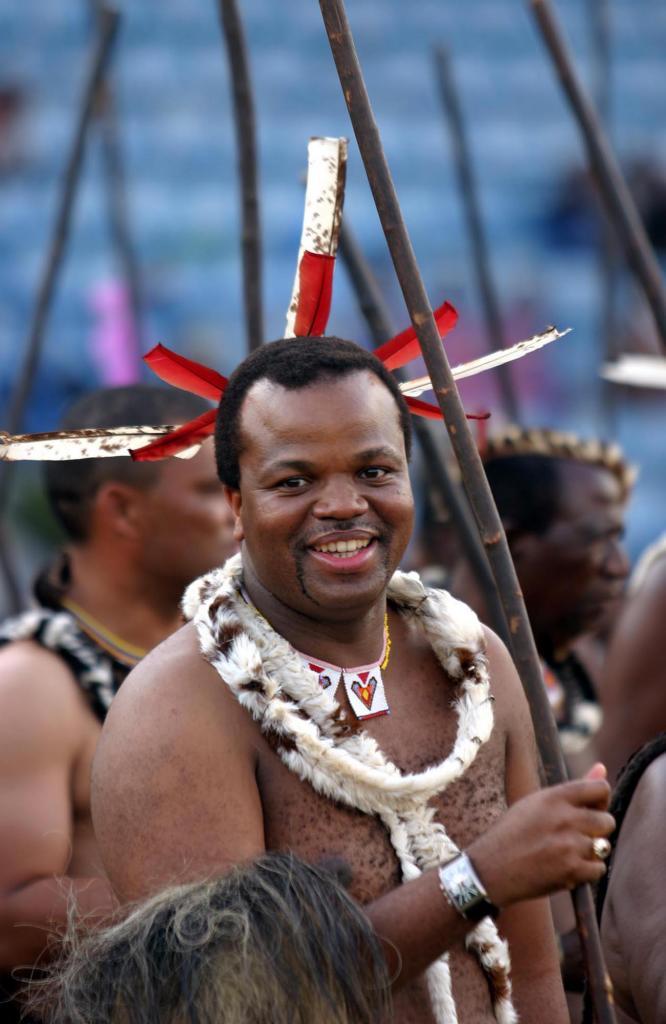
Such is the power of King Mswati III of Eswatini - better known in the country as Eswatini - that he has ordered the widowed women of Ludzidzini - the place that houses the main residence of the reigning dynasty - to shed their black mourning robes these days so that nothing spoils the festivities that the nation celebrates for his 58th birthday and, above all, the 40th anniversary on the throne, to which he ascended on April 25, 1986. That's what it's like to be the last absolute monarch on the African continent.
Eswatini - with a population of 1.3 million inhabitants - has been celebrating with great pomp all week a sovereign who has never had any intention of acceding to the pro-democratic demands of opposition groups - political parties are prohibited - and who enjoys luxuries, eccentricities, and a lifestyle that are truly offensive considering that we are facing one of the poorest countries in sub-Saharan Africa. The plump little king does not like any kind of freedoms or individual rights. Lately, he has been fixated on the LGBTQ+ community. "Homosexuality is an evil act in the style of Sodom and Gomorrah," he vociferated in his Easter Message to the Nation earlier this month, warning that as long as he remains on the throne, he will never allow the presence of homosexual people in his realm.
One of the central acts of the celebrations for these four decades of absolute power is taking place this Friday at the Somhlolo National Stadium - in Lobamba - where tens of thousands of citizens acclaim Mswati, surrounded by a good number of leaders who have traveled to Eswatini for the occasion, including the presidents of Mozambique, Zimbabwe, and Botswana, as well as the kings Letsie III of Lesotho and the Zulu Zwelithini.
The adverse weather conditions, with cold and overcast skies, are not discouraging the thousands of attendees, who greet the arrival of dignitaries by singing traditional songs. Everywhere, there are posters with images of the king, whose face is even printed on the clothing of many citizens, including the tunics of the queen consorts. The arrival of Mswati's mother, Queen Elephant Ntombi, received one of the loudest ovations. At 76 years old, her health and mobility problems are evident, and she entered the royal box of the stadium with the help of a walker.
The last to arrive at the ceremony, as protocol dictates, was the monarch himself, who did so in military uniform and riding in a convertible with which he toured the entire circumference of the stadium to receive the greetings of his present subjects, who are experiencing a festive and historic day for the nation.
The army band played the national anthem as soon as Mswati stepped onto the field, followed by a thunderous applause from the audience. This was followed by performances of more festive songs, including, of course, Happy Birthday to the king.
In previous days, all kinds of traditional ceremonies had taken place, such as the presentation of gifts to the monarch by his subjects. According to local media reports, the gifts - including over 250 heads of cattle, various objects, food, and monetary donations - have exceeded this time one million euros. A trifle for a king whose personal fortune is estimated at least 50 million, according to Forbes, although other sources indicate that it would be much higher, as he controls an investment portfolio with stakes in national sugar refining giants, the main dairy company, and a hotel chain, among other corporations.
Monarchy's Claim
"The monarchy enjoys enormous popular support and will endure in the coming years," declared on Thursday Percy Simelane, spokesperson for King Mswati, in an interview with Swaziland News on the occasion of this jubilee. "Eswatini is the oldest nation in southern Africa. It has been ruled by more than thirty kings. All survived evolution and remained relevant. Evolution in other countries devoured kings, but not in Eswatini. The main media predicted that 2011 would be the last year of the Monarchy, during the sadly famous Arab Spring uprising, but it was not so," boasted the royal spokesperson. Naturally, he remained silent about the increase in repression, as denounced by NGOs, or the news of the detention of opponents in recent weeks, so as not to tarnish the celebrations in honor of the sovereign.
Mswati succeeded his father, King Sobhuza II, who went down in history for records such as the 82 years he held the head of state position - shortly after birth - or his 70 wives and 210 children. When he died in 1982, Mswati was only 14 years old, so a regency period was established in his name until he reached the age of majority. He is unlikely to surpass his predecessor in the number of consorts, but for now, he has been married 16 times, or something like that. Although two of his wives have left him and two others have already passed away: one due to cancer, and the other took her own life with over 40 amitriptyline pills, a drug for conditions like bipolar disorder, as reported in South African media.
Tradition dictates that the monarch is imposed the first two wives, chosen for reasons of State, with great influence from the mother of the sovereign, known as the elephant queen, who symbolically shares power with her son. He chooses the following wives all by himself, usually in the famous ceremony where thousands of young virgins gather each year to dance around the palace where the queen mother resides. Mswati III's principal wife is Simbonelo Mngomezulu, known as Inkhosikati (royal wife) LaMbikiza. The last known consort is Nomcebo Zuma, daughter of former South African President Jacob Zuma, who, at 21 years old, married Mswati in 2024, "for love," as he proclaimed to the four winds.
One of the milestones of our protagonist's four decades of reign occurred in 2018 when he decreed that Swaziland would be renamed the Kingdom of Eswatini, a decision he justified by his annoyance at the country's name being confused with Switzerland due to the similarity in English spelling. Although the decision raised suspicions as it also represented a purely nationalist gesture since Eswatini, which in the local language means land of the Swazis, is a direct appeal to the majority ethnicity, which unsettles minorities.