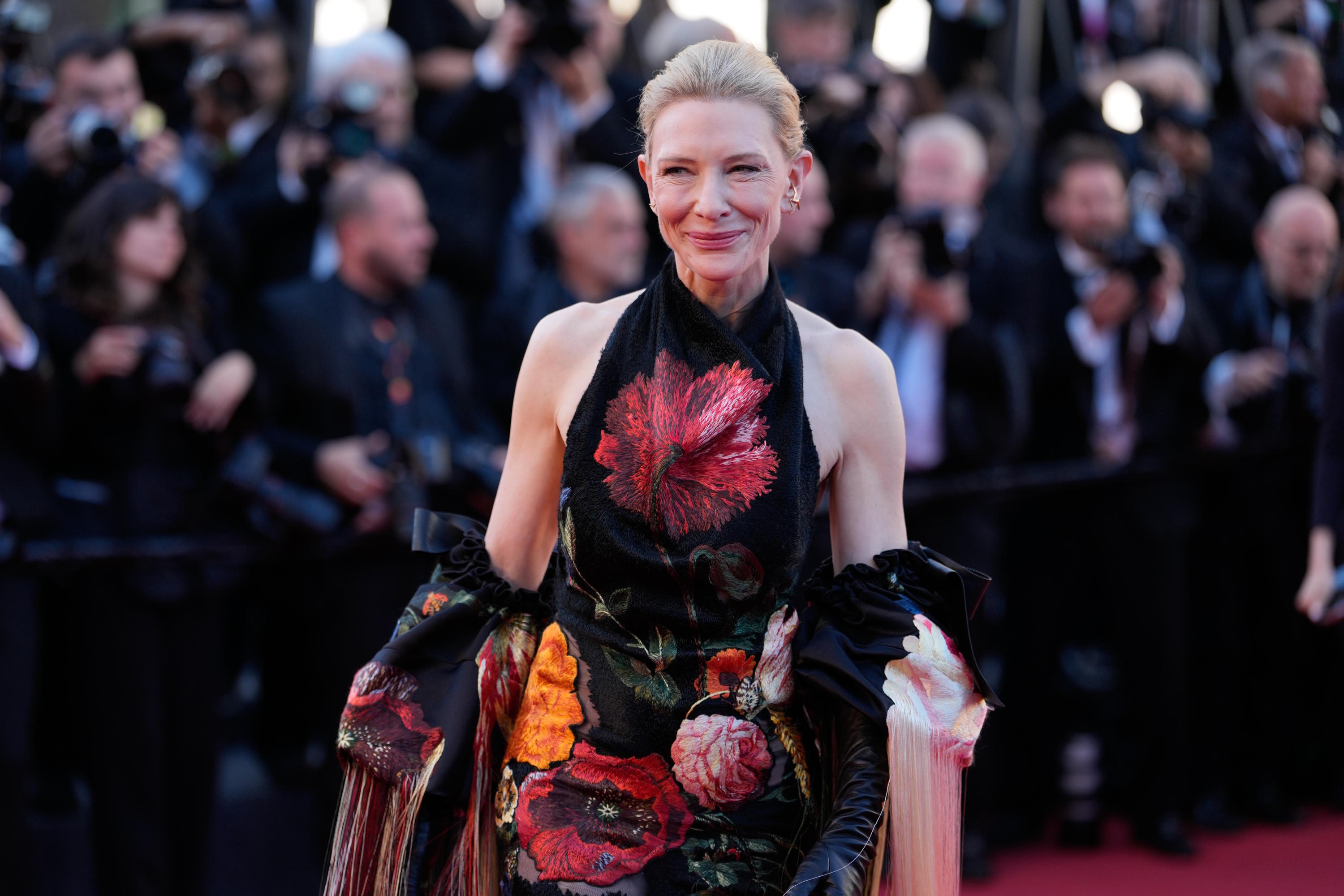
There are characters whose mere presence justifies, if not an entire festival, at least part of it. Cate Blanchett (Melbourne, 1969) is undoubtedly one of them. The Australian actress, a two-time Oscar winner, has been seen in every possible way and always excelling. She has been Queen Elizabeth of England, Katherine Hepburn, Bob Dylan, and even Galadriel, the eternal elf. Let's not forget, she was also Jasmine, Carol, and Tár. It's a shame that the dream of seeing her embody Lucia Berlin's voice in Almodóvar's project revolving around Manual for Cleaning Women did not come to fruition.
In Cannes, where she has not yet won an award, she presented The Aviator in 2008 and, to make it clear how she felt when Martin Scorsese called her for the role that would earn her first statuette, she said: "Shitting bricks". In other words, literally "shitting bricks". And figuratively, scared to death. Later, over time, she became the president of the Cannes jury in 2018 and, true to her expressive clarity, she was the one to denounce the sexism of a festival that, up to that precise moment in its long history, had featured 1,866 male directors and, pay attention, only 82 female directors. Sexism had a number: 4%. On that occasion, exactly 82 women gathered on the red carpet like 82 howls.
This Sunday, the actress once again took the stage, now simply as a decent teacher, to review her career, reflect on the future of her profession, and, most importantly, make it clear to the audience in a packed Debussy hall that things have not changed much since then. "The Me Too movement was annihilated very quickly", she said, as soon as the topic was brought up. And she continued: "There are many people with a public platform who could speak up with relative safety and say, 'This happened to me.' And they no longer do. It's a shame because there are still many women who could join the denunciation. Things are still wrong, and there are still abuses. The question to ask is why it is silenced." Pause. "What [the movement] revealed is a systemic attitude of abuse, not only in this industry but in all layers of society. And if a problem is not identified, it cannot be solved."
For the actress, the current silence in the media on the matter is incompatible with the reality that, she said, she experiences and encounters every day. According to the Australian, little or nothing has changed since Me Too made headlines, fueled protests, and sparked editorials. "I count the crew every day on the sets I walk onto daily, and I still see the same thing I saw decades ago... I barely find 10 women among nearly 75 men. And that's the case every morning, day after day, no matter where in the world I am," she said. And she added: "I love men, be careful, but I can't take it anymore. Their jokes have become too repetitive. Not only is the situation we are living in unfair, it is also profoundly boring. And that, whether you like it or not, affects the outcome of the work."
The women's march she led during her presidency was supported by names like Agnès Varda, Kristen Stewart, Léa Seydoux, and Ava DuVernay. At the time, it made all kinds of headlines, and it seemed, given the impact of the image, that there would be no turning back. But there is. Just this year, out of the twenty-plus films in competition, there are only five female directors.
"Women are not a minority in the world, but the current situation in the industry indicates otherwise," said Blanchett back then. "As women, we all face our own challenges, but today we gather on these steps as a symbol of our determination and commitment to progress. We are screenwriters, producers, directors, actresses, cinematographers, talent agents, editors, distributors, sales agents, and all the people involved in the cinematic arts," she read as a manifesto, and everything indicates that the wind did the rest and carried away each and every one of the words.
Shitting bricks. And not out of fear.