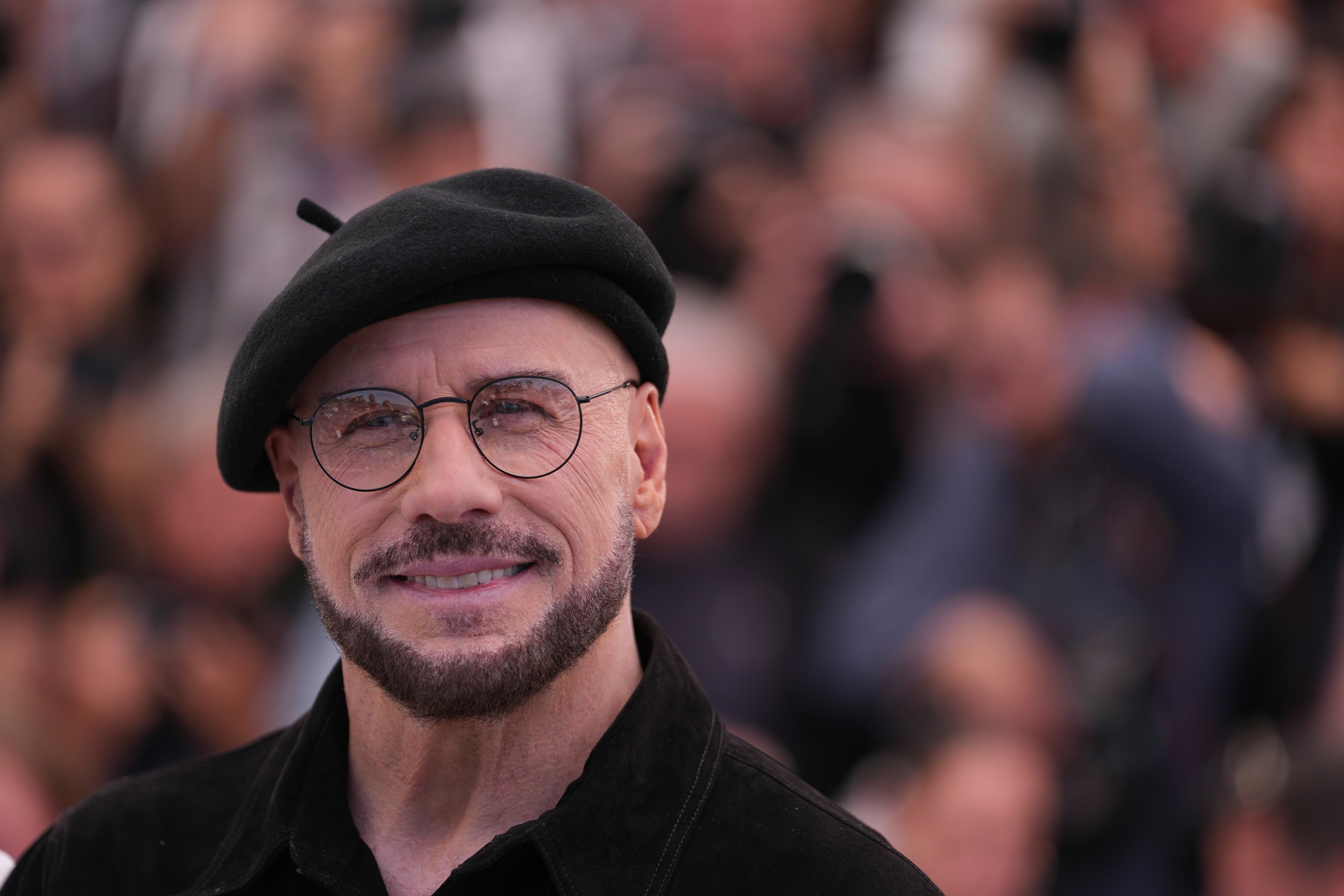
Here is John Travolta (Englewood, 1954) and the large photograph of Uma Thurman that decorates the room at the Croisette hotel where he meets with the press takes on another meaning. The real one. The actor who portrayed Danny Zuko, Tony Manero, or Vincent Vega is now, in addition to the legend he has been since the 70s, a film director. The proof is the film Come Fly with Me, just an hour long, premiering on May 29 on Apple TV.
The film is essentially just a plane journey. But, if you look closely, it is also something more: a stroll down memory lane, a return to a time when smoking was allowed anywhere, and, why not, a tribute to the actor's second obsession after cinema, aviation. Let's not forget, Travolta is a pilot. Just a few days ago, the Cannes Film Festival surprised him with a surprise honorary Palme d'Or. Just before sitting down, from top to bottom, with his cap, his smile, and his beard (all three perfect), he recalls the emotion he felt seeing himself in the temple of auteur cinema honored with such recognition. "The tears were real," he points out.
Question. How old were you when your love for aviation began? Were you as young as the child we see in the movie?
Answer. Even younger. I would have been five years old. We lived in New Jersey, with the airports of Newark, Kennedy, and LaGuardia nearby. When the planes took off, they passed about 600 meters above my head. If you looked closely, you could see TWA, Eastern, or United, and at night, it was quite a spectacle. You could also hear them. The planes made a lot of noise back then. I remember asking myself: who is on that plane? How does one feel when flying?
Q. The movie is based on one of your books. Do you remember when and how you wrote it?
A. I wrote it during the years when Look Who's Talking became a worldwide success. The truth is, I didn't even have time to breathe. I wrote it in 10 days. I was in a hotel in Maine unable to go out because of the fog, and I just dove into it. I worked from midnight until 6 in the morning, before our plane was ready. I stayed up putting all my childhood memories into writing. I like to think that the spirit of the child I was is there.
Q. What scares you the most: flying a plane, writing, or directing a movie?
A. I wouldn't speak of fear in any of those cases. First, I am older now. I have seen filmmakers make great movies, good ones, mediocre ones, and not-so-good ones. After 55 years of watching people make movies, I can see what works and what doesn't. You learn from seeing people make mistakes, so you try not to make the same ones. You do things as you believe they should be done, add passion, and that's it. Directing the movie was very straightforward. Exhausting, but not difficult.
Q. You mentioned that the movie is about your childhood, but in reality, your whole family is portrayed. One of the actresses is your daughter Ella Bleu Travolta, and the character of Kelly Eviston-Quinnett has expressed that it is inspired by your mother...
A. Regarding my daughter, I will say that a star has been born. I designed plans to introduce her to the world as one would with Audrey Hepburn, Liz Taylor, or Grace Kelly. She lives up to it.
"I miss smoking on planes, that mix of tobacco smell and 'cordon bleu' chicken baking"
Q. The golden age of commercial aviation that obsesses you so much, would you say it coincides with the golden age of Hollywood?
A. They run parallel. In the movie, there are 32 masterpieces of music, and half of them are soundtracks from movies of that time. That gives you an idea of the kind of cinema that was being made.
Q. How would you say that current cinema respects the legacy of that golden age: good, bad, average?
A. I prefer to focus on the music, and the truth is that the golden age of cinema used music better than we do today. They were more visually and musically aware. They understood perfectly that image and sound have to be coordinated. It is impossible to imagine Last Tango in Paris, for example, without Gato Barbieri's music. Music creates between 50 and 70 percent of the magic of a movie. The Godfather wouldn't be what it is without Nino Rota.
Q. Just as music is used differently, airplanes are too. How do you think the flying experience has changed?
A. There was a romantic component that has been lost. Just the act of dressing up to fly made it a special occasion. I miss many things: I miss the food cart (no closed trays like now), and I even miss smoking. The mix of tobacco smell and the cordon bleu chicken baking let me know I was on a plane.
Q. Which directors you have worked with have inspired you in this new endeavor?
A. There are many beyond those I have collaborated with. When I received the Palme d'Or the other day, I said that most of the films that had won it were my references: Fellini, Bergman, Lelouch, Truffaut... When I saw Black Orpheus by Marcel Camus, I didn't know it had won the Palme d'Or, but the music, the samba, the bossa nova seemed magical to me. And later, A Man and a Woman by Claude Lelouch, with that romantic music, fascinates me. As you can see, the references are always musical. When the protagonist looks out the window, she wants to be a mix between Crawford and Stanwyck; when the golden light dances on her face, that's Bergman; when the child looks at the stewardess and understands her dreams, that's Black Orpheus...
Q. Is this new directorial facet a whim or a new direction for you?
A. If I were to do it again, I would have to be equally inspired. When you are completely inspired, like Quentin Tarantino in Pulp Fiction, it's not a job, it's your drive.
Q. Has Tarantino seen 'Come Fly with Me'?
Not yet, but he congratulated me, though.
Q. Have you ever stopped to think about your legacy in cinema?
A. Never. I wouldn't know what it is. In fact, I only became aware of something similar when I received the Palme. Cannes makes you feel important.