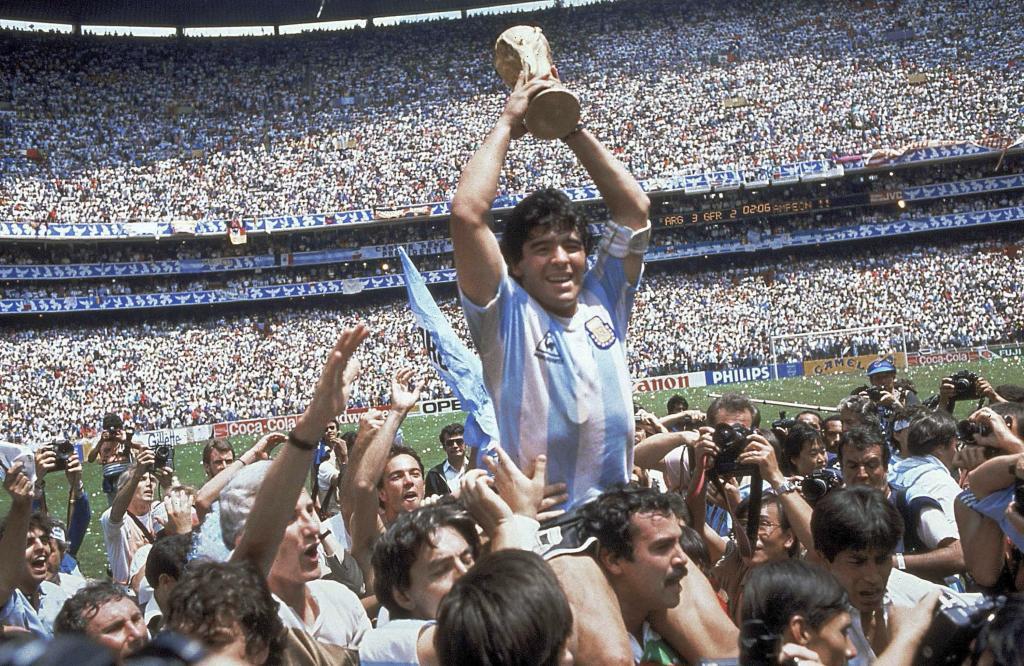
The chant that encapsulates their desire to win this American World Cup will begin to echo in the stands of Arrowhead Stadium in Kansas City, in the voices of thousands of Argentinians. This time it's not just about giving Leo Messi the glory he lacked, as in Qatar, or about bringing out a generation that barely remembers a few images from the '86 final at the Azteca and who bitterly cried over the defeat against Germany in Brazil a decade ago. They want to see Argentina claim the fourth star, yes, but in this championship, there is also a desire for revenge that is evident in the second verse of the cumbia song that Palmito has adapted: "And 32 years later/The Scaloneta will avenge/The Cup that was stolen from the 10/The one we were not allowed to lift".
That Argentina team coached by AlfioCocoBasile showcased their authority in the first match against Greece with a 4-0 victory, with Batistuta's hat trick and Maradona's contribution, celebrating in front of the camera, a moment that became historic. "I had scored three goals in my first World Cup match, and Diego took all the glory," joked the historic Fiorentina striker years later. It was a group that was starting to have fun.
Against Nigeria, the next opponent, it was Caniggia who scored two goals (2-1), and it seemed like they were on track for group leadership, although they still had to beat Bulgaria with Hristo Stoichkov, a team that would go on to make history for their country.
Maradona left the field that match in Boston hand in hand with a nurse: it was time for the anti-doping test. Along with him, central defender Sergio Vázquez, who had stayed on the bench due to discomfort. Years later, he recounted how Maradona entered the locker room joking around. Not a hint of tension. Days later, FIFA announced the positive test of the number 10 for a "homemade cocktail" of stimulants, including ephedrine.
"They cut off my legs, mine, my family's, and those around me. They took us out of the World Cup, out of the dream, and me out of football. I don't want another rematch, I have my arms down and my soul shattered. I want it to be clear to the Argentinians that I didn't drug myself. I didn't run because of drugs. I ran for the heart and the shirt," Maradona's words were a bomb that sank the albiceleste. Nobody on the streets doubted him, but it is still believed that the AFA did not defend him sufficiently. Perhaps because they did doubt. Diego had been suspended by the Disciplinary Committee of the Italian Federation for 15 months because in June 1992, he tested positive for cocaine after a match for Napoli against Bari. It was the last of the 25 tests he had to undergo that season, but his addictions abruptly halted his football career.
It was Bilardo who revived him at 31 by taking him to Sevilla, where he reunited with Simeone and played 26 league matches and four Copa del Rey games. He scored seven goals between the two competitions (against Celta, Sporting, Albacete, Zaragoza, Rayo, Mérida, and Alcázar). But the relationship soured due to his clashes with Bilardo, and in mid-1993, he moved to Newell's Old Boys. In the Rosario club, injuries prevented him from having continuity, yet he was able to return to play for Argentina in the qualification for the United States World Cup.
He achieved this by working hard with his fitness coach, Fernando Signorini, but also with the help of a controversial figure: Daniel Cerrini. All eyes turned to him when the positive test was announced. There were doubts that he had administered that stimulant cocktail behind the backs of the AFA doctors. Their president, Julio Grondona, did not request a second test, something that is still remembered, as well as Joao Havelange, who saw his Brazil become World Champions, making him his vice president at FIFA. "Someone was afraid of us and kicked us out," Maradona recalled years later.
The damage was immense. The star was expelled from the tournament and never wore the national team shirt again. His assist for Caniggia's second goal was his last service to the country.
The scandal was followed by shock, and the team could not recover. "We lost our guiding light," confessed Roberto Sensini, the full-back, in an interview with FourFourTwo magazine a year ago. Diego's departure left one of the favorites to win the World Cup without leadership, forcing them to mentally rebuild to compete again. They couldn't do it. They lost 2-0 to Bulgaria, finished second in the group, and were sent back to Buenos Aires by Romania with Gica Hagi, Belodedici, and Popescu, who defeated them 3-2 in the round of 16.
Some see in the Scaloneta the unity and quality that those players had, and therefore believe they will avenge that offense, starting by defeating Algeria. An uneven match, but with the memory of the stumble against Qatar.