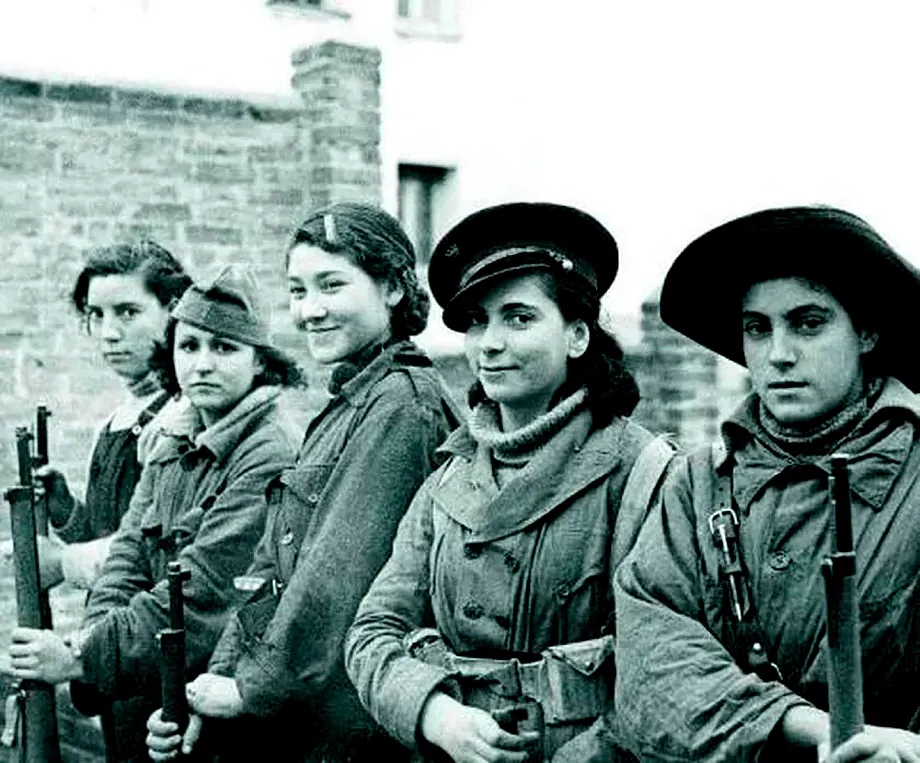
Each one smiles in their own way. Four of them look at the camera. The first one challenges it; the second one, with a friendly gesture, flirts with it; the third one prefers other distractions; the fourth one seems surprised by the photographer's attention, and the fifth one senses that perhaps destiny lies behind the lens pointing at her. They all carry weapons, all know they are on the brink of lives that have just begun. The image, almost an icon, was taken somewhere in Spain and at some point during a Civil War that had just begun. It is not known for certain what became of each of them. But it is not difficult to imagine nothing good amidst all the bad. The last one mentioned, the one in the background, the one who is wary, is Angelines Fernández. She was no more than 14 years old at the time. It was cold then. She did not know she would lose the war she fought in. She did not know she would leave the country where she was born. She did not know that all the tragedy hidden in a photo essentially cheerful was nothing more than the omen of a lifetime dedicated to comedy. No one knew then. Then no one knew anything.
Between that image and any of the portraits where that same girl appears characterized as La Bruja del 71 or Doña Clotilde in the early seventies, a whole lifetime passed. That girl with a rifle in hand who knew nothing would end up becoming a myth who desperately invoked Satan (her cat, not the devil) with the same energy and rage that she unintentionally called out "¡chingüengüenchón!" to none other than El Chavo del 8. It is said, without ever being clear on what is being said exactly, that comedy is tragedy plus time. In Angelines' case, the reflection seems to make perfect sense. Everything suffered in the cruelest of fratricides acquired over time in the life of the most hidden and surprising of Spanish actresses the privilege and virtue of meaning (or meaninglessness, depending on how you look at it).
Angelines Fernández, according to her unwritten biographies, wanted to be an actress and, although there is no record of her early work anywhere, the truth is that very soon, too soon, she left everything for the war. The photo bears witness to this. When it all ended, she was left alone, without work, and under the threat of being discovered. A photo is never innocent. Perhaps that gesture between fear and distrust is because she already had something of a witch in her back then. She left Spain in 1946 when the end of the other war, the greatest of all, brought no change to Spain. She first arrived in Havana and from there, without fortune heeding her pleas, she jumped to Mexico. Remember, the government of Lázaro Cárdenas welcomed around 25,000 exiles rejected by other countries under the Montevideo Convention with no more requirements than their request. There everything changed. Time took its toll, and drama turned into the most brilliant of farces.
Indeed, this Madrilenian born in 1924 struggled to touch that coveted and futile thing called success. But she stood her ground, always very attentive to the camera. Her arrival in Mexico coincided with what time has once again defined as the golden age of cinema there, with the legendary Churubusco studios newly created in 1943. Her face would become a familiar presence in the cinema of the 1950s alongside directors like Miguel M. Delgado, not far from the global explosion of Cantinflas with whom she shared the cast in films like El padrecito, Un Quijote sin mancha, and El profe. Her characters were almost always of an essentially stern rectitude, but not exaggerated. Her angular face and that icy gaze, very close to suspicion, which had already appeared in her first portrait as a militiawoman, did not label her as a villain but made her the perfect parody of a villain, which is not the same. Between a villain and her caricature, probably only time mediates, once again, the time necessary to realize that no evil lasts a hundred years. Nor does any body endure it.
Mrs. Morales' skeleton
And so it goes, before becoming La Bruja del 71, to El esqueleto de la señora Morales, by Rogelio A. González. In this authentic and extremely acidic marvel of Mexican cinema—a sort of Ealing farce filtered with a very dark and wildly surreal humor worthy of Buñuel himself—, Angelines Fernández is seen as a supporting character or even a shadow of a totem like Amparo Rivelles in her best role in Mexican cinema. She is the sister of the woman (Rivelles) who, with her strong and very Castilian puritanism, torments to exasperation the innocent philanderer of her husband, a taxidermist brought to life by a vibrant Arturo de Córdoba. Everything, just look at the protagonist's profession, ends badly. Angelines' mastery lies in just a few strokes (what the script allows her) to place the viewer in front of all of their doubts. How can one not rejoice to laughter at a murder so just, how can one not feel guilty for so much laughter with no possible justification, how can one not distrust our joy as that gaze in that photo did, how can one not feel the paradoxical and liberating function of time.
But fame, the one granted by popularity, would come a little later, in the 1970s, with the most famous television program ever known in the Spanish-speaking universe. All of it. Doña Clotilde (that is, the Witch of 71) was always secretly in love with Don Ramón (Ramón Valdés) and the necessary complement to simply be thrilled by the life of El Chavo del 8, Chespirito, El Chapulín Colorado, or, if you prefer, Roberto Gómez Bolaños. Bergson maintained that laughter punishes the mechanization of life. When a body stumbles and shows it does not adapt to the rhythm and feeling of living, we laugh. When a gesture is repeated and does not understand the rigor of, once again, life, we laugh. When a woman is mistaken for a witch without the kids understanding that her loneliness is everyone's, we laugh. And that's when Doña Clotilde, La Bruja del 71, or Angelines Fernández would say, "¡Hushale, hushale!" to scare children and fears away. From that photo until now. From tragedy to the most unforgettable of comedies. From Angelines to Fernández, the best-kept secret of time itself.