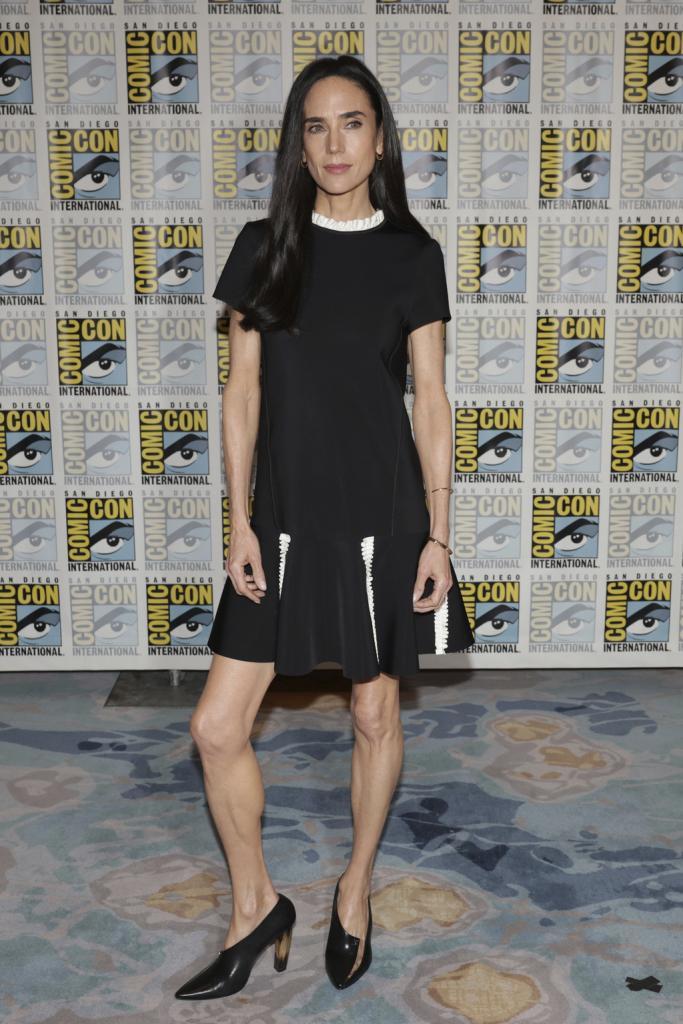
In the room, completely black and with her hair tied back in a smooth ponytail, appears Jennifer Connelly (New York, 1970). And the question is: is it really her? What version of the actress is here right now? Is it the student who won an Oscar for A Beautiful Mind? Is it the heroin addict from Requiem for a Dream? Is it the waitress from Top Gun? Is it all of them? Or none? Does this room exist? What universe is this that we are in?
The questions may seem excessive - and indeed they are - but the essence of those questions is what underpins the second season of Dark Matter, the series by Blake Crouch based on his own novel, premiering this Friday on Apple TV. The quantum principle of superposition - things exist in different forms and places at the same time - and the well-worn multiverse to develop a familiar story that navigates between science fiction and thriller.
Let's say, then, that it is Jennifer Connelly who is sitting here in one of the rooms on the third floor of the Four Seasons hotel in downtown Madrid. That it is she who is trying to unravel some of the debates proposed by this project from a scientific perspective. And that it is she who lets out a timid laugh when asked if the possibility of losing the mundane aspects of life - as happens to her character - is something she has experienced with fame.
"To be honest, I don't feel like I can't relate to people in a normal way. Sometimes I see that people have prejudices, as if I have to be a certain way or have certain characteristics, but we do that to each other for different reasons. I don't think I am famous in the sense of not being able to do what I normally do with my family, with my children, with my friends... There is something special about people who just continue with their lives," she explains. And continues: "I mean, there are people for whom it's different. I've seen it when I've been with Tom Cruise. There are people so famous that it's undeniable, but I'm not famous. I can walk down the street".
-One of the central points of Dark Matter is the importance of human identity. I want to know if this project has made you reflect on this, at a time when it has become a common debate in this world.
-It's funny because when filming the series, I didn't think about those things at all. You can't interpret those more abstract concepts there. I think: 'Where is Daniela? What is she doing in this scene? What is my goal? What am I afraid of? What am I trying to get from the person I'm talking to?' I focus on specific things, but when talking about this project, watching it, and reflecting, all those questions arise. All those elements are what make this series fun. It's the construction of an amazing world and the imagination behind it, but also those provocative concepts of identity, commitment, choice, and memory.
The actress, like her co-star Joel Edgerton, also serves as an executive producer of this fiction. A move that has been deepening in Hollywood for years with figures like Brad Pitt, Margot Robbie, Leonardo DiCaprio, or Emma Stone as a way to control their careers and get involved in the projects they lead. "I can't speak on behalf of anyone or make general statements about the motivations of others. In my case, it's to be part of the more conceptual conversations, not so much about the structure with the creators. Simply about our plot, our characters, and the main marital relationship. It's like sharing the responsibility, being the guardians of the character," Connelly points out.
That character, Daniela, is exploring in this case if, in the midst of that multiverse and quantum superposition, love, personal relationships can survive... "I think there is something romantic in that idea, although it may seem unromantic, of choice and commitment. There is something beautiful in saying 'this is the path I have chosen and my journey is not about looking for something different, easier, or better, I have chosen this person, this path, and I have committed'. There is something beautiful in recognizing that happiness comes from within, from ourselves and what we do with what we have," Connelly states.