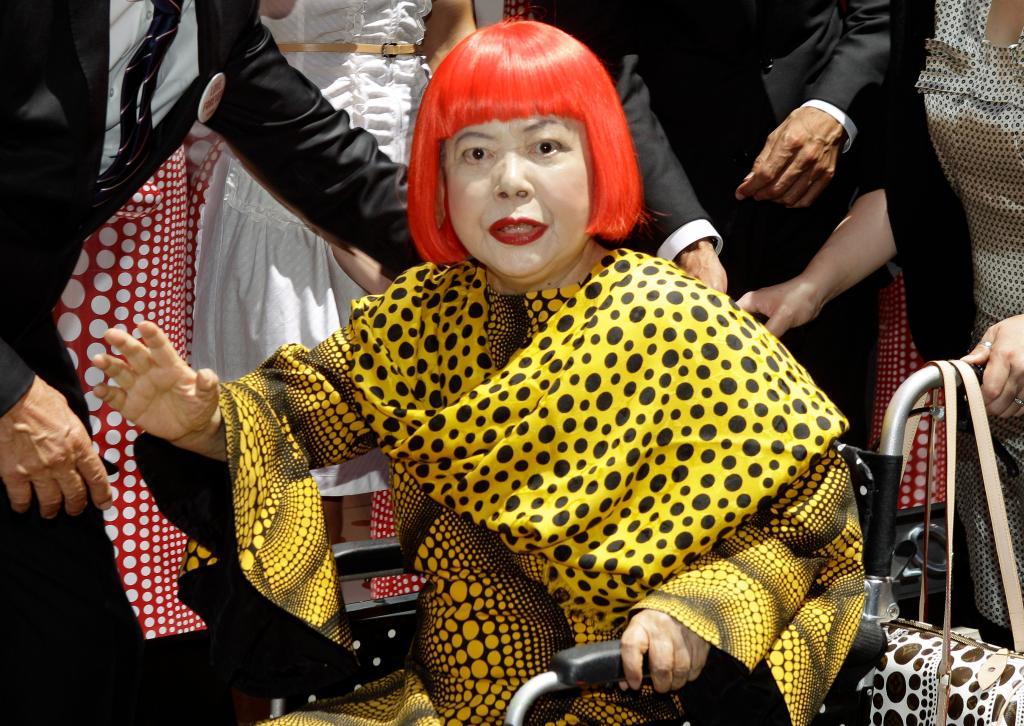
The last queen of pop, Yayoi Kusama, who always claimed that Andy Warhol himself had appropriated some of her ideas in the wild New York of the 1960s, has passed away at 97 years old in a Tokyo hospital. And she did so "never letting go of the brush," as communicated by her Japanese studio, conveniently located in front of the Seiwa psychiatric hospital, which she never completely left since voluntarily admitting herself in the 1970s. Both her astonishing work -literally born from hallucinations: talking violets, jumping polka dots, nets creeping under her skin- and her tough biography turned her into a pop icon. And in the 21st century, she went viral: her pumpkins and Louis Vuitton bags have flooded Instagram and Facebook posts. Tickets to her exhibitions sell out worldwide in minutes, and in some installations, visitors were limited to one minute in the room.
"Let Picasso come, let Matisse come, let anyone come! I would face them with just one polka dot," provocatively wrote the woman who became the most sought-after woman in the art world, with her iconic orange (or red, depending on her whim) wig. Although it was not easy for her: hallucinations tormented her from a young age, she suffered hunger in New York (even eating discarded boiled cabbage), faced a hyper-conservative Japan that initially rejected her for her transgressions and eccentricities. She never hid her mental disorders, on the contrary, she extensively wrote about her traumas and suicidal temptations in her more than ten books, including novels, poetry collections, and her autobiography, where phrases like "I feel as if I am driving on an endless road, heading towards my death" or "I fight pain, anxiety, and fear daily, and the only method I have discovered that alleviates the illness is to continue creating art."
With her mirror sculptures, her polka dot paintings, her endless nets, and her radical youth performances (which today could either be canceled or cause even more scandal), Kusama exorcised her fears and traumas. In her writings, the lesser-known part of her work (most of her novels have not been translated from Japanese), she confessed her irrational disgust for penises and macaroni. That's why she incorporated them into her sculptures obsessively but in the form of harmless soft phalluses, almost like plush toys that deactivated any sexual connotation. Later came the half-naked performances (or "sociopolitical happenings," as she called them, amidst the Vietnam War protests) and the clandestine orgies where the Japanese artist stood as a sort of priestess walking among the revelers -mostly homosexuals- without engaging in intercourse but painting their bodies with colorful polka dots.
It is the darkest part of her biography, detailed in her first book, Manhattan Suicide Addict (1973). Only a French publisher dared to translate it, the independent Les Presses du Réel: there are passages of great harshness that are hard to digest. Under the guise of the novel -a fiction that fits meticulously with her biography- Kusama recounts how she became a successful entrepreneur, a marketing pioneer who sold drugs (she could spend up to $10,000 on cocaine, which she distributed among her court of gay youths) and tickets to her orgies disguised as sexual happenings.
With her Japanese calculator, she did the math for a single night: 156 tickets at $50 each amount to $7,800, minus the artistic expenses for the body paintings, $20. This is the flip side of the adorable pop granny, the image she cultivated in recent decades: that of a mysterious artist interned in a clinic by her own choice (in reality, she spent a few hours there), who rarely granted interviews or attended the openings of her exhibitions or any artistic events.
Behind that image of an artist locked in her studio, behind the multimillion-dollar brand that Louis Vuitton signed (the French maison even dedicated a gigantic sculpture in its Paris headquarters to launch one of its collections), violent childhood traumas lurk: an authoritarian mother (she used to tell her "I wish you were never born"), a suffocating hyper-conservative Japan, the atomic bomb when she was a teenager...
From a very young age, when she didn't even understand what sex was, her mother forced her to spy on her father, a playboy with several mistresses and friends. When young Yayoi told her what she had seen, her mother unleashed her fury on her. She ended up developing a kind of frigidity and aversion to sex. She is only known to have had a significant romantic relationship with artist Joseph Cornell, whom she met when she moved to New York and who was 26 years her senior. A relationship that Kusama described as "passionate and romantic, but platonic." Both detested sex (he was impotent).
The violets that speak
As a child, she also experienced some of her most painful hallucinations, even losing her hearing while playing in the meadows of Matsumoto, a valley surrounded by mountains, in Nagano Prefecture. There, she heard violets speak and saw a face in the flowers, as if they were little people who suddenly jumped on the girl and ran over her body,entering her skin. And the hallucination turned into a nightmare. As it would happen to her in New York years later: she jumped out of the window of her apartment in Greenwich Village when the nets she had painted came to life, jumped on her, and penetrated her skin. She ended up in the hospital.
That's why Kusama understood her work as "an art that struggles on the border between life and death, questioning who we are and what it means to live and die." Or also: "Painting was a fever born of desperation, the only way I had left to continue living in this world." The vertigo and disorientation produced by some of her major installations -like Infinity Mirrors, which the Tate Modern in London extended for over a year due to its enormous success- is what Kusama experienced in her hallucinatory trances. But it wasn't until the 2000s that she became a global phenomenon.
The axe, the bonfire, and the "hell" in New York
Before leaving her hermetic Japan, a 27-year-old Kusama performed her own redemptive bonfire. She took an axe, destroyed hundreds of her works -some paintings were over a meter and a half- and set them on fire in a bonfire behind her house. "I burned them all without the slightest remorse. However, seeing how much my early works sell for now, I made hundreds of millions of yen vanish in a column of smoke," she confesses in her autobiography, The Infinite Net.
In 1957, she boarded a flight to New York with a few thousand dollars sewn into her dress and 60 silk kimonos. She barely knew a few words of English. "Hell on earth," is how she would remember her first years in the Big Apple. She went hungry, collected fish heads and cabbage leaves from the street to make soup, and compulsively painted her endless fishing nets. But she also carved out a niche for herself in the underground scene, rubbing shoulders with Warhol, Yoko Ono, and the Velvet Underground.
But she went even further than all of them, mixing art, sex, politics, drugs, and provocation. A.W., as she refers to Warhol in many of her writings, seems like an innocent Disney character next to her.
Japan, from rejection to stardom
In 1966, it was time for the Venice Biennale. And although she hadn't been invited, Kusama showed up at the Giardini and filled it with 1,500 mirror balls: she titled it Narcissus Garden and sold the spheres for two dollars. She was expelled, and the Japanese press tore her apart, calling her a national "disgrace." In Manhattan Suicide Addict, written a few years later, Kusama spoke out about her country like this: "They're sick with complexes. I realize they're inferior. It's worse than being covered in the remains of Buddha's or Christ's masturbation."
She would have to wait until 1993 to be officially chosen as Japan's representative at the Biennale. She presented her Mirror Room (Pumpkin), a room of mirrors with polka-dotted pumpkins that multiplied to infinity. Since then, Japan has adored her: her public sculptures have multiplied throughout the country, she has received every possible award, she has had tea with the emperors at the Imperial Palace, and she herself gave then-Prime Minister Shinzo Abe a Kusama tea set.
In 2017, in the Shinjuku district, she opened the Yayoi Kusama Museum, her solo museum, which she spearheaded and is managed by the Yayoi Kusama Foundation. She only organizes two exhibitions a year, and KUSAMA's POP closes on August 30th. With her polka dots, pumpkins, and books, she herself has become an endless work of art.