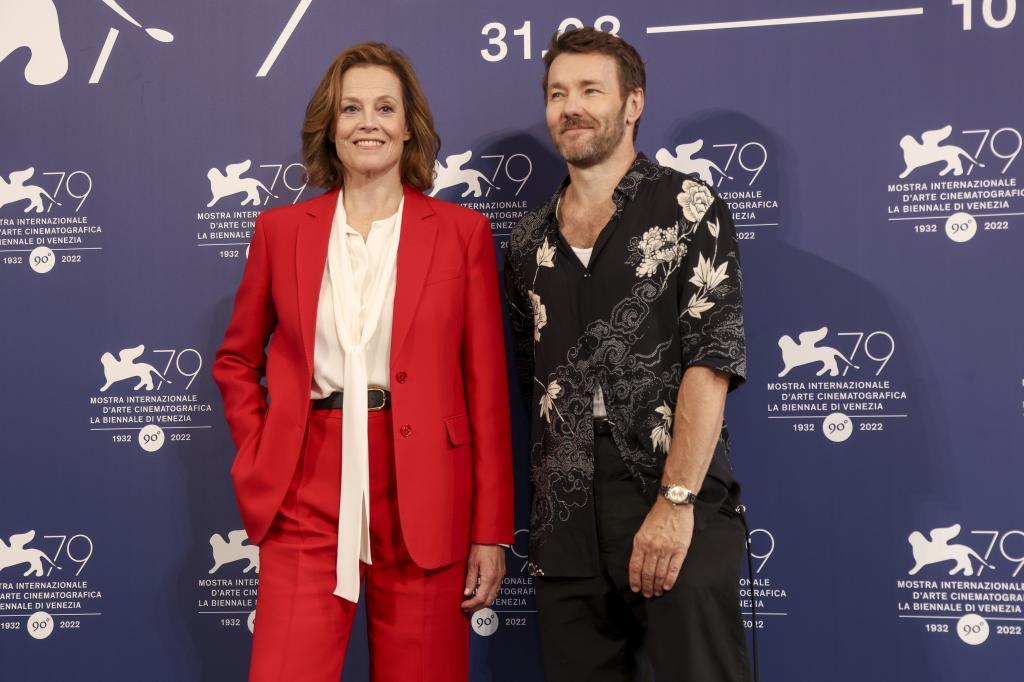
Joel Edgerton (Sydney, 1974) adjusts his beard as the question is being asked. He savors it, calmly laughs briefly, and embarks on a generous dissertation, precisely addressing what has been conveyed to him before seeking a more complex connection. And the ritual repeats itself over and over. The Australian actor once again runs his fingers through his thick beard, calmly ponders, and lets out that knowing chuckle that oscillates between approval and the certainty of knowing what to respond.
The actor is in Madrid to promote the second season of Dark Matter, the science fiction series by Blake Crouch for Apple TV based on his own novel, and as soon as he enters the room at the Four Seasons where this encounter is taking place, he asks what he will encounter when he goes out on the street. The usual response for August in the capital is usually heat. Edgerton seems to grimace, but as soon as he takes a seat, that regret is gone. It has disappeared. And once again, there is the smile.
In Crouch's fiction, Edgerton has experienced how his character, and therefore himself, splits into a myriad of avatars with different personalities in just as many worlds, pushing the principle of quantum superposition to the extreme - a particle can be in two or more states at once. "As an actor, I am drawn to the idea of transformation. Initially, I imagined an extreme physical change, but it turns out to be the opposite: how do we make these two versions of Jason [his character's name] as similar as possible? That the changes focus more on confidence, attitude, intention, or the effect of experience, that they are subtle so that one might think they are very different. We must trust in subtlety rather than seeking extreme changes," explains the actor.
Question: While you were immersed in this project—since you approach it as one of the foundations of your screenplay—did you find yourself reflecting on the importance of human identity at this moment in time? It's also one of the most prevalent debates taking place around us recently.
Answer: The great thing about science fiction is that it allows you to examine humanity in a more specific way. I mean, if you're separated not only from your family but also from your version of life, how do you find your way back? Science fiction amplifies and magnifies things, and from there, it raises interesting questions about nature versus nurture—about how experience can shape a person's life. I find that fascinating. Not just how my decisions led me to become who I am now, but how they shaped my character: success versus failure, family versus a lack of responsibilities... I love that, on the one hand, we have a nature, but that circumstances shape you as a person. It's very valuable to think about how this present moment, wherever you are, is the culmination of everything that has happened to you before.
This can be translated to the technological and scientific world, also present in Dark Matter as key elements, the advances of our time are also the result of everything that humanity has been shaping. "I believe we have made the same mistakes over and over again and yet we continue to benefit from new technologies. But, at the same time, we deal with the terrible consequences of these. Because humans, as this series points out, are guilty of being driven by ego."
Here arises a question: should humans develop everything they believe is possible? "A character says that the human ego cannot be stopped. I believe that we are all trapped in a pattern, in a cycle, but somehow we manage to overcome difficulties. I have faith that, for example, AI will not destroy us because somehow we will find a way to prevent it. I truly hope so. But it's better not to leave it up to me."
Question: The possibility that we might lose human life as we know it is one of the issues addressed in this series. Do you see any parallels with the loss of everyday life that fame can lead to?
Answer: My level of fame is somewhere in the middle—I don't get mobbed on the street. Although I don't know why—I really don't know why. [Laughs] The other day I used the expression "be careful what you wish for" as it applies to technology and AI. We think, "This is great, it's new, let's play with it," and we don't realize the downsides. I think being in the public eye creates a false sense that you need to impress or be relevant. And if you give it too much importance, it can lead to a very disappointing life. It's what I call buying tickets to your own parade—to feel like you deserve to be celebrated or that you're better than others just because you're on a TV show. That's a very dangerous trap because there will be times when you want people to leave you alone, but in a way, you've brought it on yourself. Just like with technology, there are good and bad aspects, and there are certainly parallels. There are musicians or actors who truly enjoy creating a barrier between themselves and the real world, but if you break down that barrier—even psychologically—the rest of the world no longer treats you as if you were special.
In addition to his starring role, Joel Edgerton - like co-star Jennifer Connelly - serves as an executive producer of the series. An increasingly common move among Hollywood actors and one that the Australian had already tried on other occasions. In 2008, he took on these roles in The Square, the thriller he wrote himself and directed by his brother, Nash Edgerton; in 2015 and 2018, he repeated with The Gift and Boy Erased, which he directed, wrote, and starred in, and in 2017, he was one of the producers of It Comes at Night, the horror film by Trey Edward Shults whose cast he led. "It's about inviting humans into the process and taking ownership of a character. In the case of actors, that influence as executive producers usually means that we contribute a little more, that it's not just about showing up to say your lines. It's a way to participate in conversations about the plot and help define the outcome without being too authoritarian. At least, that's what I hope."
Beneath the scientific and technological layers, in which, at many moments, the plot of Dark Matter gets lost, there are elements inherent to the human condition. No matter how much the characters multiply in spaces - the ever-present multiverse - and times, love remains present. "There is a quite poetic layer about entanglement that seems quite romantic to me, where people meet again and again no matter what happens in the universe. Imagine if that were real, it's beautiful that we are cosmically connected in some way. In fact, it's an enduring ideal in many cultures as shown in the Korean film Past Lives. I believe that humans like to think that there is an invisible line that connects us with the people who mean a lot to us."
And there it is, once again, that smile.