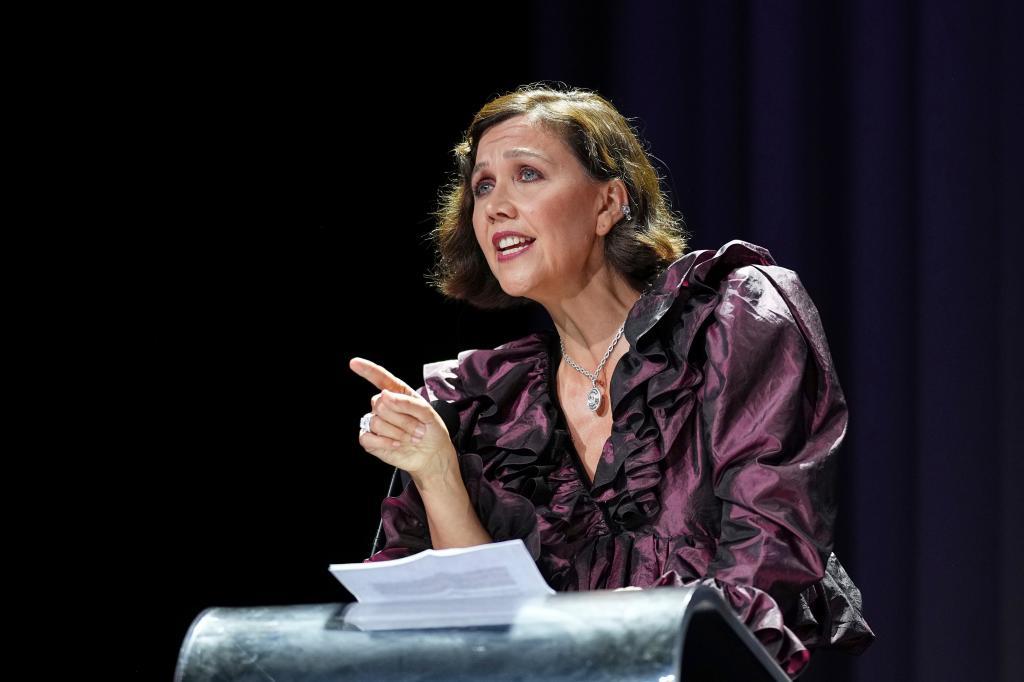
Just a few days ago that seem like centuries, when the Mostra began, Maggie Gyllenhaal corrected the director of the festival Alberto Barbera (and his selection). She did so as the president of the jury. According to the festival's director, the issue of the absence of female directors (there are only two) in the competition lies outside the Lido venue, in society as a whole. He and his team, he reasoned, only select films based on "their quality." The filmmaker corrected him live and spoke about how perhaps the problem is not in the films being watched but in the eyes of those watching. In her opinion, what she referred to as a "systemic deficit" has more to do with certain themes and arguments that have historically been ignored and still are. A few days later, the director presented the short film Flesh Impact and it became clear that the reflection did not come out of nowhere. The film fantasizes about a Marilyn Monroe who, at 100 years old (she would have turned 100 on June 1), auditions for Tennessee Williams' play Orpheus Descending. On stage, to everyone's surprise, she reviews her life, her "systematic" humiliations, and, ultimately, her own death. The protagonist is a majestic Ellen Burstyn (93 years old and an honorary Golden Lion) who is portrayed in the subsequent flashbacks by Dakota Johnson. Both are Marilyn.
Question: How would you describe your relationship with the myth and with Marilyn Monroe as an actress?
Answer: The truth is, it's quite accidental. The movie wasn't my idea. It was proposed to me with the premise of having her play a role she might never have had the chance to play. Then the idea arose to portray her as if she were still alive at the age she would be now. Everything fell into place. Her 100th birthday was on June 1. Other than that, I don't consider myself a big fan of myths. I didn't know much more about her than any movie fan might know. But even knowing just a little, she's a fascinating figure. It's not just her sex appeal and beauty, but also her ability to be both the saddest and most heart-wrenching and the most fun at the same time.
Q: In your film, one might say that sadness carries much more weight; your Marilyn is essentially a tragic heroine...
A: It bothers me to reduce characters to a single concept. And especially female characters. It seems that actors find it easier to find characters who can be everything at once. In contrast, the material that comes to actresses tends to be more one-dimensional. I like to think that my Marilyn is capable of reflecting and embodying pleasure, cruelty, kindness... Sex too, of course, but always very aware of the price that comes with it. Ultimately, it's only fair to insist that all characters—men or women—be capable of embodying everything it means to be alive.
Q: This ties into what you mentioned at the opening press conference about the systemic lack of a female perspective in cinema. Perhaps everything related to Marilyn is connected to that—to the way her image was exploited by the industry.
A: Yes, without a doubt. I think Marilyn is an extreme example of the systemic sexism I'm talking about. And I say it's extreme because she didn't survive. The system took her life. You could say she was devoured by society, by everyone around her, and, in a sense, that continues to happen today with her memory. There's a certain responsibility—or guilt—that's passed down.
Q: What exactly do you mean by that? How can we be responsible for something that happened in the past?
A. Because her experience is still the experience of many actresses. Dakota and I identify with much of what she went through, and she is the way we've found to talk about problems that persist in the industry.
Q: After this experience, do you feel you've solved the mystery of Marilyn? Who was Marilyn?
A: I don't know how to answer that. There are many "Marilyns" because no one understood better than she did the power of masks to hide and protect us. I prefer to think that the film opens up a space for each viewer to imagine and create their own vision of her. After all, myths belong to all of us.
Q: Be that as it may, decades after her death, Marilyn remains an inexhaustible source of controversy. I'm thinking of Andrew Dominik's film *Blonde*, based on the novel by Joyce Carol Oates, which premiered right here in 2022. Do you have an explanation for this? Why does she still appeal to us so much?
A: I'd rather not talk about *Blonde*. But I don't know why she still appeals to us. I imagine it has to do with a certain sense of collective guilt. When someone doesn't survive, we're all implicated in one way or another in their death. The way we consume public figures—through social media, for example—is part of the problem. Then there's something related to sex.
Q: Excuse me?
A: Yes, she aroused so much desire that she was a constant source of conflict. That power of attraction is something we also tend to reject. Billy Wilder said of her that she made such an impression that viewers came to think they could simply reach out and touch her on the screen. That was the "Impact of the Flesh" that gives the film its title, in fact. Wilder's description was wild, but also beautiful. People wanted to look at her, touch her, have sex with her. There has never been anyone as captivating and attractive as she was. And that, as I said, came at a cost. She paid for it with her life. She didn't survive her own magnetism.