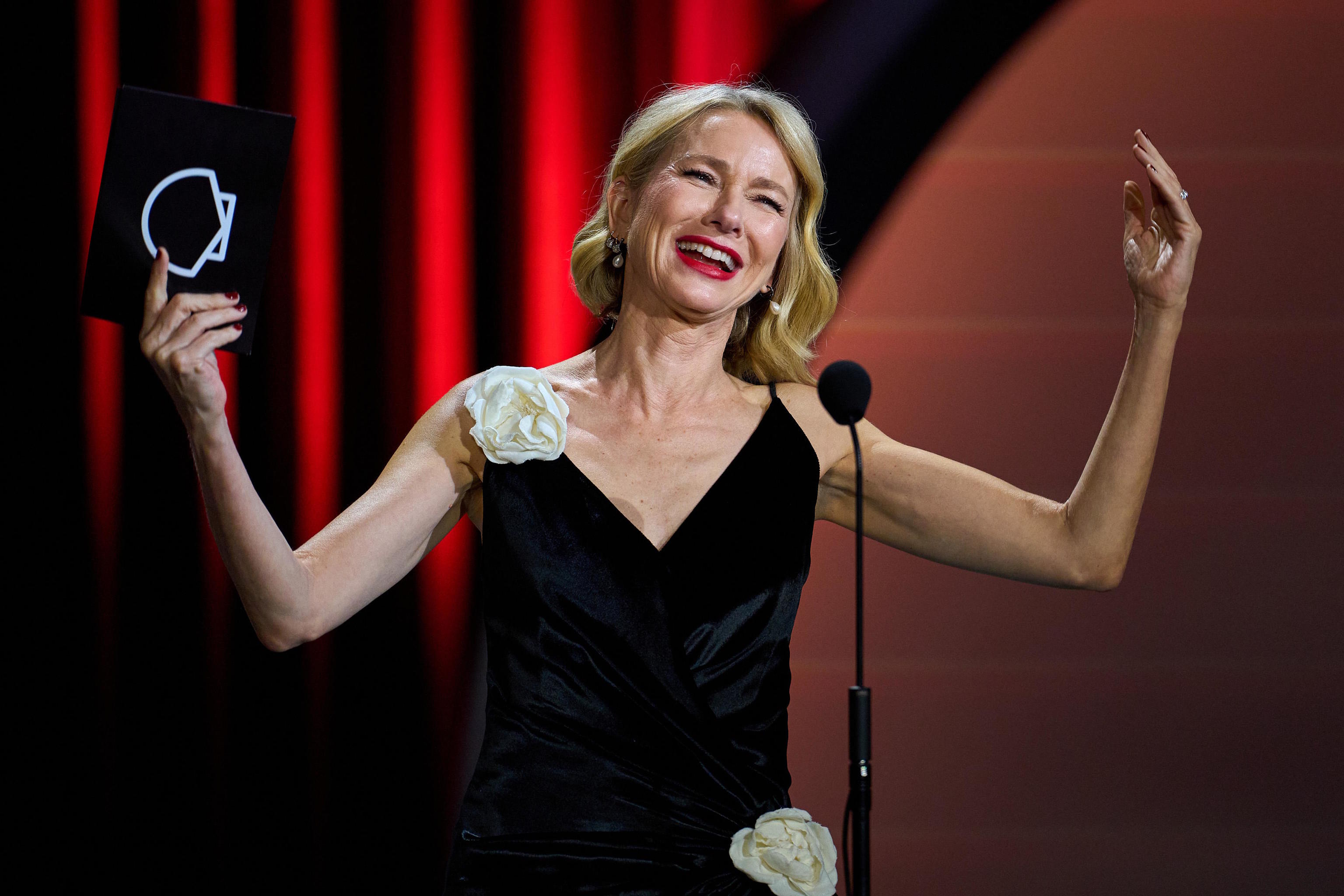
She was born in the United Kingdom, grew up in Australia, and acquired her star status right at the beginning of her career with a movie that would revolutionize the world. All of it from the ground up. Her work in Mulholland Drive, by David Lynch, marked her in 2001 as the star of the new century. From then until now, she has been nominated for an Oscar twice, one of them for The Impossible, by Juan Antonio Bayona, she has stood firm against offers that are also threats from the Marvel universe, and has built a reputation as a deep, mysterious actress full of complexities, always more concerned with what she hides than what she reveals, with what is sensed from a glance before even uttering a word. In San Sebastian, she receives the Donostia Award for her entire career while presenting The Perfect Wife, by Ben Shirinian. In the movie, she plays Hermine Braunsteiner, the first American citizen to be deported for hiding a detail from her past from the authorities: she was a Nazi, she was and continued to be a monster all her life.
"The real horror does not lie in what sets us apart from a monster, from a Nazi, but in our similarities with him."
"We live in a time of global division. These are times that are terrifying."
Can we empathize with a monster? Or, in a more classic way, does humanizing a monster mean that we understand and forgive them?
The true horror lies not in what sets us apart from a monster, from a Nazi, but in our similarities with them. And that is the actor's task: to approach them seeking what unites us, but without forgiving anything. I was clear about this from the moment I read the script for the first time. I knew nothing about the story and had never portrayed a character even remotely similar. I knew what I was exposing myself to, and I confess that I tried to rid myself of the role many times. But in the end, I thought that the fear I felt was something powerful. Obviously, I was curious to know how that evil took hold of this woman. And it's not just about the facts, the atrocious war crimes - of which there are many - but about how everything happened. What led her to that extreme? And then, of course, the consequences; that's where the story unfolds. And hopefully, the viewer will ask themselves the same questions. What would they have done in the same circumstances?
Is forgiveness possible?
I believe in second chances. But I also believe that each case must be analyzed individually. In the case of this woman, I 100% believe that forgiveness is not possible. She never showed remorse. She continued to believe until the end that what she did was right.
Hermine Braunsteiner is not a fictional character, but real. Does that influence in any way?
It facilitates because the documentation is there. I have to say that I read a lot about her and people like her. And it affects you. Delving into the mentality of Nazism leaves you shaken. It is a tough task, and the work does not stay on the film set; you take it home at night and it never leaves you in peace. You close the door at home, turn the key, and you can't free yourself. The character haunts you and comes to visit you at night.
You mentioned earlier that you had never faced something similar, but it is very common to find characters in your filmography who hide something. What does Naomi Watts hide?
I don't know. It is true that it is something common in my career. I imagine it all started with Mulholland Drive. It was David Lynch who prepared me for that. I prefer to call it duality. No one is truly just one person. We have many facets and can be many things.
The film addresses the first American citizen deported and arrives at a time when the United States Government, with ICE (Immigration and Customs Enforcement) as the executing arm...
There are many things in the film that directly appeal to us. First, even before the deportation issue, the hatred she feels. Hatred, in general, is more present in society than ever before. We live in a time of global division. These are times that are frightening. Regarding deportation, I prefer not to draw parallels. She was deported because she committed atrocious war crimes. It is not the same as the atrocities that ICE is currently committing. Not at all.
What relationship do you have with your own legacy as an actress, which serves for the delivery of the Donostia Award? Traditionally, you are labeled as a difficult-to-classify or unconventional actress who has chosen carefully her roles, who has not fully embraced blockbusters, who is not entirely English, Australian, American, or European. Do you recognize yourself in this definition that, in truth, you are not?
Yes, indeed. I recognize myself as an outsider. I have always felt that way, I accept it, and I nurture it. It has to do with the place and the conditions in which I was born, far from privileged. My mother always struggled to move forward, especially after my father died. Looking back, I see myself as a very young person always moving from one place to another and always in a different school every year. Wherever I went, I always felt like a foreigner. Much of what I have done in my life has been about finding ways to integrate into an environment to which I did not belong. And that has affected my work and the roles I have chosen in my career. I invite you to watch my movies, and you will see that many of them deal with one of these two themes: grief or identity. Honestly, it's not something I planned, and many of my decisions regarding this have not been entirely conscious, but there are my characters. The strange thing is that if you ask me, my answer is always the same: I try to make my characters always different and have nothing to do with each other. However, it's as if I'm trapped in the same storylines.
You started working with the century in cinema, and 27 years later, nothing seems to be as it was back then. From the Metoo movement to the rise of AI, passing through the boom of platforms, nothing is the same. Is cinema at its best or worst moment?
I dare not make such a broad assessment. I just need to look around and see a festival like this. I see a group of active people convinced that there are other ways to make movies. That's enough for me. I am satisfied with feeling the need for independent cinema, a cinema that reflects voices we didn't hear before, a cinema that tells relevant stories for everyone. As for me, I have just presented two films. This one we have talked about and Closing Night, by Cody Fern. So, my moment is good.
And regarding the role of women?
Something has changed, undoubtedly. Before, everything ended in the 40s, and now I am in my fifties, and women have strengthened their presence in all facets of the industry. There is a new narrative around women, and I am happy to be part of that revolution.