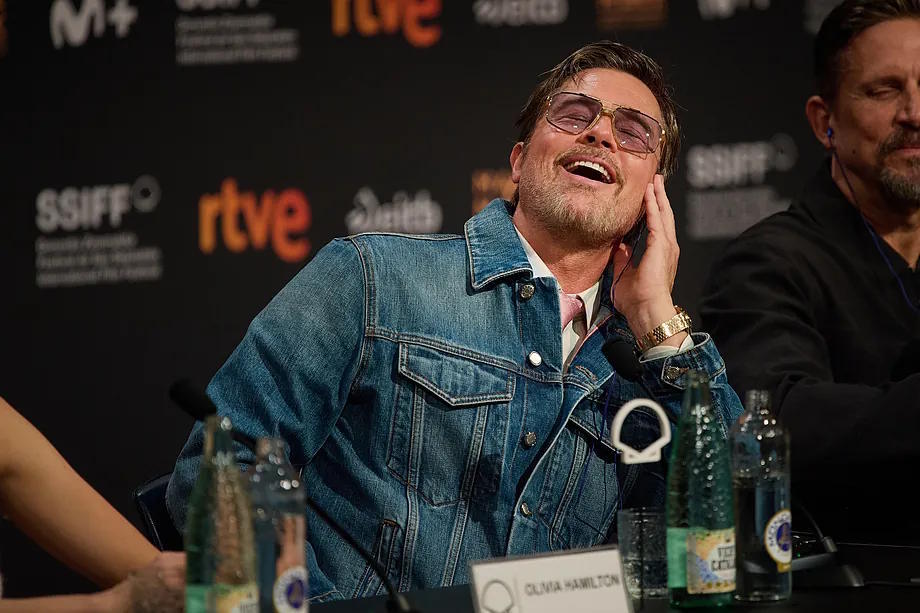
To make a movie with an animal, let's say a dog, two things are needed: the animal in question and boiled chicken. If you also have Brad Pitt, even better. In essence, the above was the biggest and most glamorous revelation of Brad Pitt's appearance before the media during the presentation on Wednesday of In the Heart of the Beast, the survival film directed by David Ayer and starring the dog named Uber (like the app) and the star named Brad Pitt (like the actor). However, the film would not have been possible without another feathered animal that neither appears in the credits nor has a name. "To get Uber's attention, I had to carry a piece of chicken in my pocket. That's what saved us. To this day, I hate boiled chicken," Pitt commented after a long explanation of what it was like to work with the aforementioned dog.
Basically, and to set the scene, the film tells with extreme simplicity the journey through the Alaskan forest of a veteran soldier of a thousand wars and his inseparable four-legged friend, also suffering from post-traumatic stress. They peacefully fly over the mountains in a small plane until an accident throws them into the middle of nowhere. What remains is survival. Nothing more. Beyond the adventure for adventure's sake, there is something else. "The central idea of all this," the actor himself comments, "and what survival experts teach us is that everything boils down to small victories. You will suffer losses and feel pain. The solution always lies in trying to achieve the next small victory. And that applies to life: when we are going through difficulties and facing many challenges, we must focus on the nearest and smallest victory, forgetting about the overall plan. The small immediate triumphs matter." Who said getting lost in the forest was indeed a waste of time? Everything teaches us something.
Brad Pitt recounts that working with Uber was challenging but rewarding. The driving idea was to face each day with whatever came up: rain, snow, or the dog getting distracted. Overall, and thanks to the chicken mentioned earlier, Uber, a German Shepherd native to New Zealand, behaved. "I had a very moving experience with him. We connected right away," the actor recalls. And he continues: "We tried to make each day a day of play for him. Sometimes he did amazing things that were not in the script and can be seen in the movie: his expressions, his close-ups... Other days, however, bees buzzed, possums came down the hill, and Uber found a thousand things much more interesting than what was in the script. Thank goodness for editing." And the chicken.
But beyond the challenges and what is learned from survival experts in terrible and freezing conditions, what the Hollywood star learned from the film is not necessarily profound, but elemental. "An animal's loyalty shows you that it is more important to focus on fighting for others than for oneself." First maxim. "Furthermore, we should dedicate more time to what we share with others rather than what separates us." Second maxim. "Ultimately, the film is nothing more than a love story. If we look around us, we see that we all share 98% of interests and desires. Let's focus on that and not on the 2% that sets us apart, as it seems we are currently fixated on. But, to start somewhere, perhaps we should take care of the people around us and make sure they are okay. I think that's a good starting point," he added in case the message was not entirely clear.
Having said that, the actor, who is also a producer, did not miss the opportunity to offer a brief diagnosis of his profession and the industry around it. And he is optimistic. "There have been huge changes and radical transformations, especially with the streaming industry and the consolidation of studios. What I love about what streaming has brought us is that there are many more opportunities for actors, writers, directors, and technical teams. And thanks to that, we have seen a greater variety of truly interesting stories and talents... However, something has happened with the cost of films, which is undesirable after the COVID crisis. Both big-budget productions and very low-budget independent films have managed to move forward, but the middle range -- films between 30 and 80 million -- have faced many difficulties. I trust that the cost reductions in post-production that we are experiencing now will help them in the new phase because that's where I want to be." And having said that, one last note. "Right now, I feel that independent cinema is stronger than in the '90s," he concluded in a slightly less enthusiastic tone than when talking about the dog. And the chicken.