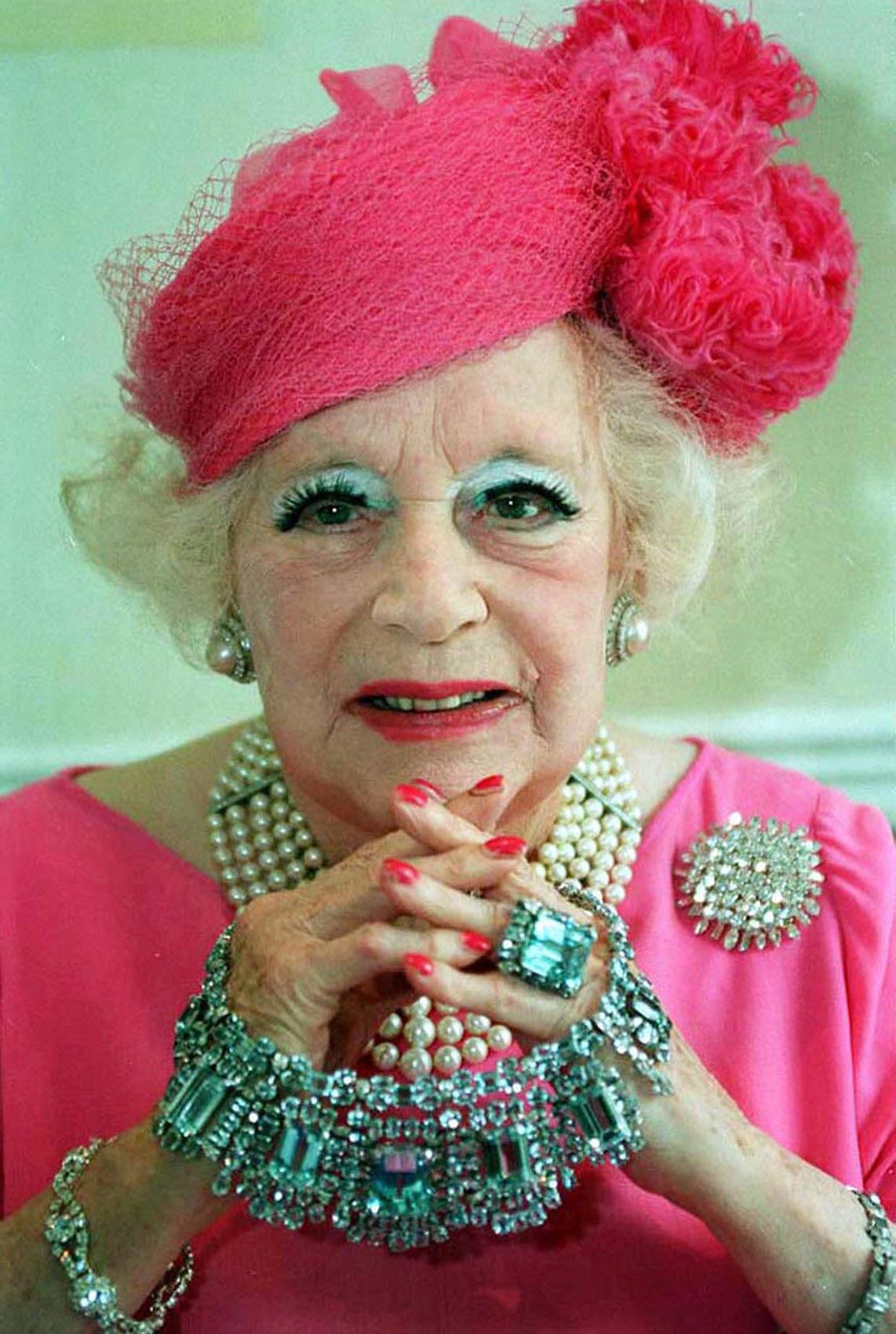
On one occasion, the writer and literary critic Clive James described Barbara Cartland's eyes and face as "the corpses of two little crows that had crashed into a chalk cliff."
A pale and whitish base, similar to that of a doll; pastel blue or turquoise eyeshadow; spider-like false eyelashes on which she applied Meltonian shoe cream "because it doesn't run when you cry," she once said; cheeks and lips in pink or fuchsia tones, and a platinum blonde bouffant hairstyle, teased and sculpted with plenty of hairspray.
For the most prolific romance novel author in history, with 723 published books and around 1 billion copies sold, her physical appearance was a must. Flowy pink dresses made of silk, satin, and organza, with puffy sleeves, pronounced ruffles, boas or marabou feather cuffs, low-heeled pink shoes, and extravagant jewelry -the pearls were usually fake-. Additionally, a tiny white Pekingese under her arm could not be missing.
It hasn't even helped that in the mid-70s she became the step-grandmother of Lady Di. Surprising, as she is the third best-selling author in history, only behind Shakespeare and Agatha Christie.
To avoid being forgotten, Matthew Sweet has just published the biographyThe Great Dictator: A Life of Barbara Cartland. Tara McCorquodale, granddaughter of the protagonist, gave him carte blanche to access all the documentation from Camfield Place, the mansion in Hertfordshire. There, he discovered 151 unpublished manuscripts and juicy correspondence with the then Prince of Wales -current Charles III-.
The stories of lovestruck virgins who star in her novels share personal traits with the author. As Sweet explained to the BBC, "some of the crises she herself has experienced are repeated for these heroines: the loss of a fortune or a bad first marriage. She draws on her own traumas and difficulties and conveys them to her heroines."
She was two years old in 1903 when her paternal grandfather committed suicide after going bankrupt, forcing her parents to leave the palatial mansion in Worcestershire and move to a house, where they lived in a "respectable poverty." At 17, her father died during World War I and her mother had to open a clothing and grocery store in London to feed her three children.
Without pedigree, fortune, or many charms, young Barbara had to reinvent herself. "She didn't have many resources at her disposal, so she always had to bring out the best in herself and go for it with devilish energy," the biographer told the BBC.
She had a talent for designing her dresses, especially for costume balls, which gradually allowed her to enter the rigid London high society. Soon she had an ally: a fashion student named Norman Hartnell, the designer of Princess Elizabeth's wedding dress and the coronation robe when she ascended the throne. However, Barbara made sure to proclaim that the designer had created her first bridal design.
Her staging caught the attention of Lord Beaverbrook, founder of the tabloids Evening Standard and Daily News, for whom Barbara Cartland began to write as a gossip columnist. In 1925, she published her first novel, Jigshaw. The myth was born.
As Matthew Sweet reveals in his book, Cartland devised a ritual. Between lunch and her chocolate eclair, she stretched out on a divan and dictated between 6,000 and 7,000 words, which her secretary transcribed. Hence the name "the great dictator." In seven to ten sessions, she completed a novel. In 1976, she published 26 books.
Many said it was cheap literature, but among her loyal readers were Anwar el Sadat and Lady Diana, obsessed with stories of virgins rescued by blue princes. In her case, hers turned out to be a disappointment.
Barbara was clear: "I sell millions of paperback books to women who take Valium because they are going through a tough time in real life. They don't want to read about misery; they can read about that when they are peeling potatoes. I am their escape route. I offer them glamour, beautiful clothes, and the wonderful and attentive men they long for."
She participated in the general strike of 1926, became aware of extreme poverty and overcrowding in the suburbs, and in the 60s, she defended the rights and legality of the gypsies to the point of creating Europe's first settlement named after her: Barbaraville.
In her lifetime, the queen of romance novels did not achieve the coveted noble title. After rejecting 49 marriage proposals, in 1927 she married Alexander McCorquodale, a drinker and spendthrift who ended up squandering the family fortune, and practically impotent. Nevertheless, she had her daughter Raine, whom she described as a great disappointment. In 1976, Raine married Edward John Spencer, VIII Earl Spencer and father of Diana, who despised her stepmother to the core.
That first marriage ended in divorce because Alexander was a drunk and incorrigible womanizer. Three years later, in 1936, she married Hugh, her cousin from her first husband, with whom she discovered the pleasures of sex. "Wounded men tend to be exceptional lovers," she used to say; her husband had been wounded in the war. They had two children, Ian and Glen. The grande dame of pink passed away in 2000, at the age of 98.