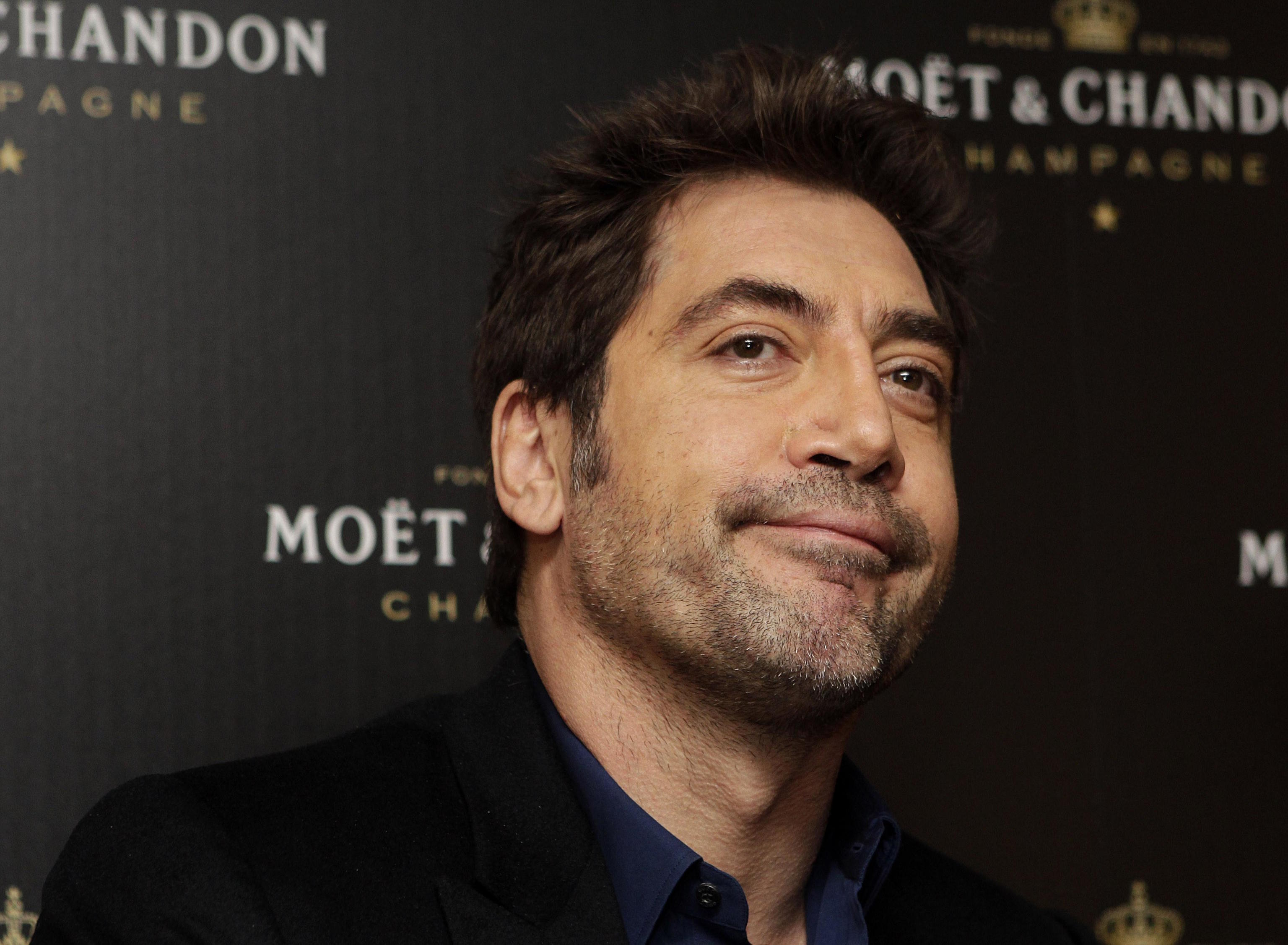
In Chekhov's early works, innocence, wonder, and doubt lead his characters toward universal emotions, from sadness to love. Like another character from the Russian author, who starting this Thursday until February 7 will officially be, it is Javier Bardem facing his first time at the age of 57 on the theater stage in Madrid, surrounded by four colleagues and under the direction of his mentor, Juan Carlos Corazza. And there, among them, is all of Chekhov.
"It has been a very pleasurable process on a personal level, especially being accompanied by these people and being directed by my friend and mentor [Juan Carlos Corazza]. I couldn't ask for more; that is more powerful than any fear," the actor stated at a press conference held on the very stage where he will debut, before recalling his mother, Pilar Bardem, with whom he began frequenting theaters in the capital. "I have a small photo of my mom placed there that gives me strength. I wish she could have seen me. She had a relationship with Juan Carlos, and I know she is present in his heart and mine. I know she is out there watching me. The theater may have been the place where I started to love and enjoy this profession, going every day to do a job, whether the audience is empty or full. I have immense respect for the theater and everyone who works in it. I wish my mother could have seen it, but she will enjoy it somewhere."
Bardem has been surrounded by his four colleagues, Ben Temple, Alicia Borrachero, Manuela Velasco, and Rafa Castejón, and by director Juan Carlos Corazza. He, in the center, receiving a blushing shower of praise from those sharing this debut. "I believe he is one of the most enjoyable and passionate actors I know; he truly enjoys the journey and the search," Velasco assured. "Seeing someone like him with that hunger and curiosity is a reminder, for me as an actress, to keep the flame of curiosity alive," Borrachero elaborated. "He is a being gifted by the gods for acting, and seeing him these months in such a long process, seeing him eager to work and with love for his profession, has been amazing," Castejón added. And Temple concluded: "In the first rehearsals, one of the things he asked was, 'What do you do to learn all this text? What is the technique?' He was just one of us with the humility he has and has become the caretaker of the team."
Bardem's choice for his debut may surprise due to the venue, Espacio Zafra, with only 100 seats and a small square for the stage; the chosen text, Chéjov, Chéjov, a compilation of small fragments from the Russian author, far from universal theatrical works, and even the theme, between absurd humor and social realism. But for the actor, it makes sense: "It is the gift of remembering how humble this acting business is. There is something about transcending your own and knowing how to manage your ambition, your need for success, applause, and recognition. When you touch the true essence of acting, you find the meaning of this, and it doesn't matter if it's on this stage or the biggest in the world. [...] I have the fortune and privilege to live from this. My insecurity is not being at the depth of the work that my colleagues are at. It is more of an artistic demand than a social or professional one."
Bardem's career began in 1990 with his foray into desire alongside Bigas Luna in Las edades de Lulú, 36 years during which the actor never stepped onto a stage to try theater. Until now. And the question is: why? What has changed now? "Whenever I thought about doing theater, it was under Juan Carlos's direction, and I wanted to wait until we had our own space. [...] That's why it has happened here, with these people. This is how I want to take my first step into theater. This space personally nourishes me a lot because there is a direct and intimate contact that makes the audience part of the work. I find it beautiful and brave; perhaps in another place, it would have been louder, but also more detached."
"The choice of these pieces has to do with the fact that they lend themselves well, and I consider them very suitable for a space with intimacy and closeness to the audience. I am interested in that with this team, particularly with Javier in his first work," Juan Corazza detailed, referring to the choice of Chekhov because his theater allows "to nourish hope in humanity." "There is nothing kinder than meeting people and that we can continue cultivating the challenge of meeting with others and with oneself. How are you going to meet the other if you haven't met yourself?," he emphasized.
Bardem has insisted on the "where" as an element that led him to decide to venture into theater. That is, a room in which he also participates alongside his mentor. "I said I wouldn't do anything that wasn't with Juan Carlos; it has happened now at 57. I have many years left, and I can play many characters, although Romeo is a bit late for me." Precisely that room has also, as he detailed, made the price higher than usual for theater -60 euros-. "It is the minimum ticket price we could set considering that we are losing money. We are going to lose a lot of money, but for me, it is not a loss; it is an investment. There are percentages to pay, VAT, sales platforms, and there are only [100] seats, and this was the minimum price. We have refused to raise it. The tour would be the way to recover that money, but it has not been possible to arrange it."
When asked about Chekhov's special disdain for politicians and the fact that the play premieres during the electoral campaign for the 29-N. "Popular clamor is necessary, but when it is clouded by individuals who have nothing to do with the protests, it is something that does not help, and we should think about who creates those actions so that the underlying message dilutes," he began. He continued: "I hope a progressive government wins that respects women's rights, housing, the right to education and public health, as well as the right for those with less to live a dignified life. I believe we all desire that here. There are parties that do not defend that philosophy, but it depends on all of us to go and exercise a useful vote that defends social rights. I hope so, but we will deal with whatever happens as always."