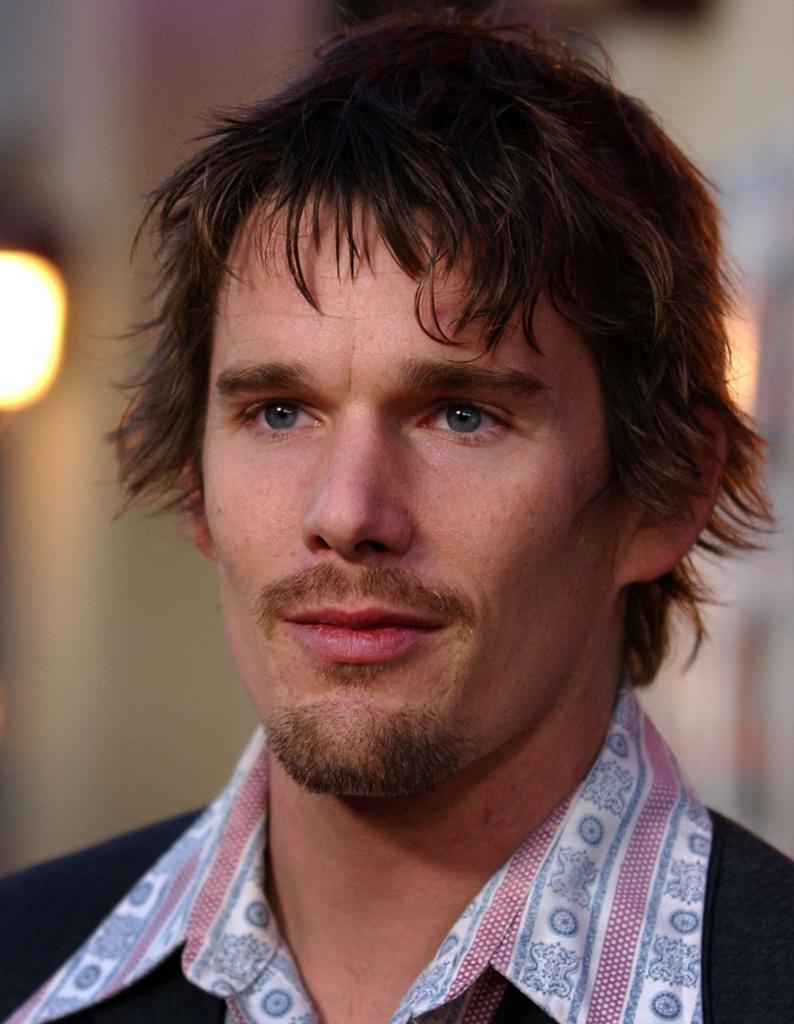
More than 40 years have passed since he made his film debut at age 15—he is now 56—and he has appeared in well over a hundred movies. A kindred spirit to Richard Linklater and an icon of Generation X, an occasional writer, and a director almost out of necessity, few contemporary filmmakers so perfectly encapsulate everything his profession has been capable of in recent times—for better, for worse, and for everything in between. His latest film—*Gold* (directed by Padraic McKinley)—serves as a fitting metaphor for him. It is classic adventure cinema, yet strikingly fresh. It is a throwback to the past, yet—entirely devoid of nostalgia—it remains deeply committed to depicting many of the miseries of the present day. Set during the Great Depression of 1929, an innocent man is imprisoned. What follows is a fever dream, with Ethan Hawke in the lead role.
Question: Having seen your film, would you consider yourself a nostalgic person?
Answer: Not necessarily, but I do get the impression that they no longer make films with a "biblical" scope—stories where good clashes with evil in the most classic sense. And that's a shame, because this is the kind of cinema I watched when I was young, the kind that inspired me to choose this profession. These films almost always centered on a good man facing an unjust situation, with the natural world as a backdrop. One of the reasons I signed on for this project is that, while it is an action story, it doesn't revolve around revenge—unlike so many others. At its core, it's simply about a father trying to keep a promise he made to his daughter.
Q: Which films were you referring to earlier?
A: The first one that comes to mind is John Huston's *The Treasure of the Sierra Madre*. It was an incredibly entertaining film—one that didn't leave you with that feeling, so common in today's mainstream cinema, that you'd been cheated. My impression is that, right now, there is too much "fast-food" cinema—films that offer no real nourishment. I don't think that was as much of an issue in the past. *Sorcerer* by William Friedkin, *The Wages of Fear* by H.G. Clouzot, and *Deliverance* by John Boorman are clear touchstones for *Oro sin ley*. I remember the moment I first watched each of them, and I remember how they all left me breathless. What they share is that, despite their extremely simple stories, they explore universal themes.
Q: You're clearly a nostalgic man.
A: Perhaps. The thing is, the film industry has become obsessed with the idea that "bigger is better." And that never leads to anything good. More often than not, the most harrowing scene in a film hinges on something so mundane—something we all experience—that it resonates. That's why it works: anyone can relate to it. That was a golden rule in classic cinema. Today, if an entire city isn't being destroyed, it's considered worthless. There's an overabundance of absurd post-apocalyptic settings. Yet, if you look closely, all the best stories revolve around something as universal as a greedy man taking advantage of someone in need.
Q: Perhaps all of this is a reflection of the cynical times we live in...
A: Yes, there's a pervasive feeling today that if you aren't a cynic, you're immediately dismissed as a fool. Values like integrity, humility, respect for others, or keeping one's word are now seen as signs of weakness. Consequently, the art being produced is inherently cynical. These days, it's surprising to hear someone claim to be a "good person." Just look at who's in charge—globally, and in my own country in particular. The strange thing is that my personal experience has been the exact opposite. I spend most of my life working and meeting people, and I see a shared desire to help others. Why don't these people ever come to the fore? Why aren't they the ones in charge? I honestly don't understand it.
Q: Your character in the film is a good father. Is it the same for you? Has fatherhood made you a better person?
A: Without a doubt. In my case, fatherhood has expanded my life in an incredible way. I've been lucky enough to watch my children—I have four—grow up and see firsthand how different they are from one another. Once you experience something like that, you view humanity in a completely different light. You realize that all their classmates have parents who love them just as much as I love my own children. And you come to understand something as fundamental as the fact that no one is born perfect.
Q: I'm not quite following.
A: What I mean is that when you become a parent, you realize that we need our societies and our culture to be environments that foster our growth and allow us to develop freely. While that might sound naive or elementary, it's becoming increasingly rare—and yet, more necessary than ever.
Q: Recently, we've seen you in an independent film like *Blue Moon*—teaming up once again with Richard Linklater—directing a documentary about Paul Newman, and, not long ago, appearing in a short film by Almodóvar... Is it hard to keep track of what you're up to?
A: First of all, working with Almodóvar was a true privilege, an absolute honor... You dedicate yourself to this craft in the hope that, at some point, you might get to work with unique voices like his. Beyond that, I don't think I'm being original when I say that my only real ambition is to do things I haven't done yet—things that I, as a viewer, would want to see. I suppose it's a way of forcing myself to grow. For instance, I still have a desire to do a comedy in the style of Buster Keaton.
Q: And what about Paul Newman? Why that particular fascination?
A: There's a reason for it. For one reason or another, in most of the roles I've played, I do a great deal of talking. Newman, on the other hand, was a guy who could say everything with his eyes. He could handle Tennessee Williams, yet in *Cool Hand Luke*, he barely has a few lines of dialogue.
Q: Are you concerned about your legacy?
A: As I get older, I find myself having to talk about my past more and more. I imagine that's quite common. But no—I'm only interested in the present. People used to ask me if I was nostalgic. I'm not. The notion that cinema is immortal, or that they don't make movies like they used to, is simply false. The present is what's immortal.