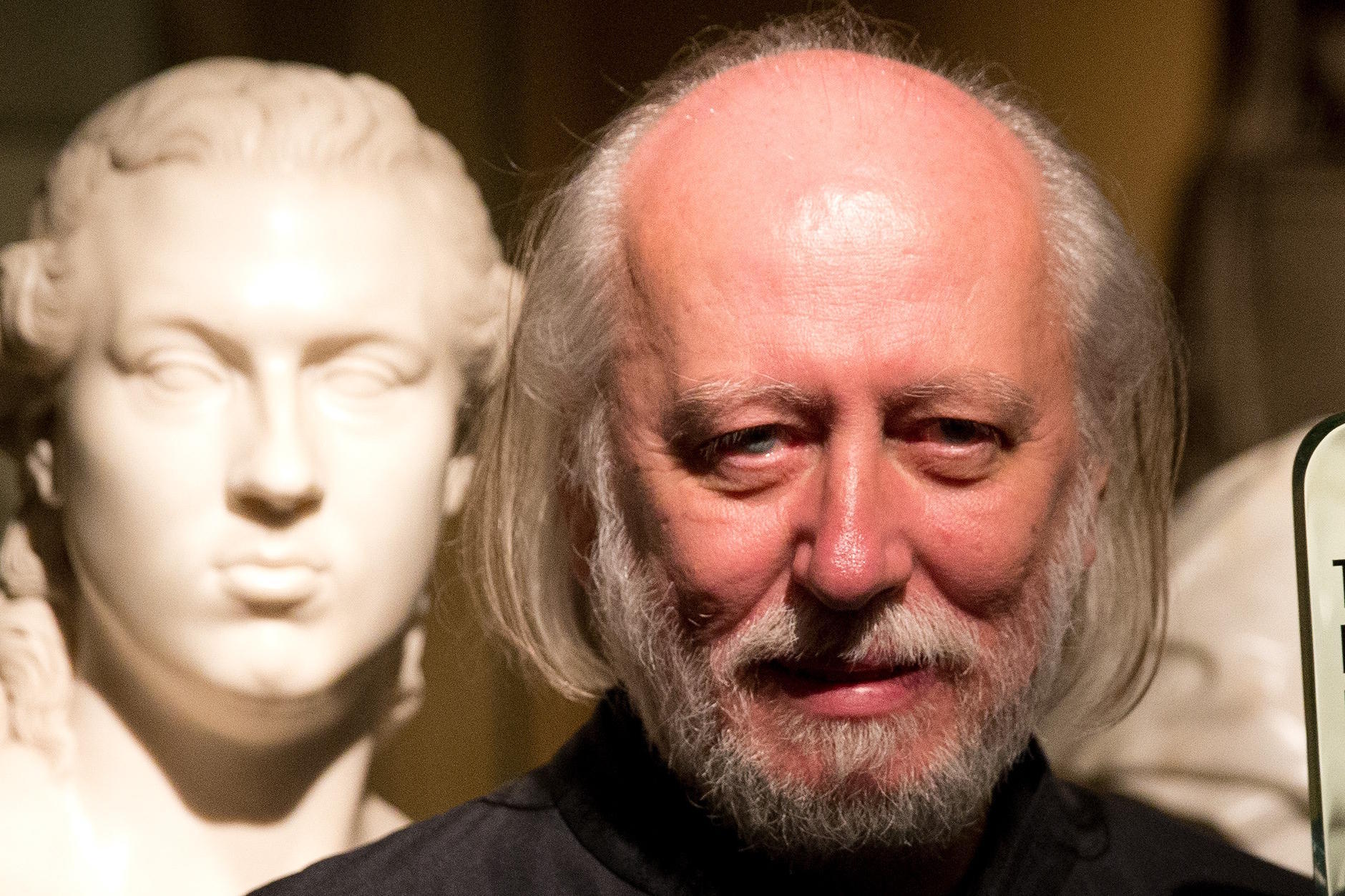
Feverish monologues, outbreaks of sweet and humorous schizophrenia, Kafkaesque suicides, drinking reverends, gangs of teenagers resembling wolf packs, demons reminiscent of Bulgakov, dystopian landscapes akin to Jodorowski and Moebius... These are the materials from which the stories of László Krasznahorkai, the Hungarian writer who received the Nobel Prize in Literature 2025 awarded by the Swedish Academy this Thursday, are made.
László Krasznahorkai's nomination for the Nobel Prize was submitted by the Norwegian writer Jon Fosse, the 2023 laureate. In a conversation with EL MUNDO, Fosse expressed being "very happy that Krasznahorkai has received the Nobel." "In reality, I have only read one of his novels, Seiobo Descends to Earth, but that novel made a great impression on me and is one of the best novels I have read in many years. I will definitely read more of his novels, I had already planned to do so, and now I am even more eager to. It is a truly accurate choice by the Swedish Academy," Fosse said.
The jury's decision referred to the "compelling and visionary work that, in the midst of apocalyptic terror, reaffirms the power of art," as stated by Mats Malm, permanent secretary of the Swedish Academy.
Some facts about Krasznahorkai. He was born in 1956, during the Soviet invasion of Hungary. His first novel, Satanic Tango (1985), only appeared in the twilight of that leaden age, but his formation was marked by it. That debut was a political-fiction that played with the idea of a collapsing socialist state turning into a delirious dystopia full of ironically drunkards and former paranoid informants visited by the devil, no less. Satanic Tango has barely 300 pages in its Spanish edition (published by Acantilado), but it became a seven-hour black-and-white film directed by Béla Tarr that has remained in history as one of the milestones of European cinema.
In 2018, Krasznahorkai told EL MUNDO that Tarr was already pressuring him to film his novel even before he had finished it, and he was avoiding it. "In the end, he convinced me. Or rather, I convinced him. We always ended up making the film I wanted, but with ideas he didn't know he had," said the new Nobel laureate. "We faced a lot of pressure from the communist government not to carry out such a critical project. To prevent Béla from killing himself, I kept writing novels and promising to help him bring them to the screen."
In 1987, on the eve of the fall of Berlin, Krasznahorkai was granted a scholarship to Germany and began a long life as an exiled writer. His next novel, Melancholy of Resistance (1989), expanded the territory of the Hungarian writer. If Satanic Tango was essentially expressionist, Melancholy of Resistance had more to do with surrealism, with popular culture and festivities, with Dadaist humor, with magical realism, and with a fascination for baroque music. The starting point was the same, a leaden and dehumanized world where the strongest imposes his law. Krasznahorkai's citizens are like little mice fighting to climb the Party's status wheel until a circus arrives in their town and opens the cracks that reveal the absurdity of their lives.
Once again, Béla Tarr filmed Krasznahorkai and made a cult film. Werckmeister Harmonies, whose title refers to Andreas Werckmeister, a 17th-century composer and theorist who appears at the crux of the novel as an obsession drawn from art history.
The Hungarian writer follows the South Korean Han Kang, who was the unexpected recipient of the most important literary award of the year last year, endowed with nearly a million euros (11 million Swedish crowns). The previous winners were Jon Fosse (2023), Annie Ernaux (2022), and Abdulrazak Gurnah (2021).
Throughout its history, the Nobel Prize in Literature has been dominated by Western male authors. Of the 121 Nobel laureates in Literature, only 18 women have received the award, and a minority of the awarded authors are from Asian or Middle Eastern languages. No African language is represented.
Only six Spanish writers have won the Nobel Prize: José Echegaray (in 1904), Jacinto Benavente (in 1922), Juan Ramón Jiménez (in 1956), Vicente Aleixandre (in 1977), Camilo José Cela (in 1989), and Mario Vargas Llosa, the Peruvian author naturalized Spanish in 1993, who won the prize in 2010 and has been the latest Spanish-speaking Nobel laureate in Literature.
The most awarded country throughout the history of the Nobel Prize in Literature has been France, with 16 winners, followed by the United States (13), the United Kingdom (12), Germany (8), Sweden (8), Italy (6), Spain (5), Poland (5), and Russia-USSR (5).
Among the favorites this year were, according to betting houses, Gerald Murnane, Cristina Rivera Garza, Anne Carson, Mircea Cartarescu, Thomas Pynchon, Amitav Ghosh, Can Xue, Fleur Jaeggy, Michel Houellebecq, Alexis Wright, Haruki Murakami, and the Spanish Enrique Vila-Matas.
It is difficult to know the reasons for the selections: the jury's deliberations are kept secret for 50 years.
The Swedish Academy awards the prize after reviewing proposals from a small group of writers and academics through the Nobel committee. This committee was shaken by a huge controversy in 2018, when a sexual scandal led the Academy to its worst crisis in history. The prize for that year was postponed, and the committee was renewed.
Since then, there has been a rebalancing between women and men awarded.