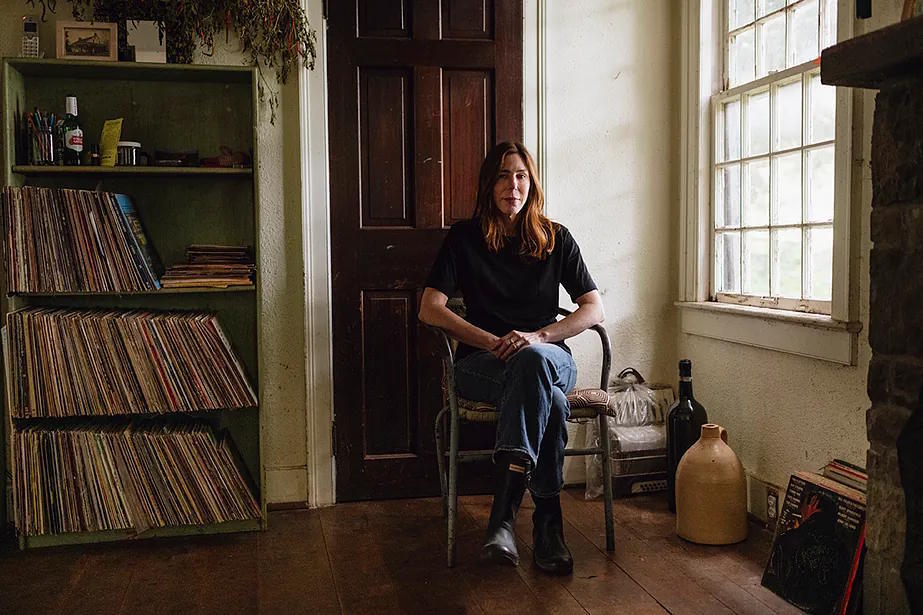
Have humans lost something along the way to today? Could we slow down our progress and even limit our use of technology that seems to be leading us to the abyss? Could we, as they say in English, put the genie back in the bottle? These questions sparked the new novel by Rachel Kushner (Eugene, Oregon 1968), The Lake of Creation (AdN), a harsh metaphysical thriller that explores with acidic humor the great human anxieties and which last year became a finalist for both the National Book Award and the Booker Prize.
"I had many different ideas in my head that I wanted to connect: themes of anthropology and primitivism, that great mystery of the pre-language era, and also the genealogy of political protests linked to nature, to the rural world, as well as how all of this can help us in a cynical and hypertechnological present. That's why it took me a while to shape the novel," confesses the writer, famous for works like Telex from Cuba, The Flamethrowers, or The Mars Room, stories written with innovative style, caustic tone, and philosophical depth set in worlds like art, anti-system politics, or crime, exploring rebellion, identity, and the clash between past and present.
A mix of all these disparate themes, The Lake of Creation is a complex amalgam of a fast-paced spy novel, historical philosophical treatise, and sharp social comedy that, set in the south of France, explores the life of a rural commune called Le Moulin, where young idealists seek to reconnect with nature and rethink civilization. "I know there is a lot of skepticism about this type of communities, but theirs doesn't seem like such a strange desire to me. Today's youth are raised in voracious consumerism and a very fleeting sense of ownership," reflects Kushner. "We watch movies on streaming, we don't buy them, or we pay monthly fees for certain services... Everything is destined to expire and be repurchased over and over. That's why I believe the current desire to leave that technological abyss behind and reestablish a healthy connection with nature is incredibly genuine."
"The current desire to leave the technological abyss behind and return to nature is profoundly genuine"
However, despite admiring it, the writer does not idealize this way of life either. The one in charge of giving voice to this other side of the coin is Sadie Smith, the alias of a former FBI agent who now works for dark private employers and who arrives at Le Moulin with the task of radicalizing the commune and involving it in a more violent struggle against the State. "She is sarcastic, manipulative, and individualistic, a provocateur who challenges the idea of utopia and who stretches the boundaries between naivety, idealism, and cynicism," explains Kushner. Her acidic voice, which narrates the novel, achieves hilarious moments of humor by saying things that social behavior and courtesy prevent us from saying, such as: "real Europe is depopulated fields, truck routes, and windowless warehouses" or "Italian gastronomy is a farce built with carton wine and various forms of a dough that is only flour and water."
The humor also arises from the radical critique that Kushner poses, always through Sadie, towards an entire French upper class characterized by narcissism, pretentiousness, and hypocrisy and featuring spectacular cameos like Bernard-Henri Lévy, a French-Spanish politician who will be key to the plot, or a Michel Thomas who is a counterpart to Michel Houellebecq and to whom she attributes "the same sexual energy as a grandmother with bone density problems," besides making him say things like aspiring "to be vulgar and omnipresent." There are also less obvious reasonable similarities hidden for the reader.
To create Sadie, the writer was inspired by several real FBI and MI5 agents who infiltrated similar eco-activist groups to push them towards violence. One was expelled from the FBI when his coercion was proven, and the British agent was accused by several women from the commune of sexual misconduct, which had serious consequences for the UK. "These scandals demonstrate that most of the time it is Governments who promote the political violence of these groups to justify their control," defends Kushner. "Groups of this kind are accused of being radical and conspiracy theorists, but to truly believe in conspiracies, one must have a lot of faith, and these people only seek to survive, not to change anything. The moulinards in my novel did not go beyond destroying some machines, and destroying a machine that ruins people's lives is not violence, it is resistance."
"Destroying a machine that ruins people's lives is not violence, it is resistance"
In this sense, Kushner insists that sometimes we use words like "terrorism" and "violence" lightly, and "we are unable to discern the role that ethics and justice play in these struggles." In her novel, for example, activists fight against a state plan to extract all the water from the water table of a rural area and store it in a huge bay lined with plastic. Something that curiously began to happen just when she published the book. "It was as if reality was replicating fiction. I could connect to YouTube and see how farmers and anarchists were fighting against the police. They were very violent demonstrations, but the violence came from the police, who brought out all their paramilitary equipment and shot pepper balls and tear gas at the farmers who were simply asking for access to water," recounts Kushner. "The idea of sabotaging or destroying this machinery does not seem like violent or terrorist acts to me, but rather people trying to resist the violence of the State and the destruction of their way of life."
Despite what has been said, the writer also does not intend to idealize and romanticize these movements that, in her opinion, are experiencing complicated moments in the present. "These days everyone is talking about Paul Thomas Anderson's new movie, inspired by Vineland by Pynchon. A friend told me he really liked it 'despite being nostalgic,' but for me, it is very contemporary cinema about how the police treat those who live independently," explains the writer. "Perhaps I didn't even notice the nostalgia because I myself am a child of the 20th century, shaped by a generation marked by the hopes of May '68 or the Italian Hot Autumn. What I know is that we live in a fractured, atomized world. In the United States, there are no longer unions or large organizations working together for common interests."
"We live in a fractured, atomized world where there are no longer organizations fighting for the common good"
"However, I do not lose hope. I don't know if those ideals of the past still work, but I'm not willing to dismiss them either. Sometimes something happens, like in Los Angeles in July 2020, after the death of George Floyd, and it seems like a switch is flipped. People explode, and that reminds us that what we believe about reality can change suddenly," reflects Kushner, before asserting: "However, it is not my job to predict the future. The novel is a space to let doubt, questions, optimism, and even the most shameful hopes come out to play. That is my job."
A job that in the novel is carried out by Bruno Latour, the spiritual father of the commune, a philosopher and leftist thinker gradually retired to live in a cave whose philosophy we know through the extensive emails he sends to the moulinards and that Sadie intercepts and reads. "Bruno is the soul of the book, who brings serenity, reflection, and a gentle humor in his critique of the present. He is the one who says that the current world is like a driverless car heading towards extinction, but he proposes solutions, offering a counterpoint that humanizes and adds depth to the story: his philosophy on life, nature, and the past unfolds as a guiding thread that connects generations and eras," explains the writer.
The combination of both characters encapsulates the moral of the novel, which moves away from the humorously resolved espionage plot to reach a philosophical truth related to the limits of human beings and their relationship with society and nature, and with a possible future where doubt, reflection, and hope coexist. Thus, Kushner highlights how the narrator transforms throughout the novel: "At the beginning, Sadie is jaded, disillusioned, a nihilist, but gradually she has to question her certainties and her cynicism crumbles," explains the author. "Thanks to Bruno, she discovers that the only philosophical way out left for us is to remember the dignity of the human project, the idea of community. I felt it was logical for Sadie to find a way to change. It's an optimistic message, a good ending."