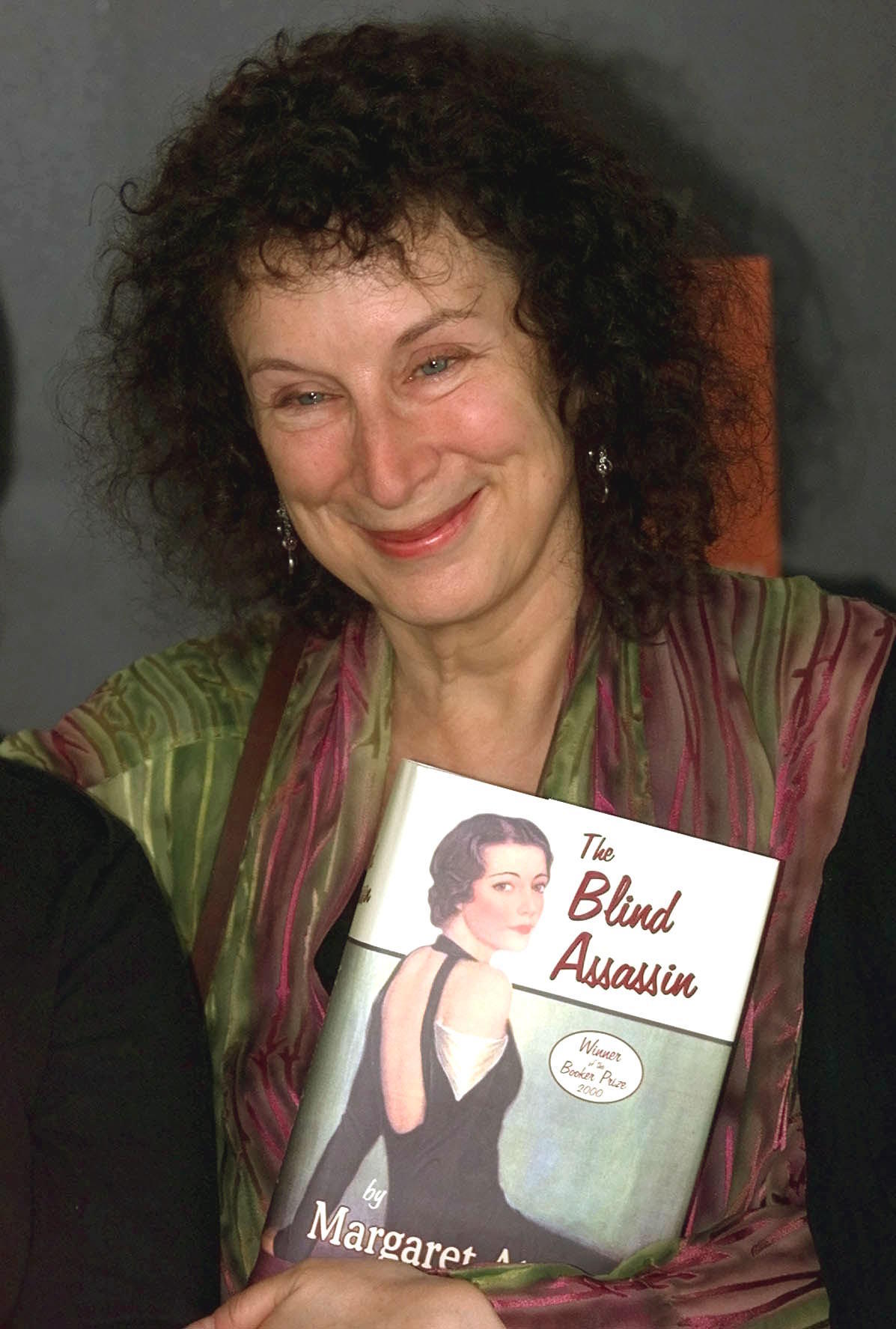
What better place for a meeting with Margaret Atwood, the Canadian author of the bestseller 'The Handmaid's Tale' and winner of the 2008 Prince of Asturias Award, than the headquarters of Random House on Embassy Gardens street in London?
Embassy Gardens is next to Random House in what was traditionally an industrial area on the south bank of the Thames and is now a gem of gentrification. The name - Embassy Gardens - refers to the building next to Random House: the U.S. Embassy. It is the fourth-largest diplomatic representation of that country in the world, and represents the government that epitomizes everything Atwood's life and work reject: Donald Trump.
The ambassador is named Warren Stephens, and he has never held a political, diplomatic, or institutional position. He is in the position for being a donor to Donald Trump. He is a billionaire, with an estimated fortune of 3.3 billion euros earned on Wall Street, and last week he gave a speech in London criticizing the Labour Government's policy of Keir Starmer to achieve zero emissions by 2050, which he called "artificial," and demanding that the UK pay more to American pharmaceutical companies for their drugs. There could be nothing more opposite to Atwood. With the frail voice that her 85 years give her, perhaps aggravated by the permanent pain she has felt since the death, here in London in 2019, of her partner, the poet and environmental advocate Graeme Gibson, the writer explains that "Trump is destroying everything that had been progressed". It is something expected from her. After all, when women in the U.S. want to protest in the state legislatures of that country against the approval of laws limiting abortion, they dress as the handmaids from The Handmaid's Tale, which became a worldwide bestseller following its television adaptation by Hulu. "This way they cannot be expelled, because they do not violate any rule or law," explains Atwood. Her voice, weak, has a sudden hint of pride.
The novelist, poet, and essayist has just published monumental memoirs - 601 pages in the English edition - titled Book of My Lives, concluding that "our luck is running out" on a "national" level (her native Canada), "international" (due to the rise of authoritarianism), and "as a species" (due to climate change). With such a panorama, it is comforting (or surprising) that she continues to write and consider new projects.
Perhaps it is because she thinks she will be gone when the worst happens. "I will not be here when the climate crisis erupts," she concludes. Because the 2008 Prince of Asturias Award winner believes that the problem will be left for the young. In my generation, "we were aware that we could disintegrate at any moment due to an atomic bomb. But we knew we would be able to find a job, to be self-sufficient. That is lost today. We were not worried about the things that distress people today," she says. Her voice may be frail. Her ideas, not.
But the Book of My Lives, in addition to being a combination of memories, essays, and personal reflections, also has parts more grounded. For example, settling scores, either against the three girls who bullied her in school or against a good part of the Canadian literary establishment. This injects lightness into a reflective book that is a thoughtful journey through several decades of feminism, personal relationships, friendships, and family.
Atwood seems not to be eager to focus on those outstanding accounts. "It's not something I admire about myself," she explains. It is possibly true. But, like a smoker who acknowledges their addiction while opening the pack, she takes advantage of the topic that has arisen to recall "a newspaper" she sued for defamation for accusing her of participating in a violent demonstration against the invasion of Iraq. She does not mention the name. Nor the outcome of the lawsuit. A question to ChatGPT points to the culprit (the conservative Daily Telegraph) and the verdict (she won, was compensated, and the newspaper had to apologize).
But, even though ChatGPT found it, Atwood does not believe in Artificial Intelligence (AI) neither as a tool in artistic creation, nor as a replacement for writers, nor as the origin of dystopia. "AI only sweeps the web and then amalgamates the information it finds without much criteria. When I asked it to write a story like mine, it was a disaster because it mixed my dystopian stories with my children's stories where I use alliterations. And yes, AI creates images, but all the images it creates are the same." For the Canadian novelist, poet, and essayist, dystopia does not come from technology. "Every time a new technology appears, people adore it as if it were the Word of God," she explains, before going into detail on how the use of various social networks and dating apps is declining.
Those who decide - for better or for worse - are people. There lies the dystopia. Margaret Atwood's dystopia speaking next to the U.S. Embassy and also next to the headquarters of MI6, the UK's foreign intelligence service, a concrete monstrosity that has given the world fictional spies like James Bond and George Smiley, and foolish women like Miss Moneypenny, 007's pathetic secretary.
Atwood has always been a feminist. And, to this day, she continues to defend the "confrontational" nature of that movement, whose origin she places in the French Revolution. But independent. In London, she once again defends her actions in the case of Professor Steven Galloway, who was lynched in an online auto-da-fé in 2016 after being accused of having sexual relationships with his students. "I still believe that everyone has the right to the presumption of innocence," she explains. After all, that was all Atwood demanded for Galloway, who was eventually expelled from the University of British Columbia when it was proven that the accusations were true.
Her position was blasted in some feminist circles, to the point that Atwood outlined, with irony, an essay titled Am I a bad feminist?. It is the same irony with which she faces EL MUNDO and says, with the frail voice of her 85 years and the sharp mind of her entire life: "Surprising as it may seem, women's rights are just one part of Human Rights".
The media session concludes. Atwood leaves the Random House headquarters, the world's largest publisher and one of the big five that control English-language book publishing, next to the U.S. Embassy defending values opposed to hers. Beyond the tower where Ambassador Stephens is supposed to be, two chimneys of the Battersea Power Station stand out, with which Pink Floyd made their most dystopian album almost half a century ago, Animals, and which today is a shopping center and a luxury apartment block. Dystopia has already left the novels.